Blanding’s Turtle
Blanding’s turtles (Emydoidea blandingii) are notable for their impressive longevity, capable of living for more than 30 years.
How long can Blanding’s turtles live, and what makes their lifespan unique among turtles?
Blanding’s turtles (Emydoidea blandingii) are notable for their impressive longevity, capable of living for more than 30 years.1
Their ability to achieve such a long lifespan is attributed to several biological and physical adaptations shared by many turtles:
- Slow Metabolism: A reduced metabolic rate limits physical strain on the body, which slows the effects of aging and cellular wear while allowing for efficient energy use.1
- Protective Armor: The bony shell, consisting of the carapace and the hinged plastron, acts as natural protection against predators and injury.21
- Delayed Development: These turtles mature slowly, prioritizing survival over early reproduction. This strategy, combined with lower death rates once they reach maturity, significantly contributes to their overall longevity.1
While many turtles share these traits, the Blanding’s turtle is specifically recognized for its resilience in its native freshwater habitats across North America.21
What are some unique behaviors or adaptations of Blanding’s turtles?
Blanding’s turtles (Emydoidea blandingii) possess several distinct physical and behavioral adaptations that allow them to thrive in their freshwater environments:
Physical Adaptations
- Hinged Plastron: The lower shell, or plastron, is hinged in the center. This allows the turtle to draw the shell up against the carapace, effectively sealing itself inside to protect its head, legs, and tail from predators.1
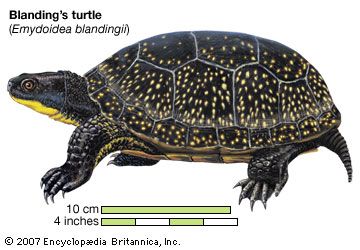
- Distinctive Appearance: They are easily identified by their smooth, dark, rounded carapace marked with yellow spots and a notably bright yellow chin.13
Behavioral Adaptations
- Terrestrial Travel: Although they are strongly aquatic, females frequently travel long distances over land to locate suitable nesting sites.1
- Nesting Strategy: Females typically lay clutches of 6–21 eggs in early summer. A unique survival strategy involves the hatchlings; they often remain in the nest through the winter and do not disperse until the following spring.1
- Basking: While they spend much of their time in ponds and quiet streams with soft bottoms, they regularly engage in basking in the sunlight during the spring.1
How do Blanding’s turtles reproduce, and what challenges do they face during nesting?
Blanding’s turtles (Emydoidea blandingii) reproduce through a process that requires significant terrestrial movement. In early summer, females leave their aquatic habitats to travel long distances overland in search of suitable nesting sites, where they deposit clutches ranging from 6 to 21 eggs.1
The nesting process presents several challenges for the species:
- Habitat Fragmentation: Because females must travel far from their home ponds or streams to find appropriate soil for nesting, they are highly vulnerable to road mortality and habitat loss during these migrations.1
- Predation and Environmental Risks: The extended period that hatchlings spend in the nest—often remaining there through the winter to emerge only in the following spring—leaves the eggs and young turtles exposed to predators and fluctuating environmental conditions for an unusually long time.1
The species’ reliance on specific, undisturbed nesting grounds makes them particularly sensitive to human development and landscape changes.
How do Blanding’s turtles hibernate or brumate during winter months?
Blanding’s turtles (Emydoidea blandingii) undergo a period of winter dormancy known as brumation. Unlike true hibernation, where animals fall into a deep sleep, brumation is a state of sluggishness or torpor in ectothermic vertebrates triggered by cold temperatures, during which the animals may still stir occasionally to drink water.4
While the provided search results do not detail the specific micro-habitats Blanding’s turtles select for this process, they are known to inhabit ponds and quiet streams with soft, muddy bottoms. Similar to other cold-blooded vertebrates that overwinter in aquatic environments, they likely utilize these soft substrates to remain dormant until the return of favorable temperatures. Additionally, as noted previously, Blanding’s turtle hatchlings exhibit a unique behavior of remaining in their nests throughout the winter, only dispersing in the following spring.15
Sources
- Blanding’s turtle — Encyclopædia Britannica
- Why do turtles live for so long? — Encyclopædia Britannica
- Blanding's turtle — Merriam-Webster
- Dormancy - Fishes and amphibians — Encyclopædia Britannica
- Sit, Shake, Pronk: 8 Words for Quirky Animal Behaviors | Brumation — Merriam-Webster
Published on · 3 min read