Archelon
Archelon is a genus of extinct, giant sea turtles that lived during the Late Cretaceous epoch, approximately 100 million to 66 million years ago.
What is Archelon?
Archelon is a genus of extinct, giant sea turtles that lived during the Late Cretaceous epoch, approximately 100 million to 66 million years ago.12
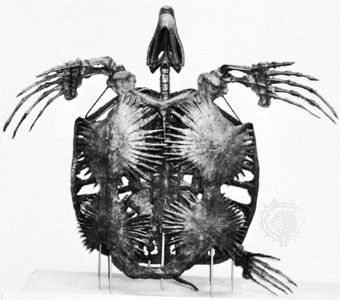
Fossilized remains of these massive reptiles have been discovered in North America, notably in South Dakota. Archelon reached lengths of about 3.5 to 3.6 meters (roughly 12 feet), making it significantly larger than the modern leatherback sea turtle, which is currently the largest living turtle.132
Physically, Archelon was protected by a shell similar to that of modern sea turtles, though it featured a well-developed plastron and a more poorly developed carapace. Its front feet had evolved into powerful, specialized structures that allowed it to efficiently propel its great bulk through the water.13
What other marine reptiles lived during the Cretaceous period?
The Cretaceous Period (145.5 million to 66 million years ago) was home to a diverse array of marine reptiles that dominated the world’s oceans alongside other predators like sharks and large teleost fishes.45
Key groups of marine reptiles during this time included:
- Mosasaurs: A diverse group of aquatic lizards that were highly adapted to marine life. They possessed snakelike bodies, large skulls, and jointed jaws that allowed them to consume large prey. While many were the size of modern porpoises, some, such as Mosasaurus hoffmanni, reached lengths of up to 17 meters (56 feet).65
- Plesiosaurs: These reptiles were characterized by broad, stout bodies and long, flexible necks. They “flew” through the water using four long, narrow flippers. Some reached lengths of 12 meters (40 feet). A subgroup known as pliosaurids typically featured shorter necks and immense skulls.75
- Ichthyosaurs: Often resembling modern porpoises, these highly specialized reptiles were streamlined for speed. Although they were most diverse during the Triassic and Jurassic periods, they persisted into the Late Cretaceous before going extinct.15
- Archelon: A genus of giant sea turtles that reached lengths of about 3.5 meters (12 feet), making them significantly larger than any modern sea turtle.89
How do scientists reconstruct the appearance of extinct animals from fossils?
Scientists reconstruct the appearance and behavior of extinct animals by integrating fossil evidence with functional anatomical studies and comparisons to living organisms. Because the fossil record is often incomplete—frequently preserving only hard parts like bones, teeth, or shells—researchers must use several analytical methods to fill in the gaps.1011
Functional Anatomy and Biomechanics
Paleontologists use functional anatomy to infer how an animal moved or fed. By examining the structure of joints and reconstructing limb musculature, scientists can create mechanical models to estimate walking or running speeds. Similarly, analyzing tooth wear patterns and jaw mechanisms provides insights into an animal’s diet and feeding capabilities.10
Comparative Studies
Researchers rely on analogous traits found in modern animals to visualize extinct forms. By comparing fossilized structures with those of living species, scientists can hypothesize the function of specific features. This process involves distinguishing between homologies—traits inherited from a common ancestor—and analogies, which are similarities that arise independently due to similar environmental pressures or functions.101213
Soft Tissue and Preservation
While soft parts are rarely preserved, discoveries of skin textures, filaments, and feathers have provided significant clues about the external appearance of animals like dinosaurs. When such evidence is absent, scientists must rely on broader evolutionary models to infer these characteristics.10
What are the main differences between sea turtles and land tortoises?
While all tortoises are technically turtles—as both belong to the order Testudines—there are significant anatomical and behavioral differences that distinguish tortoises from other turtle species, such as sea turtles.
Key Differences
- Habitat: The most fundamental distinction is that tortoises are exclusively land-dwelling creatures, whereas other turtles are often aquatic or semi-aquatic. Sea turtles, for example, spend their lives in the ocean, returning to land only to lay eggs.1516
- Anatomy: Tortoises possess unique, elephantine (columnar) hind limbs and feet, which are adapted for walking on land. In contrast, aquatic turtles typically have webbed feet or flipperlike limbs designed for swimming. Furthermore, sea turtles have evolved streamlined shells to reduce drag in the water, while many tortoises have high, domed shells that provide protection against predators.1517
- Diet: Tortoises are generally herbivorous, feeding on a variety of plants. Other turtles are typically omnivorous, consuming a mix of vegetation and animal matter, such as fish, mollusks, or jellyfish.1518
Sources
- Archelon — Encyclopædia Britannica
- reptile - Size range — Encyclopædia Britannica
- Archelon — Merriam-Webster
- mosasaur — Encyclopædia Britannica
- ichthyosaur — Encyclopædia Britannica
- sauropterygian — Encyclopædia Britannica
- Cretaceous Period — Encyclopædia Britannica
- Cretaceous Period - Marine life — Encyclopædia Britannica
- megalodon - Predators and prey — Encyclopædia Britannica
- dinosaur - Modern studies — Encyclopædia Britannica
- evolution - The fossil record — Encyclopædia Britannica
- phylogeny - Evidence for specific phylogenies — Encyclopædia Britannica
- phylogeny - Phenetics versus cladistics — Encyclopædia Britannica
- evolution - Convergent and parallel evolution — Encyclopædia Britannica
- What’s the Difference Between a Turtle and a Tortoise? — Encyclopædia Britannica
- turtle - Form and function — Encyclopædia Britannica
- What do turtles eat? — Encyclopædia Britannica
- turtle - Habitats — Encyclopædia Britannica
- turtle - Reproductive age and activity — Encyclopædia Britannica
- turtle - Courtship and copulation — Encyclopædia Britannica
Published on · 3 min read