Anchovy
An anchovy is any of numerous schooling saltwater fish belonging to the family Engraulidae, an order related to the herring. These fish are characterized by…
What is anchovy?
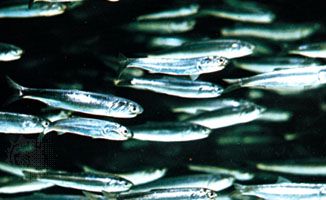
An anchovy is any of numerous schooling saltwater fish belonging to the family Engraulidae, an order related to the herring. These fish are characterized by a pointed snout and a large mouth that typically extends behind the eye.1
Most of the more than 100 species inhabit shallow tropical or warm temperate seas, though some tropical varieties live in freshwater. They feed on plankton and generally reach lengths of 10 to 25 cm (4 to 10 inches).1
The economic and ecological roles of anchovies vary by species:
- Food Fish: Temperate-water species, such as the European anchovy (E. encrasicholus) and the northern anchovy (Engraulis mordax), are significant food sources for humans.12
- Bait: Tropical species like the anchoveta (Cetengraulis mysticetus) are vital as bait, particularly in the tuna fishery.1
- Ecological Importance: Small species like the bay anchovy (Anchoa mitchilli) serve as a primary food source for various birds and larger fish in coastal ecosystems.3
What role do anchovies play in the ocean food web?
Anchovies play a critical role in the ocean food web primarily as plankton feeders that convert primary production into biomass available for higher trophic levels.14
As schooling fish, anchovies occupy a foundational position in marine ecosystems. Their ecological importance is driven by several key factors:
- Energy Transfer: By consuming plankton—including diatoms, flagellates, copepods, and various larvae—anchovies act as a vital link between microscopic organisms and larger marine predators.14
- High Abundance: Their ability to reach sexual maturity at an early age allows for high population densities, ensuring a consistent and abundant food source for a wide range of larger fish, seabirds, and marine mammals.14
- Ecosystem Support: Because they are highly abundant and travel in large schools, they serve as a primary prey species in many coastal and temperate marine environments.14
While some species are utilized as bait in commercial fishery operations, such as for tuna, their natural role remains that of a prolific forage fish that sustains the broader oceanic food chain.1
How do anchovies differ from sardines?
While both anchovies and sardines are schooling, plankton-feeding fish within the order Clupeiformes, they belong to distinct biological families and possess unique physical characteristics.154
The primary differences include:
- Taxonomy: Anchovies belong to the family Engraulidae, whereas sardines are members of the family Clupeidae, which also includes herrings, shads, and menhadens.5
- Physical Features: Anchovies are generally smaller than clupeids and are easily distinguished by a pointed snout that projects well beyond a very wide mouth, which typically extends behind the eye. In contrast, sardines and other clupeids typically have smaller mouths with weakly developed or absent teeth and often feature keeled scales along their ventral midline.15
- Life History: The high abundance of anchovies is largely attributed to their early age of sexual maturity. While both groups are economically important, their specific roles—such as the use of certain anchovies as bait for tuna fisheries—can differ based on their regional availability and ecological traits.41
Why are anchovies often used as bait in commercial fishing?
Anchovies are frequently used as bait in commercial fishery operations, particularly for tuna, due to their high abundance and schooling behavior.1
In pole-and-line fishing, tuna are attracted and kept near the vessel through a process called “chumming,” which involves throwing live bait overboard. Because tuna are often eager to feed, these small, schooling fish serve as an effective and essential attractant. The utility of anchovies in this context is supported by their natural history:6
- Natural Aggregation: Anchovies form massive schools that can contain millions of individuals. This high density makes them a reliable and easily accessible resource for fishermen.7
- Uniformity: Within these schools, individuals are typically of a similar size and age, which is convenient for the fishing industry as the fish sort themselves out naturally.7
- Operational Logistics: To maintain a successful catch, tuna vessels utilize specialized tanks with circulating seawater to keep the bait alive on board.6
While they are highly effective as bait, many species of anchovies are delicate and can be easily injured by contact with nets or solid objects, requiring careful handling during collection and transport.1
Sources
- anchovy — Encyclopædia Britannica
- bay anchovy — Merriam-Webster
- northern anchovy — Merriam-Webster
- clupeiform - Food ecology — Encyclopædia Britannica
- clupeiform - Annotated classification — Encyclopædia Britannica
- clupeiform - Schooling behaviour — Encyclopædia Britannica
- Schooling behaviour — Encyclopædia Britannica
- commercial fishing - Pole-and-line fishing — Encyclopædia Britannica
Published on · 3 min read