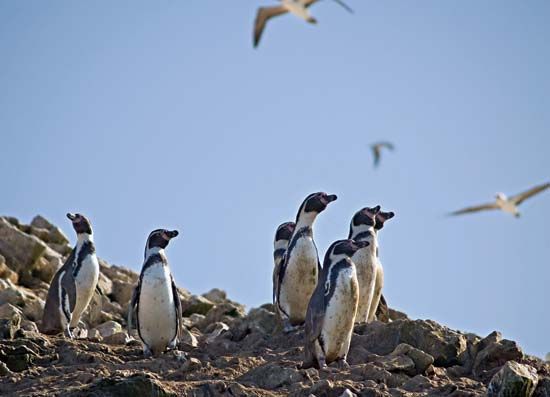
Humboldt Penguin
Climate change and associated shifts in ocean temperatures significantly threaten Humboldt penguin populations. These birds are highly vulnerable to the…
How has climate change affected Humboldt penguin populations and their habitat?
Climate change and associated shifts in ocean temperatures significantly threaten Humboldt penguin populations. These birds are highly vulnerable to the extreme weather and food shortages that accompany strong El Niño events.12
During these episodes, warmer surface waters dampen the upwelling of nutrient-rich currents, leading to a decline in the fish stocks—such as anchovies and sardines—that the penguins rely on for survival. The most severe El Niño events on record have resulted in the loss of more than 60 percent of the Humboldt penguin population on multiple occasions.13
While the species has shown some capacity to recover from these population crashes, the frequency and intensity of such climate-driven disruptions pose a persistent danger to their long-term stability. This vulnerability is further compounded by other human-related pressures, including commercial fishing, habitat loss from guano excavation, and pollution.13
How do Humboldt penguins reproduce and care for their young?
Humboldt penguins (Spheniscus humboldti) reproduce throughout the year, with the timing of egg-laying heavily influenced by geography and the phase of the El Niño/Southern Oscillation (ENSO) cycle.4
Nesting and Incubation
These penguins typically nest in burrows excavated into the ground or into guano deposits on rocky slopes; they may also utilize caves or rocky areas cleared of vegetation. A breeding pair will often successfully raise two clutches of young annually. After copulation, the female lays one to three eggs, and both parents share the responsibility of incubating them for 40–42 days.4
Rearing the Young
Once the eggs hatch, both parents actively forage and feed the chicks. Unlike many other penguin species, Humboldt penguin chicks generally do not form “crèches” (nursery groups) and instead remain in or near the nest throughout their development. Fledging occurs when the young are 10–12 weeks old, at which point they leave the colony to hunt independently. Most individuals reach sexual maturity between two and three years of age.4
What are the main threats facing Humboldt penguin populations in the wild?
Humboldt penguin populations face several significant threats that have contributed to their status as a vulnerable species on the IUCN Red List of Threatened Species. The primary challenges include:
- Climate Variability: These penguins are extremely susceptible to the food shortages and extreme weather associated with strong El Niño events. Severe episodes have historically caused population losses exceeding 60 percent.
- Commercial Fishing: Aggressive commercial fishing in the eastern Pacific Ocean depletes the stocks of anchovies and sardines that the penguins rely on for food. Additionally, individuals are often inadvertently captured in fishing nets.
- Habitat Loss: The excavation of guano from the islands where these birds nest destroys their natural burrowing sites.
- Pollution and Human Activity: Marine pollution poses a constant risk. Furthermore, some individuals are hunted for food or captured for the pet trade.
- Predation: On land, eggs and chicks are vulnerable to feral cats, dogs, foxes, snakes, and rodents. At sea, adults and juveniles may be preyed upon by sharks, fur seals, and sea lions.
How do Humboldt penguins adapt to their environment, both on land and in water?
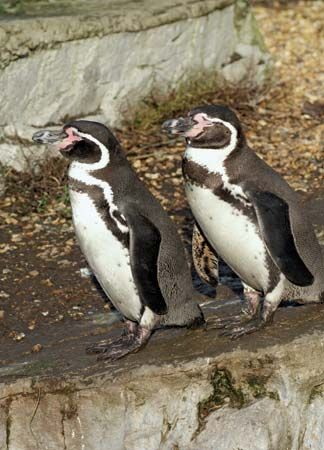
Humboldt penguins (Spheniscus humboldti) possess specialized adaptations that allow them to thrive in both aquatic and terrestrial environments.
Aquatic Adaptations
To navigate their marine habitat, Humboldt penguins have evolved a body morphology optimized for movement in water. Their forelimbs have transformed into rigid, paddle-like flippers, while their dense, short plumage minimizes friction and turbulence during swimming. To manage the high salt intake associated with their marine diet, they utilize salt glands located above their eyes, which allow them to excrete excess chloride.5
Terrestrial and Thermal Adaptations
On land, these penguins are adapted for an upright, plantigrade gait, walking on the soles of their feet. To maintain a stable body temperature, they rely on a combination of physical and anatomical features:5
- Insulation: A thick layer of fat and closely packed feathers trap a layer of air against the skin, providing essential insulation.15
- Heat Exchange: They possess a countercurrent heat-exchange system in their lower limbs, where arteries and veins are closely aligned to conserve body heat.15
- Nesting: To protect themselves and their young from the elements, they excavate burrows in the ground or guano deposits, or utilize cavesano) deposits, or utilize caves.1
Sources
- Humboldt penguin — Encyclopædia Britannica
- penguin - General features — Encyclopædia Britannica
- Galapagos penguin — Encyclopædia Britannica
- penguin - Reproduction — Encyclopædia Britannica
- How do penguins stay warm? — Encyclopædia Britannica
- Are penguins monogamous? — Encyclopædia Britannica
- Magellanic penguin — Encyclopædia Britannica
- African penguin: Top Questions — Encyclopædia Britannica
- penguin - Form and function — Encyclopædia Britannica
Published on · 3 min read