Anemone Fish
Anemone fish (genus Amphiprion) are a group of approximately 30 species of Indo-Pacific fishes belonging to the family Pomacentridae. They are widely…
What is anemone fish?
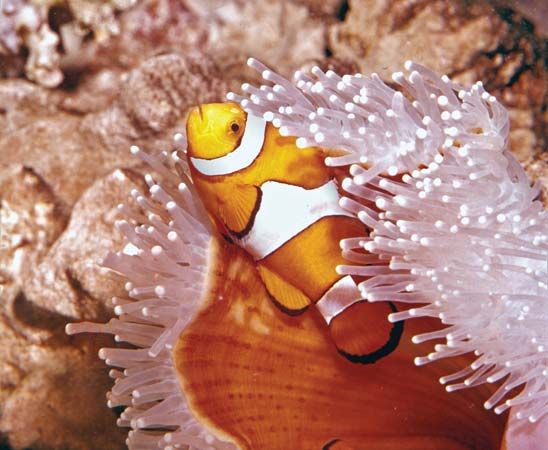
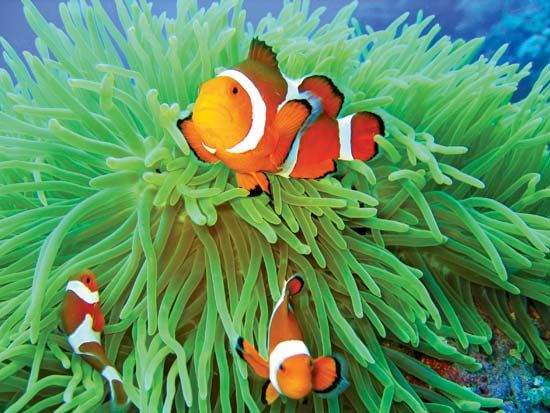
Anemone fish (genus Amphiprion) are a group of approximately 30 species of Indo-Pacific fishes belonging to the family Pomacentridae. They are widely recognized for their mutualistic relationship with large sea anemones.123
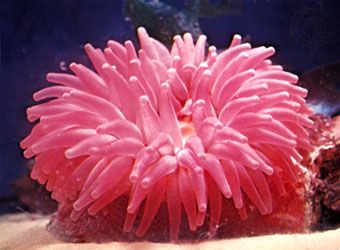
These fish live and shelter among the anemone’s tentacles, which contain stinging cells called nematocysts that are typically fatal to other small fish. Anemone fish remain unharmed due to a specialized mucous coating on their bodies that inhibits the anemone’s stinging behavior. In this partnership, the fish gain protection from predators, while the anemone benefits as the fish cleans parasites from its body and drives away other fish that might consume the anemone’s tentacles.132
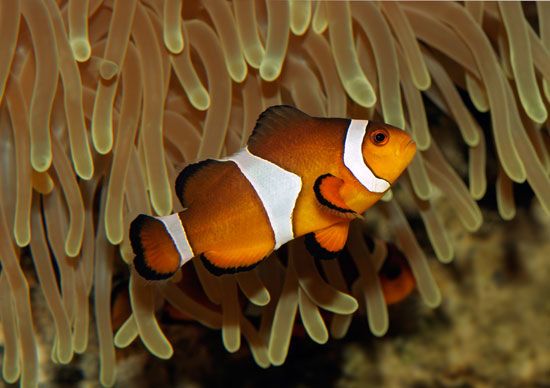
A well-known representative is the common clown fish, which gained popularity through the film Finding Nemo. These fish are notable for their ability to change sex based on social and environmental conditions.3
How do anemonefish change their sex based on their environment?
Anemonefish, such as the common clown fish, possess a remarkable biological ability to change sex in response to their social environment. All individuals are born with immature male and female sex organs, and their development is dictated by the social hierarchy within their group.1
A typical anemonefish society consists of a strict hierarchy:
- The Female: The largest member of the group.
- The Breeding Male: The second-largest member.
- Nonbreeding Individuals: Several smaller fish with undeveloped sex organs.
This structure is maintained through environmental and social cues. If the dominant female dies, the largest remaining member of the group undergoes a sex change to become the new female. Simultaneously, the second-largest individual—previously a nonbreeding member—will transition into the new breeding male as its male sex organs fully develop.1
Because the male sex organs mature earlier than the female ones, there is a common misconception that all anemonefish are born male; in reality, they are born with the potential to develop into either sex depending on the needs of their social unit.1
What other animals form mutualistic relationships with sea anemones?
Beyond the well-known anemone fish, several other marine animals form mutualistic relationships with sea anemones. These partnerships typically provide the anemone with transportation or food, while the anemone offers protection to its host.4
Crustacean Partnerships
- Hermit Crabs: Various species of hermit crabs maintain close associations with anemones. For example, Pagurus arrosor carries a Calliactis anemone on its snail shell. When the crab outgrows its shell, it often transplants the anemone to its new home. In other instances, such as with Eupagurus prideauxi and Adamsia palliata, the two are essentially inseparable throughout their lives.24
- True Crabs: Certain true crabs carry anemones on their backs, legs, or even within their claws. This provides the anemone with mobility, while the anemone protects the crab from predators like octopuses.4
Other Associations
- Deep-sea Crabs: Some deep-sea anemones actually form the shells in which their crab partners dwell, creating a permanent bond where the survival of one is often tied to the other.4
- Other Fishes: While anemone fish are the most famous examples, other types of fish have been observed forming similar protective associations with large medusae.4
What are nematocysts and how do they function in the ocean?
A nematocyst is a minute, complex capsule produced exclusively by members of the phylum Cnidaria, such as jellyfish, corals, and sea anemones. These structures are among the most sophisticated intracellular secretions known, serving as the primary tools for defense and prey capture.78
Function and Mechanism
Each nematocyst contains a coiled, hollow, and often barbed thread. When triggered by chemical or mechanical cues, a lid on the capsule opens, and the thread everts explosively. This process involves a twisting motion that allows the thread to penetrate the target like a drill. Once contact is made, toxins stored within the capsule are injected through the hollow thread to paralyze the victim.78
Nematocysts function in three primary ways:
- Penetration: Spined tubules pierce the tissues of predators or prey to deliver toxins.8
- Adhesion: Sticky tubules hold onto food items.8
- Entanglement: Threads wrap around small prey to ensnare them.78
In the ocean, these structures allow cnidarians to compete for space and food, though some specialized predators, such as certain sea turtles and parrot fishes, have evolved to be insensitive to them.9
Sources
- anemone fish — Encyclopædia Britannica
- cnidarian - Associations — Encyclopædia Britannica
- common clown fish — Encyclopædia Britannica
- sea anemone — Encyclopædia Britannica
- anemonefish — Merriam-Webster
- damselfish — Encyclopædia Britannica
- nematocyst — Encyclopædia Britannica
- cnidarian - Defense and aggression: nematocysts — Encyclopædia Britannica
- cnidarian - Ecology and habitats — Encyclopædia Britannica
Published on · 3 min read