Fireworm
The term "fireworm" refers to several distinct organisms, most notably certain segmented marine worms of the class Polychaeta. These marine fireworms, such…
What is fireworm?
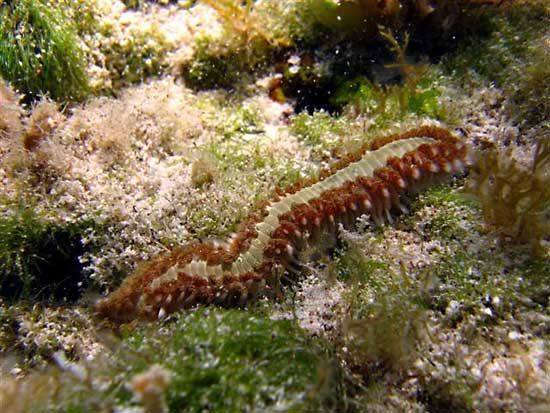
The term “fireworm” refers to several distinct organisms, most notably certain segmented marine worms of the class Polychaeta. These marine fireworms, such as those in the genus Hermodice, are found in environments like the Caribbean Sea and are covered in brittle, white bristles. If touched, these bristles break off and embed in human skin, releasing an irritating substance that causes a painful stinging sensation.1
The name is also applied to other creatures:
- Insects: It can refer to the larvae of certain moths in the family Tortricidae, which feed on cranberry leaves and create a scorched appearance on the vines.12
- Bioluminescent beetles: The term is sometimes used to describe the glowworm, which includes various adults and larvae of the beetle family Lampyridae.12
What are polychaete worms?
Polychaetes are a diverse class of marine worms belonging to the phylum Annelida, with approximately 8,000 known species. They are characterized by well-defined body segmentation and, uniquely among annelids, possess a pair of parapodia—flat, lobelike outgrowths—on most segments, which are equipped with tiny bristles called setae.3
Diversity and Habitat
Polychaetes are found worldwide, primarily in oceanic environments, where they may float, burrow, wander on the sea floor, or inhabit self-constructed tubes. They are informally categorized by their lifestyle:4
- Errantia: Free-moving forms that often possess sensory projections like palps and tentacles on the head.3
- Sedentaria: Tube-dwelling forms that are often sedentary.3
Biology and Behavior
These worms vary significantly in size, ranging from a few millimeters to about 3 meters (10 feet) in length. Their diet is equally varied, consisting of minute aquatic plants and animals, though some species are purely carnivorous. Locomotion is achieved through the coordinated use of circular and longitudinal muscles, parapodia, and coelomic fluid.35
Reproduction typically involves separate sexes, with fertilization occurring directly in the water. Some species exhibit complex behaviors, such as the formation of reproductive forms called epitokes that swarm to the surface, or the use of bioluminescence to attract mates.36
How do marine animals use bristles for defense?
Marine animals utilize bristles—often referred to as setae—as a sophisticated form of defense against predators. These structures serve several protective functions depending on the species:
- Chemical Irritation: In certain marine worms, such as the fireworm, the body is covered in fine, brittle bristles. When touched, these bristles break off and embed themselves into the skin of a predator or human, releasing an irritating substance that causes a painful stinging sensation.8
- Physical Deterrence: Many bivalves feature shells with sharp ridges or spines projecting outward. These physical barriers make the animal difficult to handle or consume, serving as a deterrent against potential attackers.9
- Structural Support and Sensory Defense: In polychaete worms, setae are paired, movable bristles located on fleshy outgrowths called parapodia. While these are primarily used for locomotion and movement, their presence and structure can vary significantly, providing a physical layer that may discourage predators. Additionally, some annelids possess stiff hairs that function as sensory receptors, allowing the animal to detect and react to threats in their environment.10
What other sea creatures live in coral reefs?
Coral reefs are among the most biodiverse ecosystems on Earth, supporting approximately 25 percent of all marine species. Beyond the reef-building stony corals themselves, these environments host a vast array of organisms that contribute to the reef’s structure and function.131415
Diverse Inhabitants of Coral Reefs
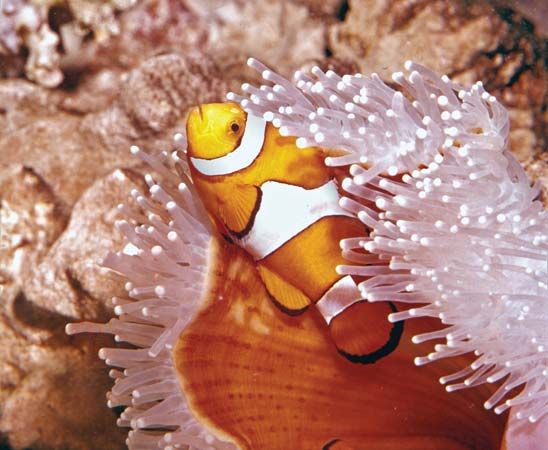
- Fishes: Numerous bright-colored species, such as those in the families Chaetodontidae, Apogonidae, and Pomacentridae, are commonly referred to as coral fish17. Additionally, specialized relationships exist, such as the mutualism between anemone fish and tropical anemones.3
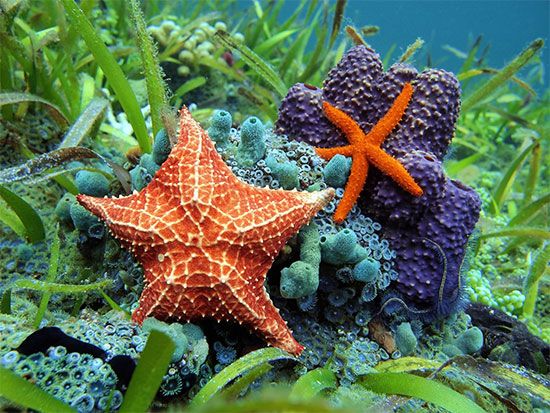
- Invertebrates: Sessile and slow-moving invertebrates are abundant. This includes sponges, sea cucumbers, sea anemones, mollusks, and echinoderms. Crustaceans, such as hermit crabs, also form complex associations with other reef dwellers.14153
- Algae and Microorganisms: Zooxanthellae live symbiotically within coral tissues, while various algae and protozoans help bind and cement the reef structure together.141513
These organisms rely on the complex, calcium carbonate matrix created by coral polyps, which serves as both a habitat and a foundation for the entire ecosystem.1413
Sources
- fireworm — Encyclopædia Britannica
- fireworm — Merriam-Webster
- polychaete — Encyclopædia Britannica
- annelid - Critical appraisal — Encyclopædia Britannica
- annelid - Distribution and abundance — Encyclopædia Britannica
- annelid - Locomotion — Encyclopædia Britannica
- Reproductive behaviour - Segmented worms — Encyclopædia Britannica
- Avoidance behaviour - Protection reflexes, armour, and spines — Encyclopædia Britannica
- mollusk - Features of defense — Encyclopædia Britannica
- bristle worm — Merriam-Webster
- bivalve - Features of defense and aggression — Encyclopædia Britannica
- annelid - External features — Encyclopædia Britannica
- Marine ecosystem - Benthos — Encyclopædia Britannica
- cnidarian - Associations — Encyclopædia Britannica
- coral reef - Corals and other reef-building organisms — Encyclopædia Britannica
- cnidarian - Distribution and abundance — Encyclopædia Britannica
- coral fish — Merriam-Webster
- Coral Bleaching: A Threat to Our Reefs — Encyclopædia Britannica
Published on · 3 min read