Annelid
Annelids, such as earthworms, are characterized by segmentation, a condition where the body is constructed of a linear series of repeating parts called…
How do annelids’ segmented bodies contribute to their survival and locomotion?
Annelids, such as earthworms, are characterized by segmentation, a condition where the body is constructed of a linear series of repeating parts called metameres. This structural organization is fundamental to their survival and movement.
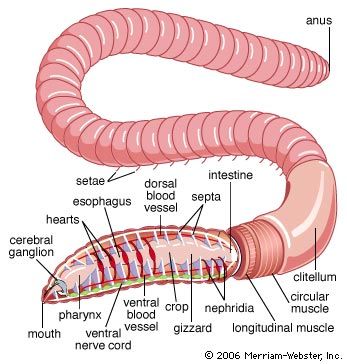
The primary locomotor mechanism in many annelids is peristaltic locomotion, which relies on the compartmentalization of the body. Each segment contains coelomic fluid confined by segment walls, creating a hydrostatic skeleton. Because this fluid cannot be compressed, it provides a firm but flexible base against which muscles can work. By alternating the contraction of circular and longitudinal muscles, the worm can extend, anchor, and shorten specific segments to move forward or burrow.12
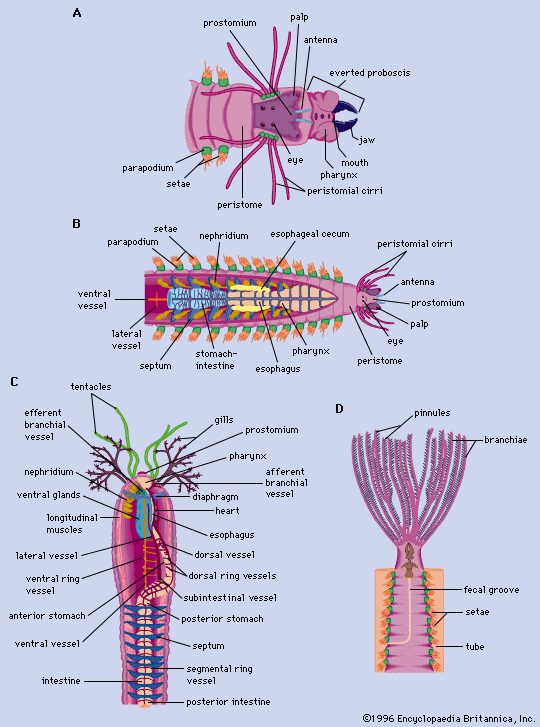
In addition to muscular control, many annelids utilize setae—movable bristles—to anchor segments to surfaces, preventing backward slippage during movement. In free-moving polychaetes, this is further enhanced by parapodia, fleshy outgrowths that provide additional leverage for crawling or swimming.
What roles do annelids play in various ecosystems?
Annelids occupy diverse ecological niches across the globe, ranging from deep oceanic waters to humid terrestrial soils. Their roles in these ecosystems are multifaceted and essential for environmental health:6
- Soil Engineering and Fertility: Earthworms are vital soil organisms that act as natural engineers. By burrowing, they aerate the soil and promote drainage. They ingest large quantities of organic matter and soil, accelerating the decomposition process and converting complex plant tissues into nutrient-rich materials that support plant growth. Their constant movement helps mix organic matter into the soil, playing a key role in the carbon and nitrogen cycles.78
- Trophic Links: Annelids serve as a critical food source for a wide variety of animals, including birds, fish, and other invertebrates.7
- Symbiotic and Commensal Relationships: Many polychaetes engage in complex associations. Some species are commensal, living within the tubes of other worms, the mantle cavities of mollusks, or on echinoderms. Others, such as certain leeches and specialized polychaetes, act as parasites, feeding on the blood or tissues of hosts like fish, crustaceans, and crinoids.96
- Bioluminescence: Some polychaetes produce light, which can be involved in mating behaviors, such as swarming, though the specific ecological function of this trait in tube-dwelling species remains a subject of scientific interest.9
How are annelids different from other invertebrates?
Annelids are distinguished from many other invertebrates by a combination of structural and physiological traits that define their phylum, Annelida.
Key Distinguishing Features
- True Segmentation (Metamerism): Annelids possess a body divided into a linear series of repeating segments called metameres. While arthropods and chordates also exhibit metamerism, this trait is a defining characteristic that separates annelids from simpler invertebrates like flatworms, which lack such internal organization.101314
- Coelom: Unlike acoelomates (such as flatworms), annelids possess a well-developed body cavity known as a coelom. This fluid-filled space acts as a hydrostatic skeleton, allowing for more complex movement and providing room for organ development.101514
- Circulatory System: Most annelids feature a well-developed closed circulatory system, which is more advanced than the systems found in many other invertebrate groups. This allows for efficient transport of oxygen and nutrients, supporting their active lifestyles.16
- Setae: Many annelids are characterized by the presence of setae—movable, bristle-like structures that aid in locomotion and anchoring.10
While annelids share an evolutionary kinship with mollusks, mollusks have largely lost or reduced the segmented structures that remain a hallmark of the annelid body plan.15
What are the three main classes of annelids and how do they differ?
Most authorities classify the phylum Annelida into three primary classes, distinguished by their habitat, anatomy, and reproductive strategies.1019
The Three Main Classes of Annelids
- Polychaeta (Marine Worms): This is the largest class, containing over 6,000 species. They are primarily marine and are characterized by paired lateral appendages called parapodia that bear numerous setae. They are often divided into free-moving forms and sedentary, tube-dwelling forms. Unlike the other two classes, polychaetes generally have separate sexes and release gametes directly into the water for external fertilization, often passing through a free-swimming larval stage called a trochophore.310
- Oligochaeta (Earthworms and relatives): These are primarily freshwater or terrestrial. They lack the complex appendages of polychaetes and possess only a few setae per segment. They are hermaphroditic and reproduce via copulation, depositing fertilized eggs into a cocoon secreted by a specialized structure called the clitellum. Development is direct, meaning they lack a larval stage.3
- Hirudinea (Leeches): Primarily found in freshwater, though some are terrestrial or marine, leeches are characterized by a fixed number of body segments (34) and suckers at both the anterior and posterior ends. They lack setae and have a body cavity largely filled with connective tissue. Like oligochaetes, they are hermaphroditic and use a clitellum for reproduction.310
Sources
- segmentation — Encyclopædia Britannica
- skeleton - Skeletomusculature of a mobile coelenterate — Encyclopædia Britannica
- annelid - Locomotion — Encyclopædia Britannica
- Locomotion - Bottom locomotion — Encyclopædia Britannica
- annelid - External features — Encyclopædia Britannica
- annelid - Distribution and abundance — Encyclopædia Britannica
- earthworm — Encyclopædia Britannica
- cnidarian - Associations — Encyclopædia Britannica
- annelid - Behaviour and associations. — Encyclopædia Britannica
- annelid — Encyclopædia Britannica
- annelid - Tissues and fluids — Encyclopædia Britannica
- soil organism — Encyclopædia Britannica
- Animal reproductive system - Annelids and mollusks — Encyclopædia Britannica
- Circulatory system - Annelida — Encyclopædia Britannica
- nervous system - Annelids — Encyclopædia Britannica
- annelid - Evolution and paleontology — Encyclopædia Britannica
- Animal - Acoelomates — Encyclopædia Britannica
- metamerism — Merriam-Webster
- annelid - Critical appraisal — Encyclopædia Britannica
- annelid - Annotated classification — Encyclopædia Britannica
- annelid - Ecology — Encyclopædia Britannica
- annelid - Distinguishing taxonomic features — Encyclopædia Britannica
- Animal - Critical appraisal — Encyclopædia Britannica
Published on · 4 min read