Antarctic Circumpolar Current
The Antarctic Circumpolar Current (ACC) is a massive, wind-driven oceanic current that flows from west to east, encircling Antarctica. As the most…
What is Antarctic Circumpolar Current?
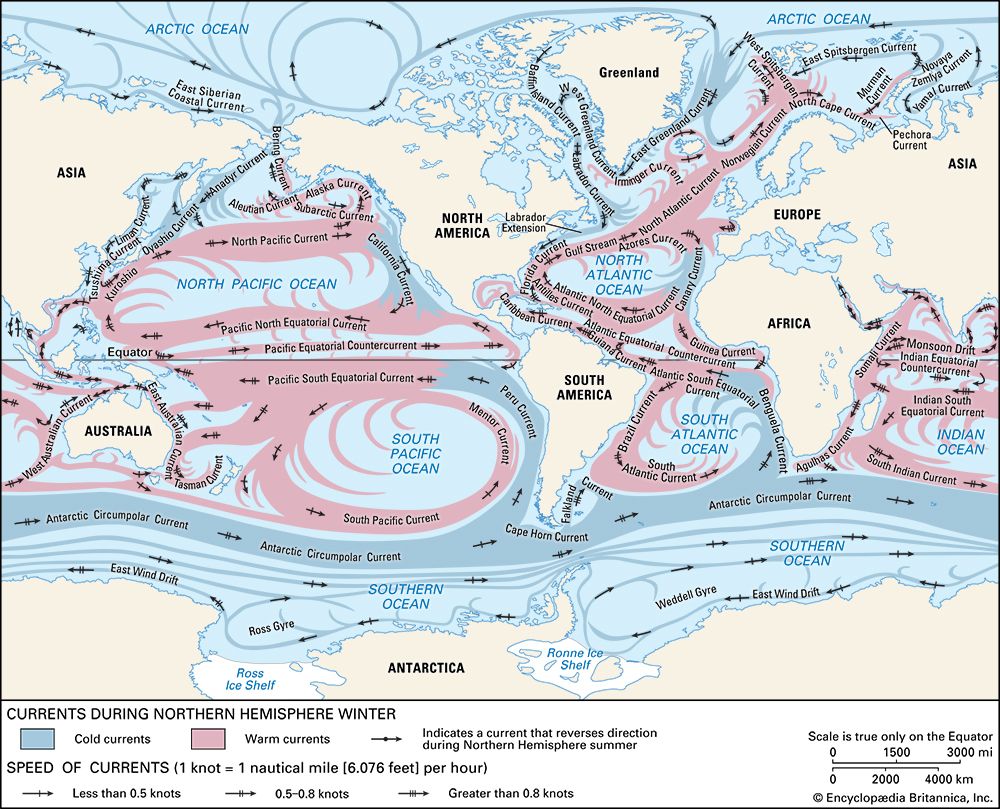
The Antarctic Circumpolar Current (ACC) is a massive, wind-driven oceanic current that flows from west to east, encircling Antarctica. As the most significant factor in diminishing differences between the world’s oceans, it links the Atlantic, Pacific, and Indian oceans.12
Rather than a single-axis flow, the ACC consists of a series of individual currents separated by frontal zones. It is irregular in width and course, reaching the seafloor and being guided by submarine topography. The current is characterized by large meanders and eddies that facilitate the poleward transfer of heat, helping to balance oceanic heat loss. Its mean transport is estimated at 134 million cubic metres per second, though flows through the Drake Passage have been measured as high as 173.3 million cubic metres per second. Additionally, the current includes the Circumpolar Deep Water, a warm water mass that influences ice melt near the Antarctic continent.213
What is the Drake Passage and why is it significant for ocean currents?
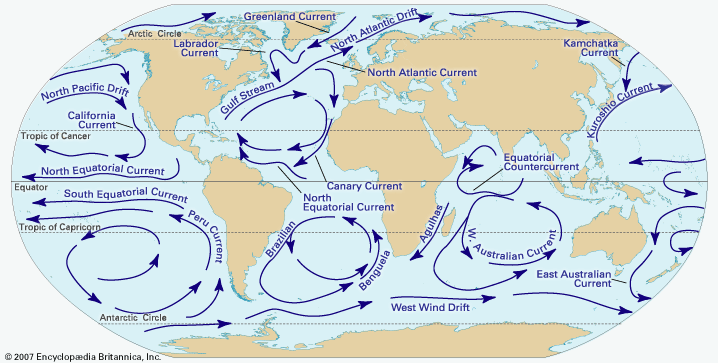
The Drake Passage is a deep, 600-mile (1,000-km) wide waterway located between Cape Horn, South America, and the South Shetland Islands near the Antarctic Peninsula. It serves as the critical connection between the Atlantic and Pacific oceans.4
The passage is of immense significance to global oceanography because it acts as a physical constriction for the Antarctic Circumpolar Current (ACC). As the world’s most voluminous current, the ACC flows from west to east, and its passage through this narrow gap causes it to accelerate rapidly in velocity, particularly near 60° S. This constriction plays a vital role in the current’s dynamics, with flow rates through the passage measured as high as 173.3 million cubic metres per second. Beyond its role in current regulation, the Drake Passage defines a major climatic transition zone, separating the subpolar conditions of Tierra del Fuego from the frigid, polar environment of Antarctica.45
How does the Circumpolar Deep Water affect Antarctic ice sheets?
Circumpolar Deep Water (CDW) is a relatively warm water mass that is a component of the Antarctic Circumpolar Current. It plays a critical role in the stability of Antarctic ice sheets by influencing the temperature at their base.6
The upwelling of this warm water mass near the edges of the Antarctica continent has been identified as a significant factor in accelerating the loss of ice volume. Specifically, in regions such as the Amundsen Sea Embayment, the upwelling of CDW warms the base of the ice sheet, which contributes to rapid ice melt and subsequent sea level rise.6
While the mass balance of the Antarctic Ice Sheet is generally maintained by a combination of snowfall and ice loss through calving and melting, the intrusion of warmer deep water beneath floating ice shelves can destabilize these structures, potentially leading to increased ice discharge into the Southern Ocean.62
What are ocean eddies and how do they influence heat transfer?
Ocean eddies are fluid currents whose flow direction differs from that of the general surrounding flow. They are essentially swirling vortices that form within larger bodies of water due to factors such as wind stress, coastal upwelling, or the instability of major currents like the Gulf Stream.1112
Influence on Heat Transfer
Eddies are highly significant for the redistribution of heat and energy within the ocean:
- Mixing and Transport: Unlike molecular diffusion, which is a slow process, eddies physically mix large masses of fluid, allowing for the efficient transfer of heat, nutrients, and other properties across different regions of the ocean.1113
- Poleward Heat Flux: In major current systems, such as the Antarctic Circumpolar Current, the development of large meanders and eddies induces a poleward transfer of heat. This process is vital for balancing the oceanic heat loss that occurs in the colder Antarctic region.14
- Energy Distribution: Eddies act as mechanisms that inject kinetic energy into the broader circulation. For instance, warm-core and cold-core rings—types of eddies that pinch off from the Gulf Stream—transport distinct water masses (and their associated heat content) into different environments, where they eventually dissipate and re-merge with the main current.1213
By facilitating these exchanges, eddies play a fundamental role in maintaining the global climate and regulating the thermal balance of the world’s oceans.1114
Sources
- Antarctic Circumpolar Current — Encyclopædia Britannica
- Amundsen Sea — Encyclopædia Britannica
- ocean current - The Antarctic Circumpolar Current — Encyclopædia Britannica
- Drake Passage — Encyclopædia Britannica
- Drake Passage — Merriam-Webster
- ocean current - Thermohaline circulation — Encyclopædia Britannica
- iceberg - Impact on ocean structure — Encyclopædia Britannica
- iceberg - Impacts on ice sheets and sea level — Encyclopædia Britannica
- iceberg - Antarctic icebergs — Encyclopædia Britannica
- A Trillion Tonnes of Antarctica Fell into the Sea — Encyclopædia Britannica
- eddy — Encyclopædia Britannica
- ocean current - The subtropical gyres — Encyclopædia Britannica
- Climate - The Gulf Stream — Encyclopædia Britannica
- Climate - Climate and the oceans — Encyclopædia Britannica
- Climate - The ocean surface and climate anomalies — Encyclopædia Britannica
- Climate - Circulation, currents, and ocean-atmosphere interaction — Encyclopædia Britannica
Published on · 3 min read