Ape
Human activities have significantly impacted ape populations, with approximately 75 percent of all primate species experiencing population declines by the…
How have human activities affected ape populations and conservation efforts?
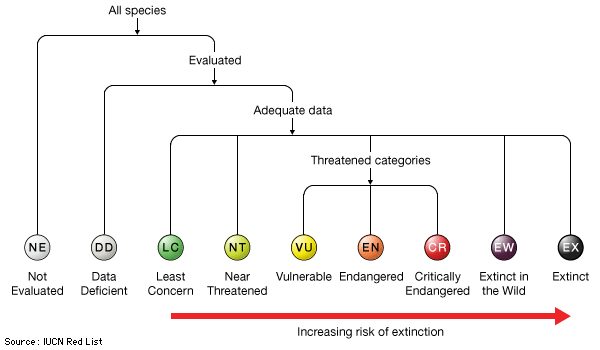
Human activities have significantly impacted ape populations, with approximately 75 percent of all primate species experiencing population declines by the 21st century. The primary drivers of this crisis include habitat loss and fragmentation caused by logging, mining, urban sprawl, and the conversion of land for agriculture and livestock.123
Beyond habitat destruction, apes face severe threats from hunting, poaching, the pet trade, and the illegal trade of body parts. Furthermore, apes are susceptible to human diseases, which can devastate populations.12
Conservation efforts are essential to prevent extinction. These include:
- Habitat Preservation: Protecting natural areas in perpetuity is critical for species like the orangutan and gorilla.4
- Captive Breeding and Reintroduction: Programs like those for the golden lion marmoset demonstrate that concerted efforts can successfully increase populations of critically endangered species.4
- Monitoring and Discovery: Identifying new populations, such as the 2008 discovery of western lowland gorillas in the Republic of the Congo, provides vital opportunities for protection.4
What are some examples of tool use among different ape species?
Ape species demonstrate remarkable cognitive abilities through the use of various tools to solve problems, forage for food, and maintain hygiene.
Chimpanzee Tool Use
Chimpanzees exhibit a diverse repertoire of tool-using behaviors that are often passed down through generations via social learning:
- Foraging: They “fish” for termites and ants using probes made from grass stalks, vines, or branches. They also use “leafy sponges” (folded leaves or moss) to soak up and drink water.5
- Processing Food: Chimps crack open hard nuts by using stones, roots, or wood as hammers and anvils.5
- Complex Sets: They utilize “tool sets” and “tool composites,” such as using a stout stick to dig into a mound and a slender wand to extract termites, or using sticks to retrieve water-soaked sponges from tree hollows.5
- Hygiene and Defense: Leaves are used to wipe soiled body parts, and sticks are used to inspect potentially dangerous objects like dead pythons.5
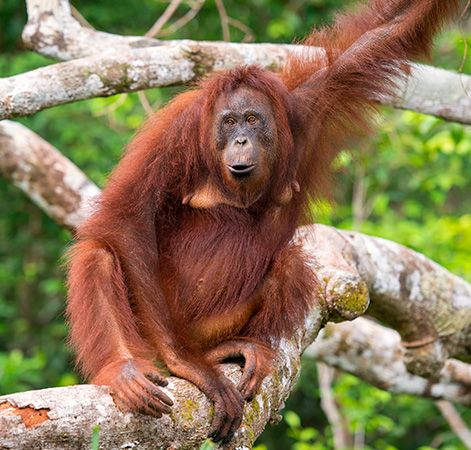
Orangutan Tool Use
Orangutans also display significant ingenuity:
- Foraging: In parts of Sumatra, they consistently use defoliated sticks to extract insects or honey from tree holes and to pry seeds from fruit.6
- Self-Medication: A notable discovery in 2024 revealed that Sumatran orangutans treat their own injuries using medicinal plants, marking the first documented case of wound care by a wild animal.6
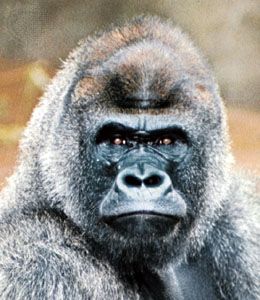
What are the key differences between great apes and lesser apes?
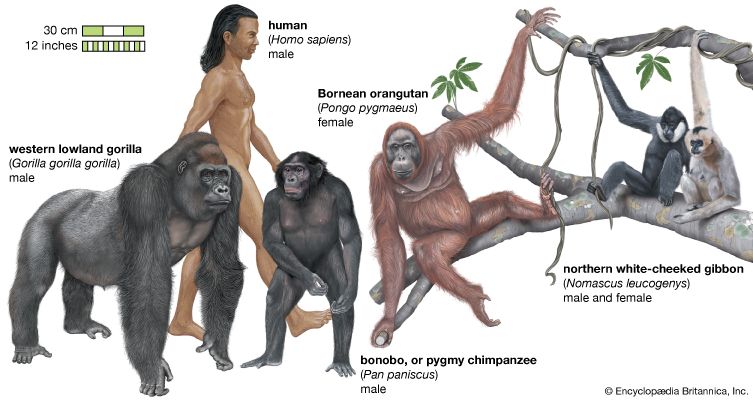
The superfamily Hominoidea is divided into two primary families: Hominidae (great apes) and Hylobatidae (lesser apes). While both groups share key primate characteristics—such as the absence of a tail, broad chests, and full shoulder rotation—they differ significantly in size, intelligence, and behavior.9
Key Differences
Feature
Great Apes (Hominidae)
Lesser Apes (Hylobatidae)
Members
Chimpanzees
,
bonobos
,
orangutans
,
gorillas
, and
humans
Gibbons
Size
Comparatively large with humanlike features
Smaller in stature
Cognition
Highly intelligent; capable of abstract reasoning, mirror self-recognition, and tool use
Less complex cognitive abilities compared to great apes
Locomotion
Varied; includes knuckle-walking (African apes) and arboreal movement
Primarily move via
brachiation
(swinging)
Nesting
Build nests for sleeping (except humans)
Do not build nests
Great apes are distinguished by their larger brain size and advanced cognitive capabilities, including the ability to learn quasi-linguistic communication and create tools. While gibbons are specialized for swinging through the canopy, great apes exhibit a wider range of movement, with African species spending significant time on the ground.9
How do apes’ cognitive abilities compare to other mammals?
Apes, particularly great apes, exhibit cognitive abilities that distinguish them from many other mammals, though comparisons are complex due to varying definitions of intelligence.59
Cognitive Distinctions
- Self-Awareness: Great apes demonstrate self-recognition in mirrors, a trait shared by few other animals, such as bottlenose dolphins and elephants.115
- Reasoning and Insight: While many animals solve problems through trial and error, great apes show evidence of insight and abstract reasoning. They can perform transitive inference—such as understanding that if A is greater than B and B is greater than C, then A is greater than C—and solve complex analogical reasoning tasks.129
- Communication: Researchers have taught chimpanzees to use sign language or symbolic tokens to communicate, though the extent to which this constitutes “true” language remains a subject of scientific debate.13
- Tool Use and Culture: Apes possess sophisticated tool-using behaviors, such as “fishing” for insects or using “leafy sponges” to drink water. These behaviors are often transmitted through social learning, forming what researchers define as culture.13
While other mammals like crows, rats, and goats demonstrate impressive problem-solving and memory, the cognitive plasticity of primates is largely attributed to the expansion and complexity of the neocortex.514
Sources
- primate — Encyclopædia Britannica
- chimpanzee - Conservation status — Encyclopædia Britannica
- primate - Distribution and abundance — Encyclopædia Britannica
- endangered species - Habitat loss, degradation, and fragmentation — Encyclopædia Britannica
- chimpanzee - Intelligence — Encyclopædia Britannica
- orangutan — Encyclopædia Britannica
- human evolution - Refinements in hand structure — Encyclopædia Britannica
- Homo — Encyclopædia Britannica
- ape — Encyclopædia Britannica
- human evolution - Learning from the apes — Encyclopædia Britannica
- Which Animal Is the Smartest? — Encyclopædia Britannica
- human evolution - Increasing brain size — Encyclopædia Britannica
- Animal learning - Insight and reasoning — Encyclopædia Britannica
- primate - General structure — Encyclopædia Britannica
- problem solving — Encyclopædia Britannica
- Primatology — Encyclopædia Britannica
Published on · 4 min read