Dromedary
The dromedary (Camelus dromedarius), also known as the Arabian camel, is a swift, one-humped camel species that is exclusively domesticated. While wild…
What is dromedary?
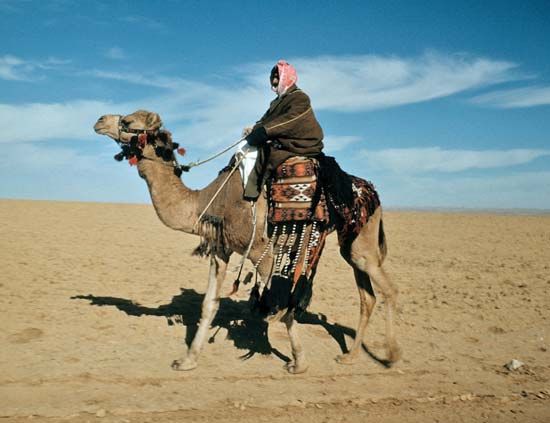
The dromedary (Camelus dromedarius), also known as the Arabian camel, is a swift, one-humped camel species that is exclusively domesticated. While wild dromedaries are extinct, a significant feral population exists in the interior of Australia, descended from animals imported during the 19th century.12
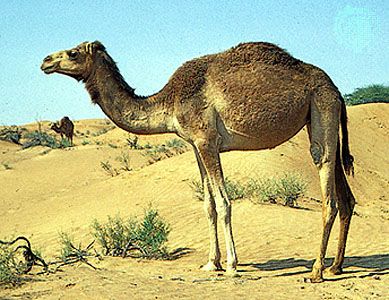
Compared to the two-humped Bactrian camel, the dromedary is slimmer and longer-legged, featuring specialized horny pads on its chest and knees that protect it from searing desert sand when it lies down. These animals are highly adapted to arid environments, capable of enduring extreme dehydration and protein deficiency. They are valued as pack and riding animals, as well as for their milk, meat, and wool. Dromedaries are known for their speed, with racing individuals capable of reaching 40 miles (65 km) per hour over short distances.132
How do camels survive for such long periods without water?
A common misconception is that camels store water in their humps; in reality, these structures contain fatty tissue used for nourishment when food is scarce.4
Camels survive long periods without water due to their extreme efficiency in water usage and unique physiological traits:4
- Blood Cell Shape: Unlike the circular blood cells of most mammals, camel blood cells are oval-shaped. This elasticity allows them to consume up to 30 gallons of water in a single sitting and ensures blood flows easily even when the animal is dehydrated.4
- Temperature Regulation: By concentrating fat in the humps rather than distributing it across the body, camels minimize heat insulation during the day. This allows their body temperature to rise during the heat and dissipate at night, reducing the need to sweat and lose precious fluids.4
Through these adaptations, camels can go nearly a week without drinking, earning them the nickname “ships of the desert”.4
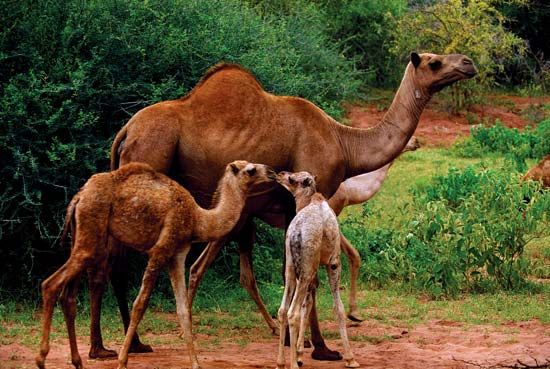
What are the main differences between dromedary and Bactrian camels?
The dromedary and the Bactrian camel are distinct species within the family Camelidae, adapted to different environments and historical uses. Their primary differences include:
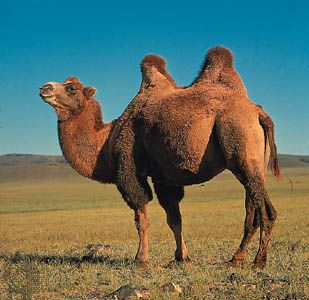
- Physical Structure: The most recognizable difference is the number of humps; the dromedary has one, while the Bactrian camel has two. Dromedaries are generally slimmer and longer-legged, whereas Bactrian camels are more robust, stockier, and possess longer, woollier coats to survive harsh winters in the steppes.25
- Anatomical Adaptations: Dromedaries feature specialized horny pads on their chest and knees that protect them from searing desert sand when they lie down; Bactrian camels lack these callosities. Additionally, dromedaries have soft, wide-spreading foot pads for sand, while Bactrian camels have firmer feet.2
- Distribution and Habitat: Dromedaries are primarily found in North Africa and the Middle East, while Bactrian camels inhabit the arid regions and steppes of Eurasia.5
- Capacity: Bactrian camels are heavier and can carry larger loads (up to 270 kg) compared to the more lightly built dromedaries, which typically carry up to 100 kg.25
Why are there wild dromedary camels in Australia?
There are no truly wild dromedary camels in existence, as the species is considered extinct in the wild. The dromedary camels found in the interior of Australia are actually a feral population.13
These camels are the descendants of pack animals imported to Australia during the 19th century. They were brought to the country to serve as beasts of burden, playing a vital role in the exploration and development of the Australian outback until approximately 1940. Once their utility as transport animals declined due to the rise of modern technology, the population established itself in the wild, where it continues to thrive today.1367
Sources
- dromedary — Encyclopædia Britannica
- camel - Natural history — Encyclopædia Britannica
- camel — Encyclopædia Britannica
- Do Camels Store Water in Their Humps? — Encyclopædia Britannica
- Bactrian camel — Encyclopædia Britannica
- Livestock farming - Camels — Encyclopædia Britannica
- camel - Cultural significance — Encyclopædia Britannica
Published on · 3 min read