Atlantic Salmon
The Atlantic salmon (Salmo salar) is an oceanic trout belonging to the family Salmonidae. Highly regarded as a game fish, it is native to rivers on both…
What is Atlantic salmon?
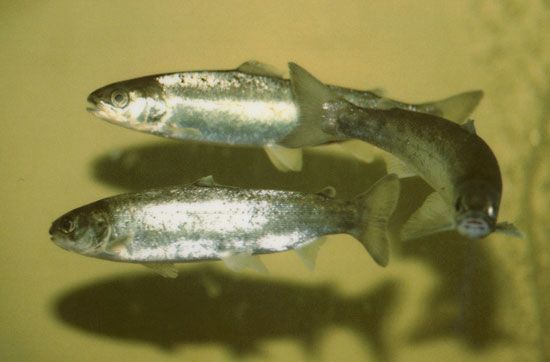
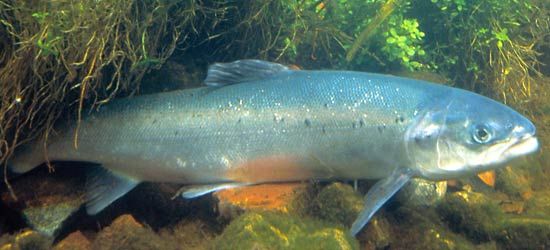
The Atlantic salmon (Salmo salar) is an oceanic trout belonging to the family Salmonidae. Highly regarded as a game fish, it is native to rivers on both sides of the Atlantic Ocean both sides of the Atlantic Ocean.12
Adult Atlantic salmon typically weigh about 4.5 to 5.5 kg (10 to 12 pounds) and are characterized by round or cross-shaped spots. Unlike many Pacific salmon species, which die after spawning, Atlantic salmon may survive the process—returning to the sea as “kelts”—and can spawn multiple times. Young salmon generally spend one to three years in freshwater streams before migrating to the ocean, where they mature over several years.12
Beyond their natural populations, Atlantic salmon are a significant species in aquaculture, where they are raised in large-scale fish pens in regions such as Scandinavia, Scotland, and North America. They have also been successfully introduced into the Great Lakes of the United States.31
How do Atlantic salmon differ from Pacific salmon species?
Atlantic salmon (Salmo salar) and Pacific salmon (genus Oncorhynchus) differ significantly in their life cycles, biology, and classification. While both belong to the family Salmonidae, they are distinct in several key ways:
- Survival After Spawning: The most notable difference is that all adult Pacific salmon die shortly after spawning. In contrast, many Atlantic salmon survive the spawning process—becoming known as “kelts”—and may return to the sea to spawn again, sometimes up to three or four times.26
- Classification: Atlantic salmon are considered a type of oceanic trout, whereas Pacific salmon comprise six distinct species, including sockeye, coho, chum, chinook, pink, and cherry salmon.26
- Physical Characteristics: During the breeding season, Pacific salmon undergo dramatic color changes and males often develop hooked jaws. While Atlantic salmon also exhibit changes, the transformations in male Pacific salmon are generally more striking.2
- Usage: Atlantic salmon are primarily valued as sport fish and are widely farmed in aquaculture. Pacific salmon support a massive commercial fishery and are also prized for sport.2
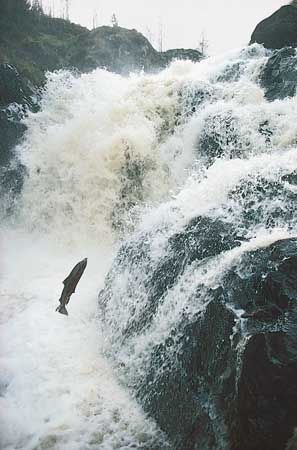
What is the life cycle of an Atlantic salmon?
The life cycle of the Atlantic salmon (Salmo salar) is a complex process involving transitions between freshwater and marine environments.27
- Spawning: Adults migrate from the ocean into freshwater streams to spawn, typically in the fall. The female excavates a pit in the stream gravel, where she and a male deposit eggs and milt simultaneously; the eggs are then covered with gravel for protection.287
- Incubation and Hatching: The eggs incubate in the gravel, usually hatching in late winter. After hatching, the fry remain in the gravel, nourishing themselves on their attached yolk sacs.2
- Freshwater Stage: Once the yolk is consumed, the young salmon emerge and remain in freshwater streams for one to three years (sometimes longer) to feed and grow.27
- Marine Migration: After this period, the salmon migrate to the ocean, where they spend several years maturing.28
- Return and Survival: As adults, they return to their home rivers to spawn. Unlike many Pacific salmon species, Atlantic salmon may survive the spawning process—becoming known as “kelts”—and return to the sea to spawn again, sometimes multiple times.2718
What are landlocked salmon and where are they found?
Landlocked salmon are smaller, freshwater-dwelling forms of the Atlantic salmon (Salmo salar) that do not migrate to the ocean. Unlike their anadromous counterparts, these fish complete their entire life cycle within freshwater systems, typically maturing in deep lakes before ascending tributary streams to spawn.101
These salmon are often regarded as distinct varieties or separate species, such as the Sebago salmon (S. salar sebago) or the ouananiche (S. salar ouananiche). They are highly valued as sport fish and are native to lakes in eastern North America, ranging from New Hampshire to New Brunswick. Additionally, Atlantic salmon have been successfully introduced into the Great Lakes of the United States.910
Sources
- Atlantic salmon — Encyclopædia Britannica
- salmon — Encyclopædia Britannica
- protacanthopterygian - Importance — Encyclopædia Britannica
- salmon shark — Encyclopædia Britannica
- Atlantic Ocean - Fisheries of the Atlantic Ocean — Encyclopædia Britannica
- aquaculture - Trout and salmon — Encyclopædia Britannica
- Migration - Anadromous fish — Encyclopædia Britannica
- Why do salmon die after spawning? — Encyclopædia Britannica
- protacanthopterygian - Life cycle and reproduction — Encyclopædia Britannica
- landlocked salmon — Merriam-Webster
- 14 Questions About Aquatic Animals Answered - Is it true that a salmon will always return to its birthplace? — Encyclopædia Britannica
Published on · 3 min read