Yellow-eyed Penguin
The yellow-eyed penguin (Megadyptes antipodes) is found exclusively in New Zealand, specifically on Stewart Island, the Auckland Islands, Campbell Island…
Where is the natural habitat of the yellow-eyed penguin, and how does it differ from other penguin species?
The yellow-eyed penguin (Megadyptes antipodes) is found exclusively in New Zealand, specifically on Stewart Island, the Auckland Islands, Campbell Island, and the southeastern coast of the South Island.1
This species differs from other penguins in several distinct ways:
- Nesting Habits: Unlike most species that breed in dense colonies, yellow-eyed penguins are solitary nesters. They build nests of grass and twigs or excavate burrows in forest and scrub areas, keeping them out of sight of other breeding pairs.1
- Social Behavior: Most yellow-eyed penguin chicks do not form “crèches” (groups) with their peers, a behavior common in many other penguin species.1
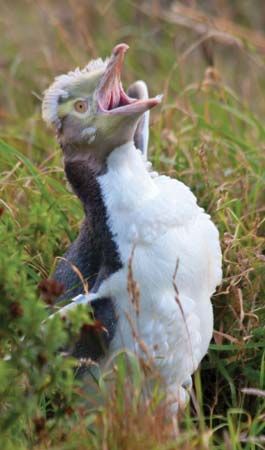
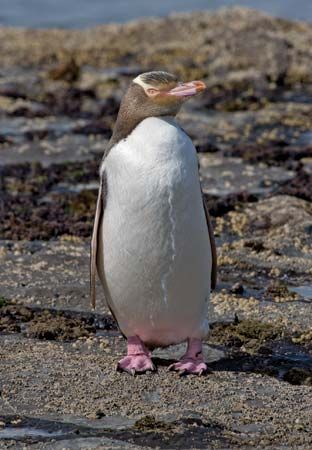
- Appearance: They are the only penguin species characterized by pale yellow eyes, yellow eyebands, and yellow feathers on the upper head.1
- Breeding: They possess one of the longest breeding seasons of any penguin species, lasting from August to March.1
What cultural significance do yellow-eyed penguins have for the indigenous people of New Zealand?
Sorry, the Britannica knowledge base does not contain this information.
What are the breeding habits and lifecycle of yellow-eyed penguins?
The yellow-eyed penguin (Megadyptes antipodes) has one of the longest breeding seasons of any penguin species, spanning from August to March.1
Breeding Habits
Unlike many other penguins that nest in dense colonies, yellow-eyed penguins are solitary nesters. Breeding pairs are typically monogamous and often return to the same nest site each year. They construct nests out of grass and twigs or excavate burrows in forest and scrub areas, usually positioned against solid structures like trees or rocks to remain hidden from other pairs.1
Lifecycle
- Egg Laying and Incubation: Following copulation, two eggs of equal size are laid. Both parents share incubation duties for 39–51 days.1
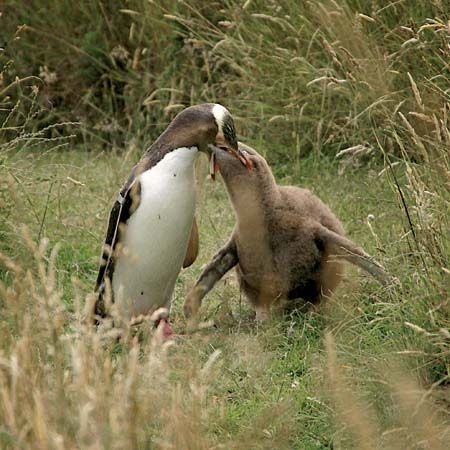
- Chick Rearing: For the first six weeks, one parent guards the chicks while the other forages at sea. Unlike many other species, yellow-eyed penguin chicks generally do not form “crèches” (groups), though small groups have been observed on Campbell Island.1
- Independence: Chicks leave the nest to live independently about 100 days after hatching.1
- Maturity and Lifespan: Females typically reach sexual maturity at age two or three, while males mature between ages three and five. Many individuals live to 20 years, with some reaching 24.1
What is the conservation status of the yellow-eyed penguin, and what threats do they face?
The yellow-eyed penguin (Megadyptes antipodes) has been listed as endangered by the International Union for Conservation of Nature (IUCN) since 2000. The global population has experienced a dramatic decline since 1960, with estimates by 2010 placing the number of adults between 4,000 and 4,800.1
Primary Threats
The species faces a multifaceted array of threats that jeopardize its survival:
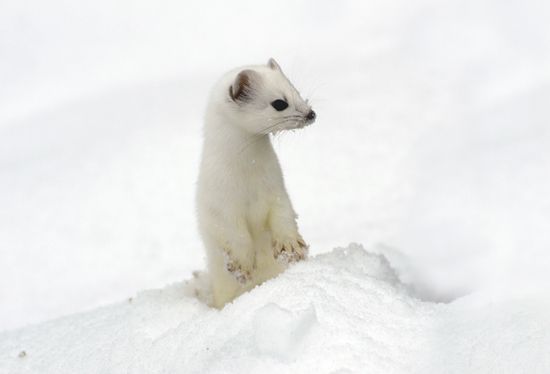
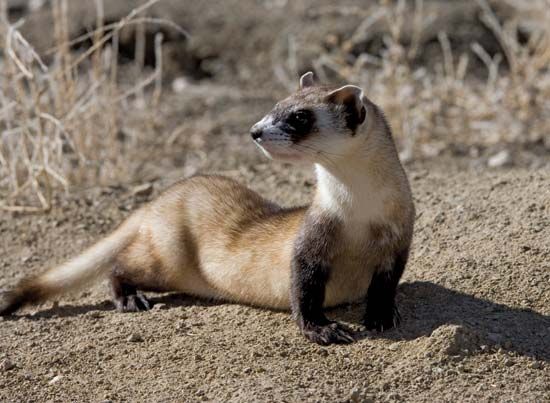
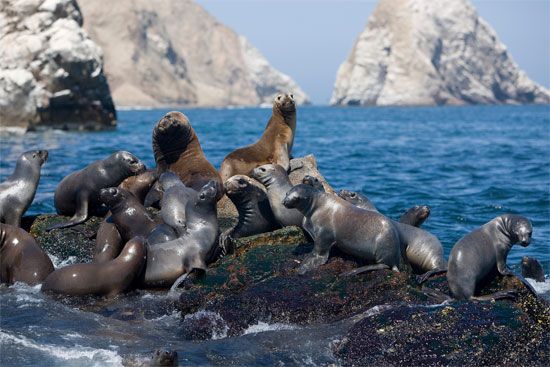
- Predation: On land, eggs and penguins of all ages are vulnerable to introduced mammals, including ermines, ferrets, and feral dogs and cats. At sea, they are preyed upon by sharks and Hooker’s sea lions.1
- Human Activity: Entanglement in fishing nets remains a significant cause of mortality. Additionally, residential development and human disturbance have degraded their limited habitat patches disturbance have degraded their limited habitat patches.1
- Disease and Environment: The species suffers from infections like avian malaria and diphtheritic stomatitis, which causes mouth lesions in chicks. Furthermore, cyclical changes in seawater temperature can lead to food shortages.1
Conservation efforts, including predator trapping, habitat restoration, and nest protection, are currently underway to help stabilize the population.1
Sources
- Yellow-eyed penguin — Encyclopædia Britannica
- Hei-tiki — Encyclopædia Britannica
- Are penguins monogamous? — Encyclopædia Britannica
Published on · 3 min read