Antipodes Islands
The Antipodes Islands are an uninhabited, outlying island group belonging to New Zealand. Located in the South Pacific Ocean, approximately 350 miles (560…
What is Antipodes Islands?
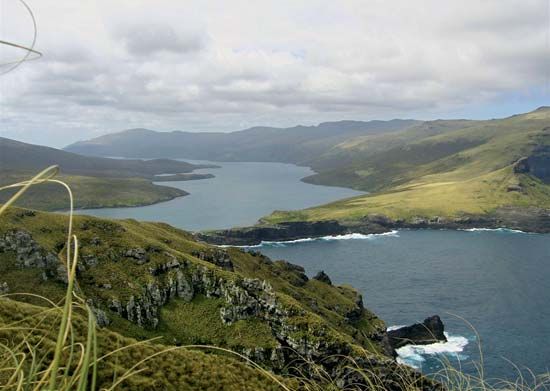
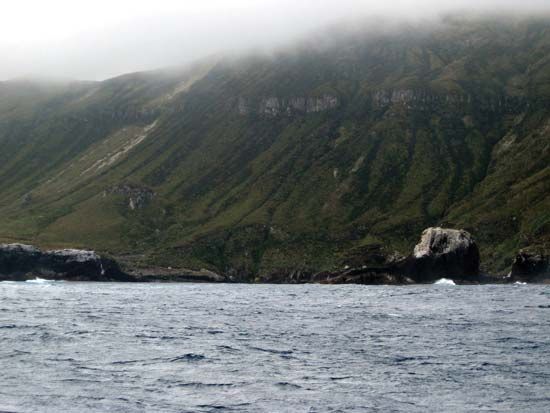
The Antipodes Islands are an uninhabited, outlying island group belonging to New Zealand. Located in the South Pacific Ocean, approximately 350 miles (560 km) southeast of the South Island, the group consists of a central island and several smaller islets, covering a total land area of 24 square miles (62 sq km).1
The islands feature coastal cliffs and an interior that reaches an elevation of 1,320 feet (402 m) at Mount Galloway. They were discovered in 1800 by the crew of the British ship Reliance. Historically, the islands supported large herds of fur seals, though these populations were severely depleted by uncontrolled hunting in the 19th century.1
It is important to note that while the term “the Antipodes” is sometimes used in British English to refer to Australia and New Zealand, the Antipodes Islands specifically designate this distinct volcanic island group.12
What does the term ‘antipodes’ mean in geography?
In geography, the term antipodes (pronounced \an-TIH-puh-deez$ refers to the parts of the Earth that are diametrically opposite to one another. Derived from the Greek words anti- (opposite) and pod- (foot), the term originally described people living on the opposite side of the globe, literally having their feet against ours.6
While the term is no longer used to describe people, it remains a standard geographical concept for identifying locations that are exactly opposite on the globe. In British English, the plural “the Antipodes” is often used specifically to refer to Australia and New Zealand because they are situated on the opposite side of the Earth from Britain. Beyond its geographical application, the word can also denote the exact opposite or contrary of something.6
What unique wildlife species live on the Antipodes Islands?
The Antipodes Islands are an uninhabited, remote group of islands belonging to New Zealand. While the islands were historically home to large populations of fur seals, these were drastically reduced by uncontrolled hunting during the 19th century.1
The provided search results do not contain specific information regarding unique wildlife species currently residing on the Antipodes Islands. While other subantarctic islands, such as Macquarie Island, are known for hosting distinct species like the royal penguin, the available data for the Antipodes Islands is limited to their geography, discovery, and historical seal populations.19
What are some other subantarctic islands near New Zealand?
New Zealand’s subantarctic islands are a collection of remote, uninhabited island groups located in the South Pacific Ocean. Together, these groups were designated a UNESCO World Heritage site in 1998 due to their unique ecological significance.2
The primary island groups include:
- Auckland Islands: A volcanic group located 290 miles south of the South Island, known for its diverse wildlife, including birds, sea lions, and fur seals.17
- Bounty Islands: A cluster of 13 inhospitable granite islets situated 415 miles east of the South Island, which serve as important breeding grounds for seabirds and penguins.4
- Campbell Island: A rugged, volcanic island 400 miles south of the South Island, historically used by sealers and whalers and later home to a meteorological station.18
- Snares Islands: A small volcanic group located 65 miles southwest of Stewart Island, characterized by coastal cliffs and serving as a vital rookery for birds.19
- Antipodes Islands: A remote group that completes this subantarctic collection.202
Sources
- Antipodes Islands — Encyclopædia Britannica
- Auckland Islands — Encyclopædia Britannica
- the Antipodes — Merriam-Webster
- Bounty Islands — Encyclopædia Britannica
- list of islands - New Zealand — Encyclopædia Britannica
- Did you know? — Merriam-Webster
- antipodes — Merriam-Webster
- antipode — Merriam-Webster
- Antarctica - Plant life — Encyclopædia Britannica
- Scotia Sea — Encyclopædia Britannica
- Macquarie Island — Encyclopædia Britannica
- Psittaciform — Encyclopædia Britannica
- conservation - Removing invasive species — Encyclopædia Britannica
- parrot — Encyclopædia Britannica
- Pelecaniform - Reproduction — Encyclopædia Britannica
- Bird-of-paradise — Encyclopædia Britannica
- list of World Heritage sites - New Zealand — Encyclopædia Britannica
- South Island — Encyclopædia Britannica
- Snares Islands — Encyclopædia Britannica
- Campbell Island — Encyclopædia Britannica
Published on · 2 min read