Backswimmer
Backswimmers (family Notonectidae) are predatory aquatic insects that primarily feed on other insects, small tadpoles, and fishes.
What is the diet of backswimmers and how do they hunt?
Backswimmers (family Notonectidae) are predatory aquatic insects that primarily feed on other insects, small tadpoles, and fishes.1
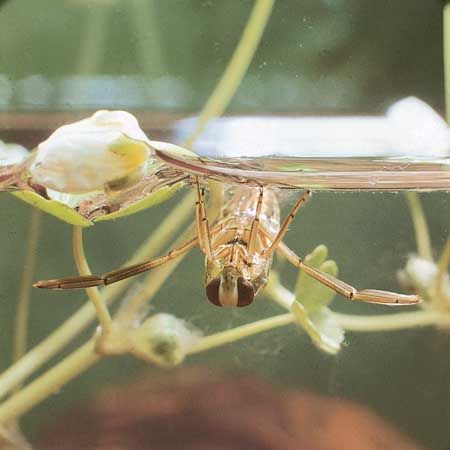
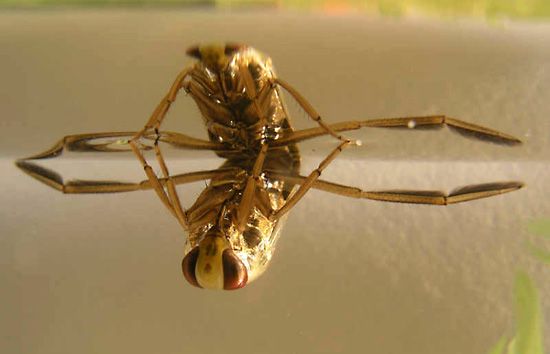
They hunt by utilizing their unique physical adaptations to remain stealthy in their environment. Often seen floating on the water surface with their legs extended, they wait for potential prey to approach. When they strike, they use a strong beak to pierce their prey and suck out its body fluids.1
Their ability to remain undetected is aided by countershading: their light-colored backs blend into the sky when viewed from below, while their darker bodies blend with the bottom of the water when viewed from above. While they are effective predators, they are also capable of biting humans if handled, which can feel similar to a bee sting.1
What role do backswimmers play in the aquatic food chain?
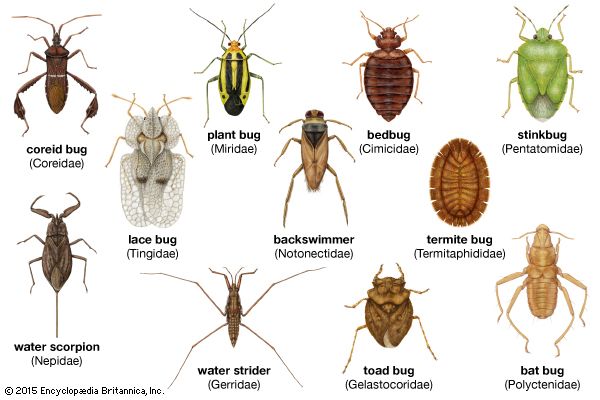
Backswimmers (family Notonectidae) function as active predators within the aquatic food chain. By preying on insects, small tadpoles, and fishes, they act as a population control mechanism for these organisms in various bodies of water.1
Because they are capable of consuming small fish and tadpoles, certain genera, such as Notonecta, can be quite destructive to these populations. Their role is defined by their position as secondary or tertiary consumers, effectively transferring energy from smaller aquatic organisms to higher trophic levels. Additionally, their ability to survive in diverse conditions—including swimming under ice during winter—allows them to maintain their predatory role throughout different seasons.1
Are backswimmers considered beneficial or harmful to humans and ecosystems?
Whether backswimmers are viewed as beneficial or harmful depends largely on the context of their environment and their interaction with humans.
Impact on Ecosystems
In natural aquatic ecosystems, backswimmers serve as active predators, helping to regulate the populations of various insects, small tadpoles, and fishes. By consuming these organisms, they play a functional role in the food web, transferring energy between trophic levels. However, this predatory nature can be considered harmful in specific settings, such as fish hatcheries or ponds where the protection of young fish and tadpoles is a priority. The genus Notonecta, in particular, is noted for being potentially destructive to these populations.1
Interaction with Humans
For humans, backswimmers are generally considered a nuisance rather than a significant threat. While they are not aggressive, they are capable of biting if handled, an experience often compared to the sting of a bee. They do not pose a danger to human health, but their presence in recreational water bodies can be unpleasant for swimmers.1
How do backswimmers get their name, and why do they swim upside down?
Backswimmers (family Notonectidae) derive their name from their unique habit of swimming on their backs. Their bodies are shaped like the keel and sides of a boat, which facilitates this inverted swimming style.1
They swim upside down primarily as an effective form of countershading. Their light-colored back, when viewed from below, blends into the bright water surface and sky, making them less visible to predators. Conversely, the rest of their body is darker, allowing them to blend in with the bottom of the water body when viewed from above.1
This orientation is supported by their physical structure, as they use long, oarlike legs for propulsion. Because they are naturally lighter than water, they rise to the surface after releasing their hold on bottom vegetation, where they can either fly or replenish their air supply.1
Sources
- backswimmer — Encyclopædia Britannica
- fish - Locomotion — Encyclopædia Britannica
- backswimmer — Merriam-Webster
- Why do oarfish swim vertically? — Encyclopædia Britannica
Published on · 3 min read