Bajada
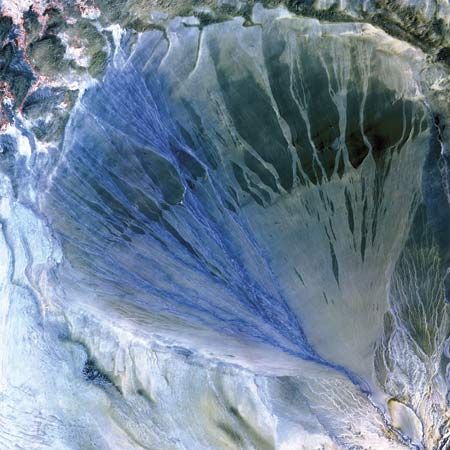
A bajada is a broad, gently sloping landform composed of debris spread along the base of a mountain range. It is primarily found in arid or semiarid climates…
What is bajada?
A bajada is a broad, gently sloping landform composed of debris spread along the base of a mountain range. It is primarily found in arid or semiarid climates and is formed by the coalescing of several alluvial fans, which creates a continuous, uniform slope that can extend several kilometers from the mountain front.123
Key characteristics of a bajada include:
- Composition: It is typically made of gravelly alluvium and may contain large, interbedded boulders.1
- Slope: The gradient is generally less than 7°.1
- Formation: As streams shift across the surface of individual fans, sediment is distributed widely; when these fans merge, they form a nondescript, expansive slope.13
- Terminology: While the term is standard in the U.S. Southwest, similar landforms in humid climates are often referred to as piedmonts.13
How do alluvial fans form?
An alluvial fan is an unconsolidated sedimentary deposit that forms at the mouth of a mountain canyon when a stream’s ability to transport sediment suddenly diminishes or ceases. These features are part of an erosional-depositional system where sediment eroded from mountains is transferred to an adjacent basin.41
The formation process involves several key factors:
- Point Source: The fan originates at an apex where a stream emerges from a confined mountain canyon onto an open plain.41
- Deposition: As the stream exits the canyon, it loses its confinement and velocity, causing it to drop its sediment load. In arid regions, this is often driven by sporadic flash floods or snowmelt.4
- Sorting: Sediment is sorted as it moves from the apex to the base. Coarser materials, such as gravels, are typically deposited near the apex, while finer sands and silts are carried toward the base.4
- Channel Shifting: Streams frequently shift across the fan surface, distributing sediment widely and creating a characteristic fan-shaped geometry.43
These landforms are influenced by tectonic uplift and climatic change, and they are particularly prominent in arid and semiarid environments.41
What is the difference between a bajada and a pediment?
While both bajadas and pediments are gently sloping landforms found at the base of mountains in arid regions, they differ fundamentally in their composition and origin.
- Bajada: A bajada is a depositional landform created by the coalescing of several alluvial fans. It is composed of gravelly alluvium and debris transported and spread by streams. Because it is formed by the accumulation of sediment, it is not a solid bedrock feature.1
- Pediment: A pediment is an erosional landform consisting of a relatively flat surface of bedrock. While it may be veneered with a thin layer of soil or gravel, it is primarily a beveled rock surface carved by processes such as laminar sheet flow. There is often a sharp break in slope between a pediment and the steeper hillside above it.5
These two features are frequently mistaken for one another due to their similar appearance and location at the base of mountain ranges.15
Why are bajadas more common in arid climates?
Bajadas are more common and prominent in arid and semiarid climates primarily because these environments favor the development and preservation of the alluvial fans that coalesce to form them.41
In arid regions, the landscape configuration often features mountains situated directly against adjacent basins, providing the ideal setting for sediment to be transported from canyons and deposited at the mountain front. This process is driven by sporadic, intense events such as flash floods or rapid [snowmelt], which effectively move large volumes of debris. Because these areas lack the constant, high-volume perennial streamflow found in humid climates—which might otherwise erode or redistribute these deposits—the fans remain better preserved and can grow until they merge laterally to create a continuous [bajada]1.43
While alluvial fans can form in various climatic zones, the specific combination of high relief, episodic sediment transport, and the absence of persistent fluvial erosion makes arid regions the primary setting where these coalescent slopes are most extensively developed.43
Sources
- bajada — Encyclopædia Britannica
- bajada — Merriam-Webster
- river - Alluvial fans — Encyclopædia Britannica
- alluvial fan — Encyclopædia Britannica
- pediment — Encyclopædia Britannica
- Pediment — Encyclopædia Britannica
- mountain - Tectonic processes that create and destroy mountain belts and their components — Encyclopædia Britannica
- tectonic landform — Encyclopædia Britannica
Published on · 3 min read