Crevasse
A crevasse is a deep fissure or crack that forms in a glacier due to stress caused by the ice's movement. These features can reach up to 20 meters (65 feet)…
What is crevasse?
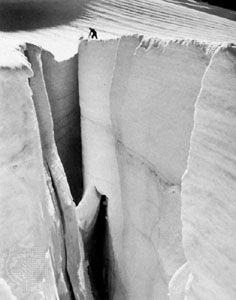
A crevasse is a deep fissure or crack that forms in a glacier due to stress caused by the ice’s movement. These features can reach up to 20 meters (65 feet) in width and 45 meters (148 feet) in depth.1
Crevasses are typically categorized by their orientation relative to the glacier’s flow:
- Longitudinal crevasses: Form in areas of compressive stress.1
- Transverse crevasses: Develop in areas of tensile stress and often curve downstream.1
- Marginal crevasses: Occur when the center of a glacier moves faster than its edges.1
- Bergschrund: A specific type of crevasse that forms between the cirque and the head of the glacier.1
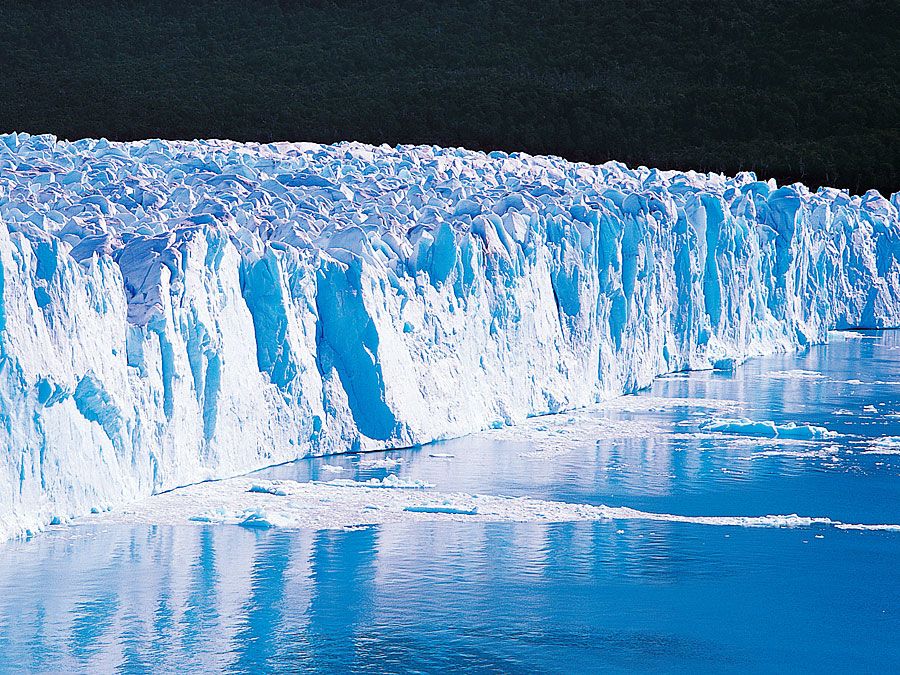
At a glacier’s terminus, intersecting crevasses can create jagged ice pinnacles known as seracs. Because they can be bridged and hidden by snow, they present significant hazards.1
What are seracs and how do they form?
A serac is a jagged pinnacle, sharp ridge, or block of ice found on the surface of a glacier on the surface of a glacier.54
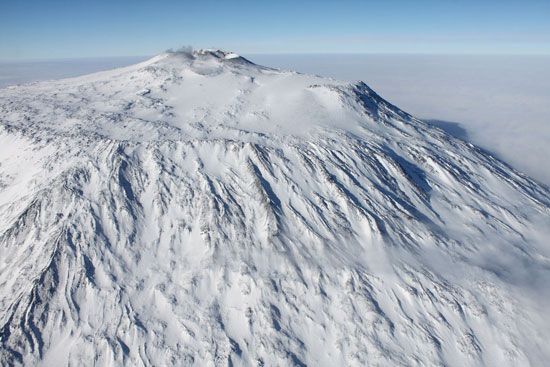
These formations occur when the glacier’s surface is broken into discrete segments by the intersection of multiple types of crevasses. Specifically, they often form when transverse crevasses (caused by tensile stress) and splaying crevasses (caused by transverse expansion) occur together, effectively chopping the ice into towers. They are frequently found at the terminus of a glacier or in areas where the ice is subjected to significant stress and deformation.15
The term itself has a unique etymology; it is derived from the French word sérac, which refers to a type of hard, white cheese, likely due to the visual resemblance between the icy blocks and the cheese. Because they create uneven and unstable terrain, areas characterized by dense fields of seracs are often considered nearly impossible to navigate.64
How do glaciers move over land?
Glaciers move over land primarily through two mechanisms driven by gravity: internal deformation and basal sliding.78
Internal Deformation
Because ice is a crystalline solid, it behaves like a fluid over long periods. Under the weight of the glacier and the influence of the surface slope, the ice undergoes creep—a process of plastic deformation where ice crystals shift and flow. This movement is governed by the Glen flow law, which states that the rate of shear strain is approximately proportional to the cube of the shear stress.98
Basal Sliding
Glaciers that are at the pressure-melting point (temperate glaciers) can slide along their beds. This occurs because a thin layer of liquid water often exists at the base, reducing friction. Two processes facilitate this movement over rough terrain:8710
- Plastic flow: Ice deforms around bedrock obstacles.9
- Regelation: Ice melts on the upstream side of an obstacle due to high pressure and refreezes on the downstream side.9
Additionally, some glaciers “ride” on a layer of water-charged sediment, which can lead to rapid, sometimes chaotic, movement.9
What is a bergschrund?
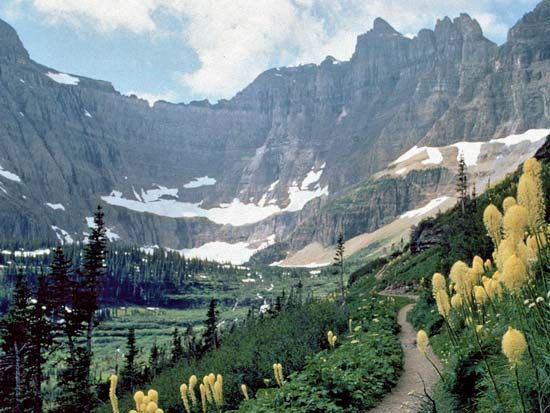
A bergschrund (from the German for “mountain crevice”) is a large crevasse or series of crevasses that forms near the head of a mountain glacier.121213
It serves as the critical boundary separating the stationary ice attached to the mountain slope from the moving ice of the glacier. During early summer, the bergschrund typically opens, exposing the rock at its base to daily temperature fluctuations. This exposure allows for frost action, which causes the rock to disintegrate and avalanche, ultimately carving out an amphitheatre-shaped basin known as a cirque. The debris resulting from this erosion is then incorporated into the glacier, where it acts as an abrasive agent to scour the valley floor.141
Because bergschrunds are essential to the formation of cirques, studying their locations and elevations provides valuable insights into historical climatic change and the past position of the snow line.14
Sources
- crevasse — Encyclopædia Britannica
- rifts — Merriam-Webster
- rift — Merriam-Webster
- glacier - Surface features — Encyclopædia Britannica
- serac — Merriam-Webster
- 8 Words with Fascinating Histories | Serac — Merriam-Webster
- hydrologic sciences - The movement of glaciers — Encyclopædia Britannica
- glacial landform - Moraines — Encyclopædia Britannica
- glacier - Flow of mountain glaciers — Encyclopædia Britannica
- glacier - Glacier flow — Encyclopædia Britannica
- glacial landform - Glacial erosion — Encyclopædia Britannica
- bergschrund — Encyclopædia Britannica
- bergschrund — Merriam-Webster
- cirque — Encyclopædia Britannica
Published on · 3 min read