Balkan Mountains
The Balkan Mountains, which serve as a major geographic and climatic divide across Bulgaria, feature several notable landmarks:
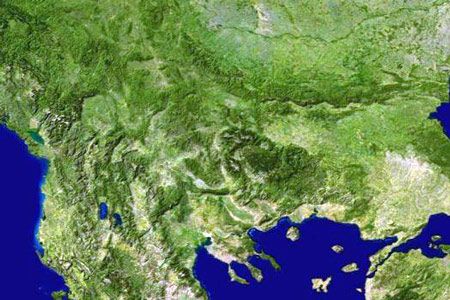
What are some of the notable peaks and passes in the Balkan Mountains?
The Balkan Mountains, which serve as a major geographic and climatic divide across Bulgaria, feature several notable landmarks:
Notable Peaks
- Botev: Standing at 7,795 feet (2,376 meters), this is the highest peak in the Balkan Mountains. It was formerly known as Yumrukchal until 1950.12
Notable Passes
- Shipka Pass: This is the most prominent of the approximately 20 passes that cross the range.1
While the mountains are no longer a significant barrier to travel, they remain a climatic divide between the continental climate of the Danube River valley to the north and the transitional climate to the south. During winter, deep snow cover can still make these routes difficult to traverse.1
What historical and cultural significance do the Balkan Mountains hold for the countries they span?
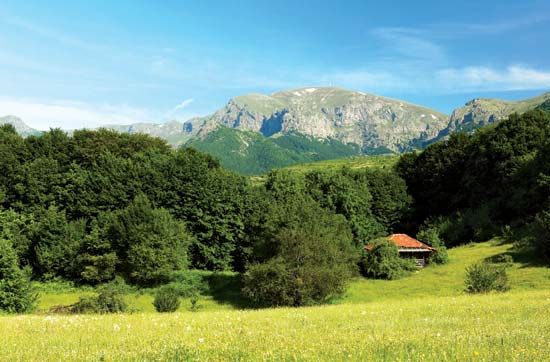
The Balkan Mountains hold profound historical and cultural significance, particularly for Bulgaria, where they serve as a defining geographic and national landmark.
Historical Significance
The range has long functioned as a strategic boundary. In 681 CE, the Byzantine Empire recognized the control of the Bulgars over the territory between the Balkan Mountains and the Danube River, marking the formal beginning of the Bulgarian state. Throughout the period of Ottoman rule, the mountains provided a degree of isolation for rural communities; some villages were granted self-governing status in exchange for guarding critical mountain passes, which helped preserve native leadership and local customs.16
Cultural Identity
In the 19th century, mountain towns such as Veliko Tŭrnovo became vital centers for the Bulgarian national revival. This movement sought to reclaim national consciousness against the cultural influence of the Greek patriarchate. The mountains are also the namesake of the Balkan Peninsula, with the term “Balkan” derived from the Ottoman Turkish word for “wooded mountain”. Today, the range remains a powerful symbol of national heritage, representing the rugged terrain that sheltered the traditions and identity of the people throughout centuries of political change.7896
How do the Balkan Mountains influence the climate and ecosystems of the surrounding regions?
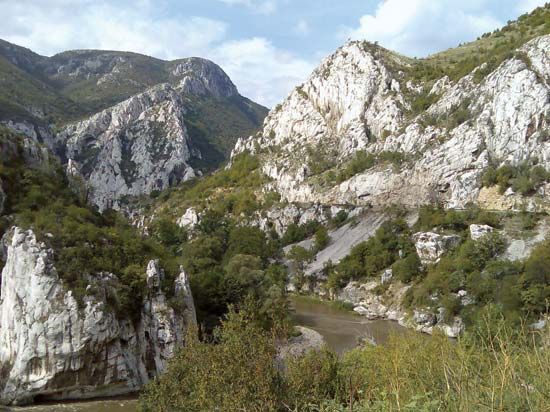
The Balkan Mountains serve as a critical climatic barrier that significantly influences the surrounding regions. By acting as a divide, the range separates the continental climate of the Danube River valley to the north from the transitional continental climate found to the south.10
Climatic Influence
- Temperature and Precipitation: The mountains experience long, severe winters with heavy snow cover and annual rainfall exceeding 40 inches (1,000 mm). This creates a distinct contrast between the northern regions, which feature cold winters and warm summers, and the southern and coastal areas, which are influenced by a Mediterranean climate characterized by hot, dry summers and mild, rainy winters.101
- Barrier Effect: The range effectively disrupts air mass movement, influencing the distribution of weather patterns across the Balkan Peninsula.110
Ecosystems
The elevation of the Balkan Mountains supports a diverse range of habitats, transitioning from high alpine meadows down to dense coniferous and deciduous forests. These forested zones and mountain slopes provide essential environments for various flora and fauna, contributing to the broader biodiversity of the region.1011
How were the Balkan Mountains formed, and what is their geological composition?
The Balkan Mountains are a prominent geological feature formed as part of the Alpine orogeny, a major mountain-building event during the Cenozoic Era. This process was primarily driven by the northward compression of the African plate into Europe, which resulted in the folding and uplift of the region’s crustal structures.1
Geological Formation
The range is classified as an extension of the Alpine-Carpathian folds. The geological history of the area is deeply linked to the evolution of the Tethys Sea. During the Mesozoic Era, the fragmentation of carbonate shelves and the subsequent subduction of the ocean floor led to the creation of complex tectonic mosaics. Slabs of the ancient ocean floor were thrust onto continental margins as ophiolites, remnants of which are still found within the Balkan region today.131
Geological Composition
The mountains are composed of diverse rock types and contain significant mineral resources, including:
- Metallic Ores: The region is known for deposits of chromite ores, which are associated with the ophiolitic structures.1
- Energy Resources: The range contains bituminous and anthracite coal, as well as graphite.13
- Other Features: The geological structure also supports the presence of thermal and mineral springs throughout the range.13
Sources
- Balkan Mountains — Encyclopædia Britannica
- Botev — Encyclopædia Britannica
- Rhodope Mountains — Encyclopædia Britannica
- Rila — Encyclopædia Britannica
- Šar Mountains — Encyclopædia Britannica
- history of Bulgaria - Cultural movement against Greek influence — Encyclopædia Britannica
- Balkans - Creating national identities — Encyclopædia Britannica
- Bulgaria - Arrival of the Bulgars — Encyclopædia Britannica
- Did you know? — Merriam-Webster
- Balkans: Top Questions — Encyclopædia Britannica
- Greece - Plant and animal life — Encyclopædia Britannica
- Bulgaria - North Bulgaria — Encyclopædia Britannica
- Europe - Mesozoic and Cenozoic eras — Encyclopædia Britannica
- Europe - Elevations — Encyclopædia Britannica
- Balkans — Encyclopædia Britannica
Published on · 3 min read