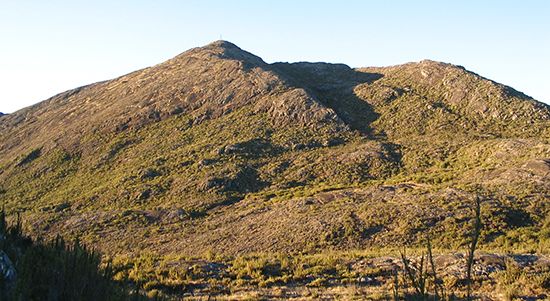
Bandeira Peak
Bandeira Peak is a prominent mountain located on the border of the Espírito Santo and Minas Gerais states in eastern Brazil. Situated within the Caparaó…
What is Bandeira Peak?
Bandeira Peak is a prominent mountain located on the border of the Espírito Santo and Minas Gerais states in eastern Brazil. Situated within the Caparaó mountain range and the broader Brazilian Highlands, the peak reaches an elevation of 9,482 feet (2,890 meters).123
It lies approximately 100 miles (160 km) inland from the coastal city of Vitória. While it was historically considered the highest point in Brazil, that distinction has belonged to Neblina Peak (9,888 feet [3,014 meters]) since its discovery in 1962. Today, Bandeira Peak remains one of the highest summits in the country.13
What is the highest mountain in Brazil?
The highest mountain in Brazil is Neblina Peak. Located in the Imeri Mountains within the state of Amazonas near the Venezuelan border, it reaches an elevation of 9,888 feet (3,014 meters) above sea level.4
Prior to the discovery of Neblina Peak in 1962, Bandeira Peak was widely considered to be the highest point in the country.41
What are the main mountain ranges found in the Brazilian Highlands?
The Brazilian Highlands are characterized by a complex system of plateaus and mountain ranges. A massive escarpment marks the eastern edge of the highlands, extending approximately 1,600 miles along the Atlantic coast and forming several significant ranges.52
Major Coastal and Eastern Ranges
- Serra do Mar: The largest segment of the eastern escarpment, extending from southeastern Minas Gerais to Paraná. Near Rio de Janeiro, it is known as the Serra dos Órgãos.
- Serra da Mantiqueira: Located north of the Serra do Mar, this range contains some of the highest elevations in the region, including Bandeira Peak and Agulhas Negras Peak.
- Serra do Espinhaço: Extends from central Minas Gerais into southern Bahia.
- Chapada Diamantina: A prominent upland region in Bahia.
- Serra dos Aimorés: Located along the border of Minas Gerais and Espírito Santo.
Interior and Northern Ranges
- Serra Geral de Goiás: Separates Goiás and Tocantins from Bahia.
- Serra dos Carajás: A mineral-rich range in eastern Pará.
- Chapada dos Parecis: Stretches between Rondônia and Mato Grosso.
How do mountain ranges like the Serra do Mar influence Brazil’s coastal geography?
The Serra do Mar and its associated ranges exert a profound influence on Brazil’s coastal geography and development in several key ways:
- Topographic Barrier: Historically, the Serra do Mar served as a formidable physical barrier that hindered the expansion of settlement and infrastructure from the Atlantic coast into the Brazilian interior until the construction of railroads in the 19th century.6
- Climate and Precipitation: The escarpment plays a critical role in regional weather patterns. The sea-facing rim of the range experiences significantly heavier annual precipitation compared to other regions, as the mountains force moist air masses to rise and condense.7
- Urban Landscape: In cities like Rio de Janeiro, the coastal mountains act as natural dividers. Offshoots of the Serra do Mar isolate different zones of the city, such as the South Zone, from the central and northern plains, creating distinct urban pockets that have historically required tunnels and roads to connect.2
- Geological Character: The range presents a dramatic, sheer face to the sea, contributing to iconic coastal landmarks such as Sugar Loaf and the rugged topography that defines much of the southeastern coastline.82
Sources
- Bandeira Peak — Encyclopædia Britannica
- Brazil - Brazilian Highlands — Encyclopædia Britannica
- South America - The plateaus — Encyclopædia Britannica
- Neblina Peak — Encyclopædia Britannica
- Brazilian Highlands — Encyclopædia Britannica
- Serra do Mar — Encyclopædia Britannica
- Brazil - Climate of Brazil — Encyclopædia Britannica
- Rio de Janeiro - City site — Encyclopædia Britannica
- Acaraí Mountains — Encyclopædia Britannica
- Brazil - Conservation and ecology — Encyclopædia Britannica
Published on · 2 min read