Beata Ridge
The Beata Ridge is a submarine ridge located on the floor of the southern Caribbean Sea. It trends south-southwest from Beata Cape on the island of…
What is Beata Ridge?
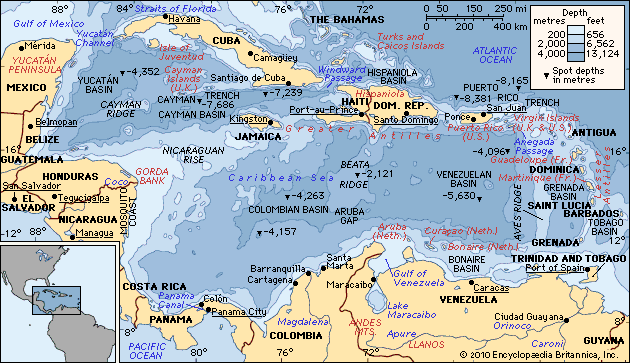
The Beata Ridge is a submarine ridge located on the floor of the southern Caribbean Sea. It trends south-southwest from Beata Cape on the island of Hispaniola and serves as a geographic divider, separating the sea into two distinct regions: the Colombian and Venezuelan abyssal plains.1
The ridge is truncated by the Aruba Gap before it can reach the continental slope of South America. Geologically, the ridge was formed by gentle warping and faulting near the end of the second phase of sedimentation in the Caribbean basin. The surface of the ridge is characterized by deposits of pteropod ooze.12
What are abyssal plains?
An abyssal plain is a vast, remarkably flat area of the seafloor located at depths ranging from 3,000 to 6,000 meters (10,000 to 20,000 feet). These plains are typically found adjacent to a continent and are characterized by an extremely low gradient, varying in depth by only 10 to 100 centimeters per kilometer.3
The formation of these plains is primarily driven by the accumulation of land-derived sediment, which fills in and smooths out the underlying irregular topography. This process is heavily influenced by turbidity currents—dense, sediment-laden slurries that flow down continental slopes due to gravity, depositing layers of silt, sand, and gravel across the abyssal floor. Between these events, fine-grained clay and the remains of microscopic organisms, such as Foraminifera, settle slowly through the water column.3
Abyssal plains are most common in the Atlantic Ocean and least common in the Pacific, where they are often restricted to marginal seas or trenches.3
How do submarine ridges form on the ocean floor?
Submarine ridges are formed through distinct geological processes, primarily categorized into those associated with the global oceanic ridge system and those of volcanic or tectonic origin.
Oceanic Ridges (Spreading Centres)
The most prominent submarine ridges are part of an interconnected 80,000-km-long system created by plate tectonics. These ridges form at spreading centres where lithospheric plates diverge.567
- Magma Upwelling: As plates move apart, molten rock from the mantle rises to fill the gap, solidifying to create new oceanic crust.58
- Thermal Expansion: The crust near these spreading centres is warm and thermally expanded, causing the ridge to rise 2 to 3 km above the surrounding seafloor.57
- Cooling and Contraction: As the crust moves away from the ridge, it cools and contracts, causing the seafloor to deepen over time.9
Aseismic Ridges
Unlike the seismically active oceanic ridges, aseismic ridges have different origins, primarily volcanic activity. These features, such as the Ninetyeast Ridge, are often formed by volcanic processes that are not directly linked to current plate divergence. Additionally, some ridges, known as accretionary prisms, are constructed from sediments scraped off a descending plate at subduction zones.561011
What is the difference between the Caribbean Sea and the Atlantic Ocean?
The Caribbean Sea is a suboceanic basin of the western Atlantic Ocean, defined by its unique geographic and hydrological characteristics. While it is part of the broader Atlantic system, the two bodies of water differ in several key ways:
- Geography: The Caribbean is a semi-enclosed sea bounded by the coasts of Central and South America to the south and west, and the Greater Antilles and Lesser Antilles island arcs to the north and east.12
- Hydrology and Temperature: The Caribbean’s bottom water is significantly warmer, at approximately 39 °F (4 °C), compared to the Atlantic’s bottom temperature of less than 36 °F (2 °C). This is because the shallow sills of the Antillean arc block the entry of colder Antarctic bottom water.13
- Sea Level: Wind-driven surface water accumulates in the Caribbean and the Gulf of Mexico, resulting in a higher average sea level than in the open Atlantic, which helps drive the Gulf Stream.13
- Ecosystems: While the Atlantic features vast areas of continental shelf and diverse plankton-rich regions, the Caribbean is specifically noted for its extensive coral reefs, which support distinct assemblages of marine life.1415
Sources
- Beata Ridge — Encyclopædia Britannica
- Caribbean Sea - Geology — Encyclopædia Britannica
- abyssal plain — Encyclopædia Britannica
- abyssal plain — Merriam-Webster
- ocean basin - General features — Encyclopædia Britannica
- seafloor spreading — Encyclopædia Britannica
- plate tectonics - Seafloor spreading — Encyclopædia Britannica
- deep-sea trench - Structure — Encyclopædia Britannica
- Indian Ocean - Oceanic ridges and fracture zones — Encyclopædia Britannica
- oceanic ridge - Principal characteristics — Encyclopædia Britannica
- oceanic ridge — Encyclopædia Britannica
- Caribbean Sea — Encyclopædia Britannica
- Caribbean Sea - Hydrology — Encyclopædia Britannica
- Caribbean Current — Encyclopædia Britannica
- Caribbean Sea - Resources — Encyclopædia Britannica
- Atlantic Ocean - Biological resources — Encyclopædia Britannica
Published on · 3 min read