Barbary Macaque
The Barbary macaque (Macaca sylvanus) is a tailless, ground-dwelling monkey native to the upland forests of Algeria, Tunisia, and Morocco. It is also…
What is Barbary macaque?
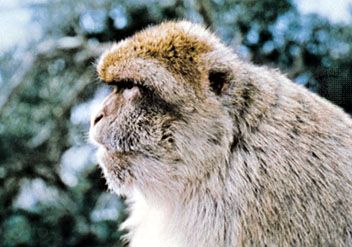
The Barbary macaque (Macaca sylvanus) is a tailless, ground-dwelling monkey native to the upland forests of Algeria, Tunisia, and Morocco. It is also famously found in Gibraltar, where it was introduced, likely by the Romans or the Moors.1
Key characteristics include:
- Appearance: They grow to about 60 cm (24 inches) in length, featuring light yellowish-brown fur and a bald, pale pink face. Adult males typically weigh 16 kg (35 pounds), while females weigh about 11 kg.1
- Classification: As a macaque, it is an Old World monkey. Because it lacks a tail, it is sometimes incorrectly referred to as the “Barbary ape”.12
- Significance: It is the only macaque species found outside of Asia and the only wild monkey currently inhabiting Europe. According to local legend, British control over the Rock of Gibraltar depends on the continued presence of these macaques.21
Why are Barbary macaques often incorrectly called Barbary apes?
The Barbary macaque (Macaca sylvanus) is frequently called the “Barbary ape” because it lacks a visible tail, a physical trait that often leads to confusion between monkeys and apes.1
In biological terms, the presence or absence of a tail is a primary, though simplified, way to distinguish between these two groups of primates. While almost all monkey species possess tails, apes do not. Because the Barbary macaque is a tailless, ground-dwelling monkey, its appearance mimics the general body plan of an ape, leading to the common—but taxonomically incorrect—misnomer.516
It is important to note that the Barbary macaque is a true macaque, belonging to the family Cercopithecidae, which classifies it as an Old World monkey rather than a member of the Hominoidea superfamily that includes apes and humans.75
How do Old World monkeys differ from New World monkeys?
Old World and New World monkeys are distinguished by several key anatomical and evolutionary differences:
Physical Characteristics
- Nose Structure: New World monkeys are platyrrhines, meaning they have broad, flat noses with a wide septum and outwardly directed nostrils. Old World monkeys are catarrhines, possessing narrow noses with a thin septum and downward-facing nostrils, a trait they share with apes and humans.2
- Sitting Pads: Old World monkeys have hard, bare “sitting pads” (ischial callosities) on their buttocks, which are absent in New World monkeys.2
- Manual Dexterity: Many Old World monkeys have opposable thumbs, allowing for precise manipulation of objects. New World monkeys lack this level of manual dexterity; in many species, the thumb is reduced or absent, and the main divergence in the hand is between the index and middle fingers.2
- Tails: Some New World monkeys possess prehensile tails capable of grasping objects or supporting their entire body weight. No Old World monkeys have this ability, and some, such as macaques, are nearly tailless.2
Dental Differences
Primates have evolved to reduce the number of teeth over time. While New World monkeys have retained three premolars on each side of each jaw, Old World monkeys and apes have only two.8
Geographic and Ecological Distribution
- New World Monkeys: Found primarily in the tropical forests of Central and South America.29
- Old World Monkeys: Inhabit a wide range across Africa and Asia, from Afghanistan to Japan, with some species naturalized in other regions like Gibraltar.2
What other primates are known to live in cold or snowy climates?
While most nonhuman primates are restricted to tropical latitudes, several species have adapted to live in cold, mountainous, or snowy environments. These primates utilize various behavioral and physiological strategies to survive in regions where temperatures frequently drop below freezing.10
Notable primates found in cold or snowy climates include:
- Japanese Macaque (Macaca fuscata): Perhaps the most famous cold-climate primate, this species lives in the mountains of northern Honshu, where snow covers the ground for up to eight months of the year. Some populations have adapted to these harsh conditions by spending significant time in volcanic hot springs to maintain their body temperature.10
- Snub-nosed Monkeys (Rhinopithecus): Several species in this genus are highly adapted to high-altitude, cold environments. The golden snub-nosed monkey inhabits coniferous forests in central China at elevations up to 2,700 metres, while the black snub-nosed monkey lives at elevations up to 4,500 metres in forests that are snow-covered for much of the year. In these regions, temperatures often remain at or below freezing during the day.1110
- Tibetan Macaque (M. thibetana): This species is found in the cold mountains of Sichuan, China, demonstrating a range that extends from warm coastal areas into high-altitude, frigid environments.10
- Barbary Macaque (Macaca sylvanus): This primate inhabits the temperate forests of the Atlas Mountains in Morocco and Algeria, where it faces seasonal cold.10
Sources
- Barbary macaque — Encyclopædia Britannica
- monkey - Old World monkeys versus New World monkeys — Encyclopædia Britannica
- primate - Distribution and abundance — Encyclopædia Britannica
- monkey — Encyclopædia Britannica
- Barbary ape — Merriam-Webster
- primate - Classification — Encyclopædia Britannica
- What’s the Difference Between Monkeys and Apes? — Encyclopædia Britannica
- monkey - Classification — Encyclopædia Britannica
- primate - Teeth — Encyclopædia Britannica
- snub-nosed monkey — Encyclopædia Britannica
- Thermoreception - Behaviour and thermoregulation — Encyclopædia Britannica
- Biosphere - Temperature — Encyclopædia Britannica
- primate - Forest and savanna — Encyclopædia Britannica
Published on · 4 min read