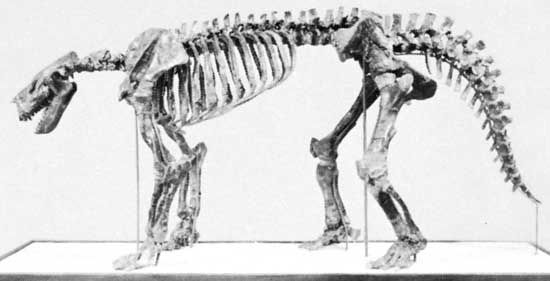
Basilosaurus
Basilosaurus is an extinct genus of primitive, fully aquatic whales that lived during the Eocene Epoch, approximately 55.8 to 33.9 million years ago.…
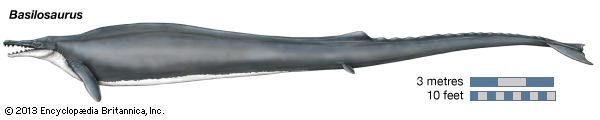
What is Basilosaurus?
Basilosaurus is an extinct genus of primitive, fully aquatic whales that lived during the Eocene Epoch, approximately 55.8 to 33.9 million years ago. Although its name translates to “king lizard,” it was a mammal, not a reptile; it was initially misclassified as a lizard when first discovered.12
These animals were characterized by slender, elongated bodies, with tails that could account for up to three-quarters of their total length. They reached lengths of up to 21 meters (about 70 feet) and possessed small, non-weight-bearing hind limbs that were likely vestigial or used for mating. Unlike modern whales, Basilosaurus had primitive, triangular, serrated teeth and a long, narrow skull.12
As members of the family Basilosauridae, they were the first widespread group of whales to be fully adapted to life in the water, unable to haul themselves onto land. Their fossils have been primarily recovered in North America, Egypt, and northern Africa.21
Why was Basilosaurus originally mistaken for a lizard?
Basilosaurus was originally mistaken for a lizard because of its initial classification when the first specimen was described. Its scientific name, which translates to “king lizard,” reflects this early misidentification based on its appearance at the time of discovery.13
The confusion stemmed from the animal’s unique morphology, which differs significantly from modern whales. Basilosaurus possessed an elongated, slender body and a long tail that made up about three-quarters of its total length, features that led early observers to associate it with reptilian characteristics rather than mammalian ones. Despite this historical error, it is now well-established that Basilosaurus was a primitive, fully aquatic mammal belonging to the family Basilosauridae.21
How did the transition from land-dwelling ancestors to fully aquatic whales occur?
The transition from land-dwelling ancestors to fully aquatic cetaceans is documented by a series of transitional fossils that illustrate a remarkable evolutionary shift.
Early cetaceans, such as the 48.5-million-year-old Pakicetus, were terrestrial mammals that possessed functional legs and an auditory system adapted for hearing in air. Despite these land-based features, their teeth and the location of their fossils in river delta deposits suggest they spent significant time hunting in water.
Over time, these archaeocetes underwent profound physiological changes:
- Locomotion: As they moved from four-legged terrestrial movement to swimming, they shifted from horizontal limb movement to vertical strokes driven by powerful back muscles.6
- Anatomy: Forelimbs evolved into finlike flippers, while hind limbs were eventually lost, leaving only internal vestigial remnants.6
- Specialization: Features like external ears were lost, and genitalia moved internally to streamline the body for aquatic life.6
By the late Eocene, groups like the Basilosauridae had become fully aquatic, setting the stage for the emergence of modern baleen and toothed whales.74
What purpose did the small hind limbs of Basilosaurus serve?
The purpose of the small hind limbs found on Basilosaurus remains a subject of scientific debate, as their exact function is not fully understood. Because these limbs were not connected to the rest of the skeleton, they were likely too small to have assisted the animal in swimming.3
While it is possible that the limbs were completely atrophied, some evidence suggests they may have retained a function. The presence of well-formed joints and signs of muscle attachments on the bones indicate they could have been functional in some capacity. One prominent theory is that these hind limbs served as claspers, helping to guide the long bodies of males and females into position during mating.3
Regardless of their utility, these limbs represent a vestigial link to the animal’s terrestrial ancestry, as Basilosaurus was a member of the Basilosauridae family, which were among the first fully aquatic whales.3
Sources
- Basilosaurus — Encyclopædia Britannica
- Basilosaurus — Merriam-Webster
- basilosaurid — Encyclopædia Britannica
- cetacean - Paleontology — Encyclopædia Britannica
- cetacean - Classification — Encyclopædia Britannica
- Pakicetus — Encyclopædia Britannica
- cetacean - Locomotor adaptations — Encyclopædia Britannica
- transitional fossil — Merriam-Webster
- reptile - Historical development — Encyclopædia Britannica
Published on · 3 min read