Batfish
A batfish is any of approximately 60 species of fish belonging to the family Ogcocephalidae, which is part of the order Lophiiformes (the group that includes…
What is batfish?
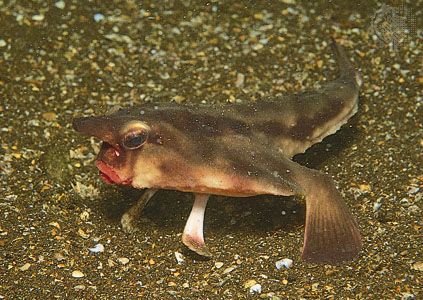
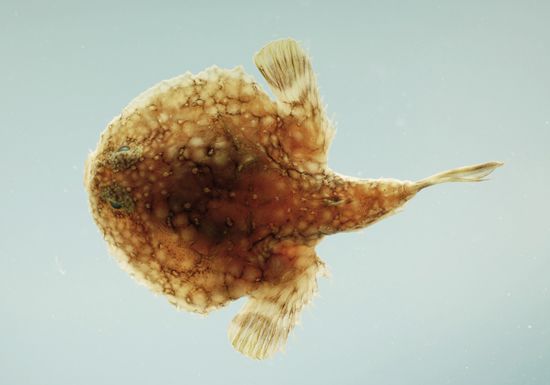
A batfish is any of approximately 60 species of fish belonging to the family Ogcocephalidae, which is part of the order Lophiiformes (the group that includes anglerfish). These fish are found in warm and temperate seas, primarily in the deep sea, though some species inhabit shallow waters.12
Physically, batfishes are characterized by broad, flat heads, slim bodies, and skin covered in hard lumps and spines. Some species possess an elongated, upturned snout. They are generally small, growing to a maximum length of about 36 cm (14 inches).1
As poor swimmers, batfishes typically move by walking along the seafloor using their thickened, limblike pectoral and pelvic fins. When disturbed, they often bury themselves in the bottom rather than attempting to swim away. Like other anglerfish, they are equipped with a specialized “fishing pole” apparatus located above their small mouth, which is tipped with a fleshy “bait” to lure prey. Unlike other anglers, this apparatus can be retracted into a recess when not in use.12
How do anglerfish use their lures to catch prey?
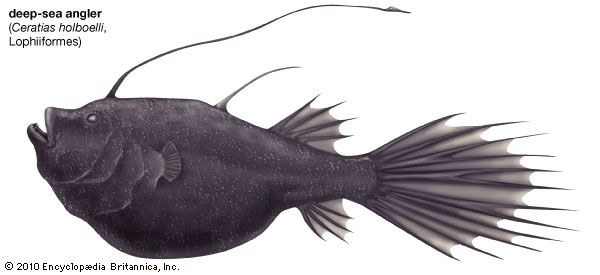
Anglerfish are named for their unique method of hunting, which involves a specialized “fishing” apparatus. The foremost spine of the dorsal fin is modified into an elongated rod that extends over the fish’s head, tipped with a fleshy “bait” used to attract prey.56
In many deep-sea species, this lure is bioluminescent, emitting light to draw the attention of unsuspecting prey in the darkness of the ocean depths. When a smaller fish or invertebrate approaches the glowing or fleshy lure, it strays close enough for the anglerfish to engulf it within its large jaws.56
While the angling apparatus is a defining feature of the order Lophiiformes, its presence and function can vary. For instance, in deep-sea anglers, only the females possess this rod, which can range from simple to highly ornate in structure. Once the prey is within range, the anglerfish uses its large mouth to capture it, sometimes consuming prey larger than itself.6
What are some other examples of fish that walk on the ocean floor?
Beyond the batfish, several other fish species have adapted to move along the ocean floor or substrate using specialized fins or body movements:
- Sea robins: These bottom-dwelling fish possess fan-shaped pectoral fins where the bottom few rays are separated into distinct, finger-like feelers. They use these appendages to “walk” across the seafloor while simultaneously sensing for prey like crustaceans and mollusks.8
- Frogfishes: As members of the anglerfish order, these fish often lie quietly on the bottom or use their limblike pectoral fins to crawl slowly along the substrate.7
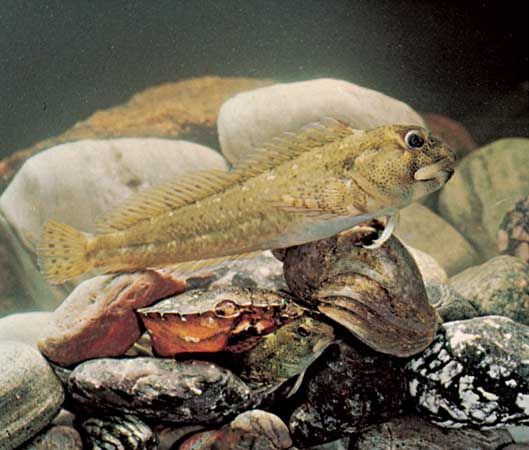
- Mudskippers: While they are famous for their ability to move on land in mangrove swamps and mud flats, these gobies use their strong pectoral fins to walk, climb, and skip about outside of the water.89
- Gobies: Many bottom-dwelling gobies move by darting from place to place, resting on the substrate between short bursts of movement.8
Why do some deep-sea fish have light-producing organs?
Deep-sea fish utilize light-producing organs, known as photophores, as a vital survival strategy in the darkness of the ocean depths. These organs serve several essential functions:
- Predation: Many species, such as anglerfishes, use bioluminescent lures to attract unsuspecting prey directly toward their jaws.513
- Counter-illumination: By emitting light downward from their ventral surfaces, many deep-sea fishes match the intensity of sunlight filtering from above. This effectively obliterates their silhouette, concealing them from predators lurking below—a specialized form of countershading.514
- Communication and Recognition: Distinctive patterns of light organs allow individuals to identify members of their own species or sex, which is crucial for schooling and mating.513
- Defense: Some organisms use light to frighten predators or to disguise their form, making it difficult for enemies to identify them.5
The light produced is typically blue-green, as this wavelength transmits most efficiently through seawater and is most visible to deep-sea life.13
Sources
- batfish — Encyclopædia Britannica
- paracanthopterygian - Annotated classification — Encyclopædia Britannica
- paracanthopterygian - Ecology and behavior — Encyclopædia Britannica
- chondrichthyan - Rays — Encyclopædia Britannica
- Bioluminescence - The role of bioluminescence in behavior — Encyclopædia Britannica
- anglerfish — Encyclopædia Britannica
- fish - Locomotion — Encyclopædia Britannica
- sea robin — Encyclopædia Britannica
- frogfish — Encyclopædia Britannica
- ostariophysan - Swimming — Encyclopædia Britannica
- Locomotion - Tetrapodal vertebrates — Encyclopædia Britannica
- mudskipper — Encyclopædia Britannica
- Marine bioluminescence — Encyclopædia Britannica
- coloration - Countershading — Encyclopædia Britannica
Published on · 3 min read