Anglerfish
Anglerfish play a significant role as specialized predators within their marine ecosystems. Their primary ecological function is that of a carnivore…
What role do anglerfish play in their ecosystem?
Anglerfish play a significant role as specialized predators within their marine ecosystems. Their primary ecological function is that of a carnivore, utilizing a unique evolutionary adaptation to secure food in environments where resources may be scarce.123
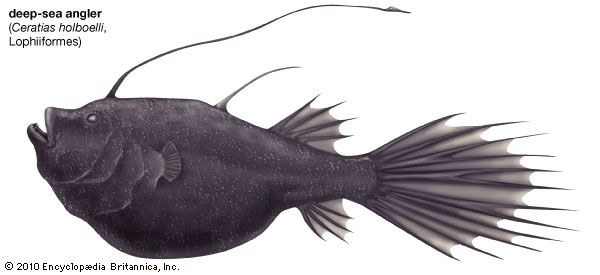
The most distinct feature of the anglerfish is its “fishing rod”—a modified dorsal fin spine tipped with a fleshy, often bioluminescent “bait”. By dangling this lure, they attract unsuspecting prey, such as various fishes and invertebrates, directly toward their large, powerful jaws. This method allows them to capture prey efficiently, with some deep-sea species capable of swallowing organisms larger than themselves.1425
Beyond their role as predators, some deep-sea anglerfish exhibit a remarkable reproductive strategy: in three families, males live as permanent parasites on females. The male attaches to the female, their bloodstreams fuse, and he becomes entirely dependent on her for nourishment. This extreme biological relationship is a defining characteristic of their life cycle and reproductive success in the deep-sea environment.16
How does the anglerfish’s bioluminescent lure work, and what purpose does it serve?
The bioluminescent lure of the deep-sea anglerfish is a specialized evolutionary adaptation that serves as a highly effective hunting tool in the darkness of the deep ocean.21
How the Lure Works
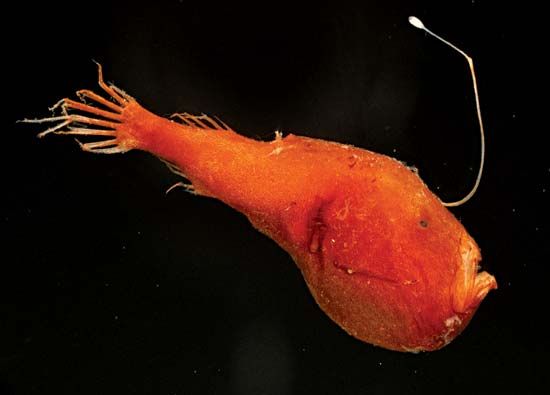
The anglerfish’s “fishing rod” is actually a modified first dorsal spine that has migrated to the top of the head. At the end of this rod dangles a fleshy, luminous organ known as a “bait” or esca. In many species, this light is produced intracellularly by special cells called photocytes, though some species may harbor symbiotic luminous bacteria within the organ to generate light. The structure of these organs can range from simple to highly ornate, depending on the species.217
Purpose of the Lure
The primary purpose of the lure is to attract prey, such as various fishes and invertebrates. By dangling the glowing bait, the anglerfish draws unsuspecting prey toward its large, powerful jaws. Once the prey is within range, the anglerfish can engulf it, sometimes consuming organisms larger than itself. This mechanism is essential for survival in the deep-sea environment, where food resources are often scarce.21
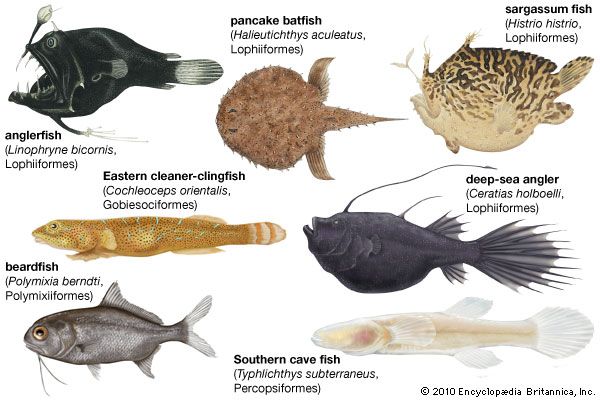
What are some of the different species of anglerfish, and how do they vary?
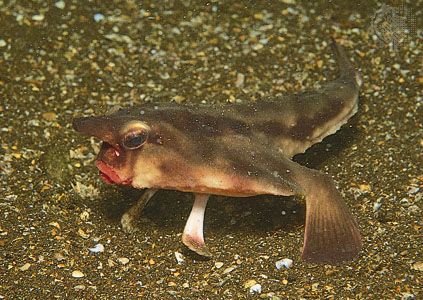
Anglerfish belong to the order Lophiiformes, which includes approximately 210 species divided into four primary groups: batfish, goosefish, frogfish, and deep-sea angler.1
Key Variations Among Groups
- Habitat and Movement: Most anglerfish are bottom-dwelling (benthic) species that possess limblike pectoral fins to navigate the sea floor. In contrast, deep-sea anglers (superfamily Ceratioidea) are mid-water swimmers that lack pelvic fins and inhabit extreme ocean depths.18
- Size: While most anglerfish are about 30 centimeters (1 foot) long, there is significant variation. The European monkfish (Lophius piscatorius) can reach lengths of up to 2 meters (6.6 feet), whereas deep-sea species typically grow up to 1.2 meters (4 feet).2
- Reproductive Strategies: A defining variation among deep-sea anglers is sexual dimorphism and parasitism. Females are significantly larger than males—often 3 to 13 times their size. In three families of deep-sea anglers, males live as permanent parasites; they bite the female, fuse their tissues and circulatory systems, and become entirely dependent on her for nourishment.412
- The Lure: While all anglerfish use a modified dorsal fin spine as a “fishing rod,” the “bait” (esca) varies from simple to highly ornate. In deep-sea species, this lure is almost always bioluminescent, a feature not found in all other angler groups.14
What are the mating habits of anglerfish, and how do they differ from other fish species?
The mating habits of deep-sea anglerfish are distinct from most other fish species, which typically rely on external fertilization where eggs and sperm are scattered in the water column.1
In contrast, deep-sea anglerfish exhibit extreme sexual dimorphism, with males being significantly smaller than females and lacking the characteristic “fishing rod” angling apparatus. In three families of these deep-sea species, the mating process involves a unique form of sexual parasitism. The male attaches himself to the female by biting into her skin. Over time, his mouth fuses with her body, and their bloodstreams become connected. The male then becomes entirely dependent on the female for nourishment, effectively living as a permanent parasite.510
While many other fish species engage in elaborate courtship behaviors, nest building, or long-distance migrations to spawn, the deep-sea angler’s strategy is an evolutionary adaptation to the scarcity of mates and resources in the deep-ocean environment.51
Sources
- anglerfish — Encyclopædia Britannica
- Bioluminescence - The role of bioluminescence in behavior — Encyclopædia Britannica
- Marine bioluminescence — Encyclopædia Britannica
- deep-sea fish — Encyclopædia Britannica
- How big are anglerfish compared to humans? — Encyclopædia Britannica
- goosefish — Encyclopædia Britannica
- Bioluminescence - The range and variety of bioluminescent organisms — Encyclopædia Britannica
- paracanthopterygian - Annotated classification — Encyclopædia Britannica
- paracanthopterygian - Life cycle and reproduction — Encyclopædia Britannica
- fish - Reproduction — Encyclopædia Britannica
Published on · 4 min read