Batodonoides
Batodonoides is a genus of extinct insectivorous mammals that lived during the Eocene Epoch, approximately 56 to 33.9 million years ago. Classified within…
What is Batodonoides?
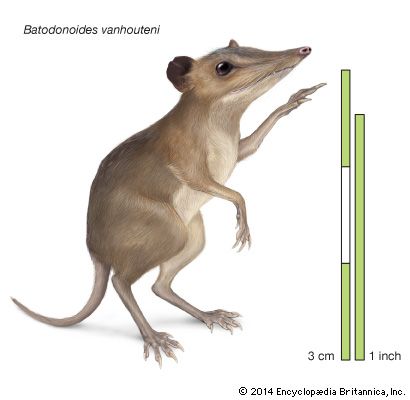
Batodonoides is a genus of extinct insectivorous mammals that lived during the Eocene Epoch, approximately 56 to 33.9 million years ago. Classified within the extinct family Geolabididae, these creatures were likely terrestrial and capable of climbing.1
The species Batodonoides vanhouteni is notable for potentially being the smallest mammal to have ever lived. Based on fossilized molar teeth, researchers estimate its body mass at 0.93–1.82 grams, which is smaller than the bumblebee bat, the smallest living mammal. Because of its tiny size, Batodonoides faced significant physiological challenges in maintaining a constant body temperature, as its high surface-area-to-volume ratio caused rapid heat loss. It likely thrived by living in the tropical climates of the Eocene.1
What is the Eocene Epoch?
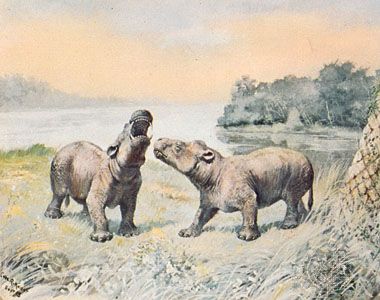
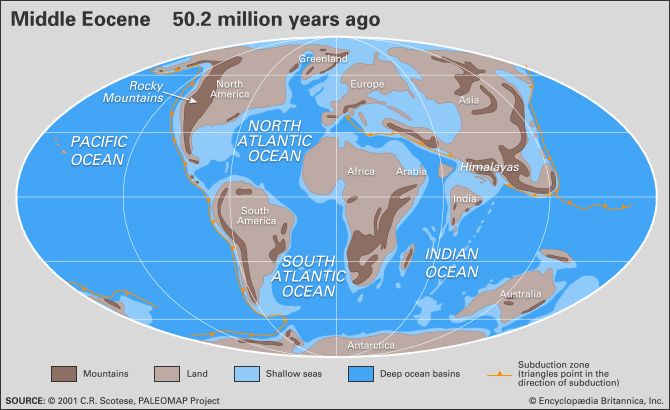
The Eocene Epoch was the second of three major divisions of the Paleogene Period, spanning from 56 million to 33.9 million years ago. Its name is derived from the Greek word eos (“dawn”), reflecting the significant appearance and diversification of many modern biological groups, particularly mammals and mollusks.2
The epoch was characterized by a warm and humid climate, with widespread temperate and subtropical forests. Early in the epoch, the Earth experienced the Paleocene-Eocene Thermal Maximum, a period of intense global warming.23
Key evolutionary developments during the Eocene include:
- Terrestrial Vertebrates: The emergence of perissodactyls (odd-toed ungulates like horses, rhinoceroses, and tapirs) and artiodactyls (even-toed ungulates like cattle and deer).2
- Marine Life: The first appearance of fully marine mammals, including cetaceans (whales, porpoises, and dolphins) and sirenians.2
- Other Groups: The appearance of early bats, elephant-like animals, and modern bird orders.2
How do scientists estimate the size of extinct animals?
Scientists estimate the body mass of extinct animals by analyzing the statistical relationships between fossilized structures and the known characteristics of living relatives.1
Key methods include:
- Dental Analysis: Researchers often use the size of teeth, such as the lower first molars, to infer body mass. This is possible because the dimensions of these structures often correlate with the overall size of the animal.15
- Limb Bone Measurements: Weight-bearing bones, particularly the femur, are frequently used to calculate mass. By measuring the diameter of these bones, scientists can estimate the weight the skeleton was adapted to support.5
- Allometric Scaling: This field of biology studies how biological variables, such as metabolic rate or bone dimensions, change in relation to body size. Using allometric equations—often expressed in the form Y=aMbY = aM^b—scientists can predict body mass based on the scaling of specific anatomical features.6
- Growth Rings: For some vertebrates, scientists can determine the age and growth history of an individual by counting annual growth rings in long bones, similar to tree rings, which helps reconstruct the animal’s size at different life stages.7
What challenges do tiny mammals face to stay warm?
Tiny mammals face significant challenges in maintaining a stable body temperature because their small size results in a high surface-area-to-volume ratio, which causes them to lose body heat to the environment much faster than larger animals. As endotherms, they must generate internal heat to maintain homeostasis, a process that requires a high and constant intake of food to fuel their elevated metabolic rates constant intake of food to fuel their elevated metabolic rates.91011
To manage these energy demands, many tiny mammals employ several strategies:
- Metabolic Heat Generation: They produce internal warmth through muscle shivering or the oxidation of brown adipose tissue.9
- Insulation: Dense fur helps trap air near the skin, creating a warmer microclimate and reducing heat loss to the environment.9
- Behavioral Adjustments: They may seek out protected sites like burrows or crevices to escape extreme temperatures and wind chill.129
- Torpor and Hibernation: To conserve energy when food is scarce or temperatures are extreme, many species enter torpor—a state where they lower their body temperature and metabolic rate. Some species undergo hibernation, an extended form of torpor that allows them to survive long periods without active thermoregulation.121013
Sources
- Batodonoides — Encyclopædia Britannica
- Eocene Epoch — Encyclopædia Britannica
- Paleocene-Eocene Thermal Maximum — Encyclopædia Britannica
- Paleocene Epoch — Encyclopædia Britannica
- Phoberomys — Encyclopædia Britannica
- tyrannosaur - Other skeletal features — Encyclopædia Britannica
- allometry — Encyclopædia Britannica
- rodent - General features — Encyclopædia Britannica
- bat - Thermoregulation — Encyclopædia Britannica
- Dormancy - Energy conservation — Encyclopædia Britannica
- How do sea otters stay warm? — Encyclopædia Britannica
- Biosphere - Temperature — Encyclopædia Britannica
- Endotherm — Encyclopædia Britannica
- Dormancy - Neural changes — Encyclopædia Britannica
Published on · 3 min read