Paleocene Epoch
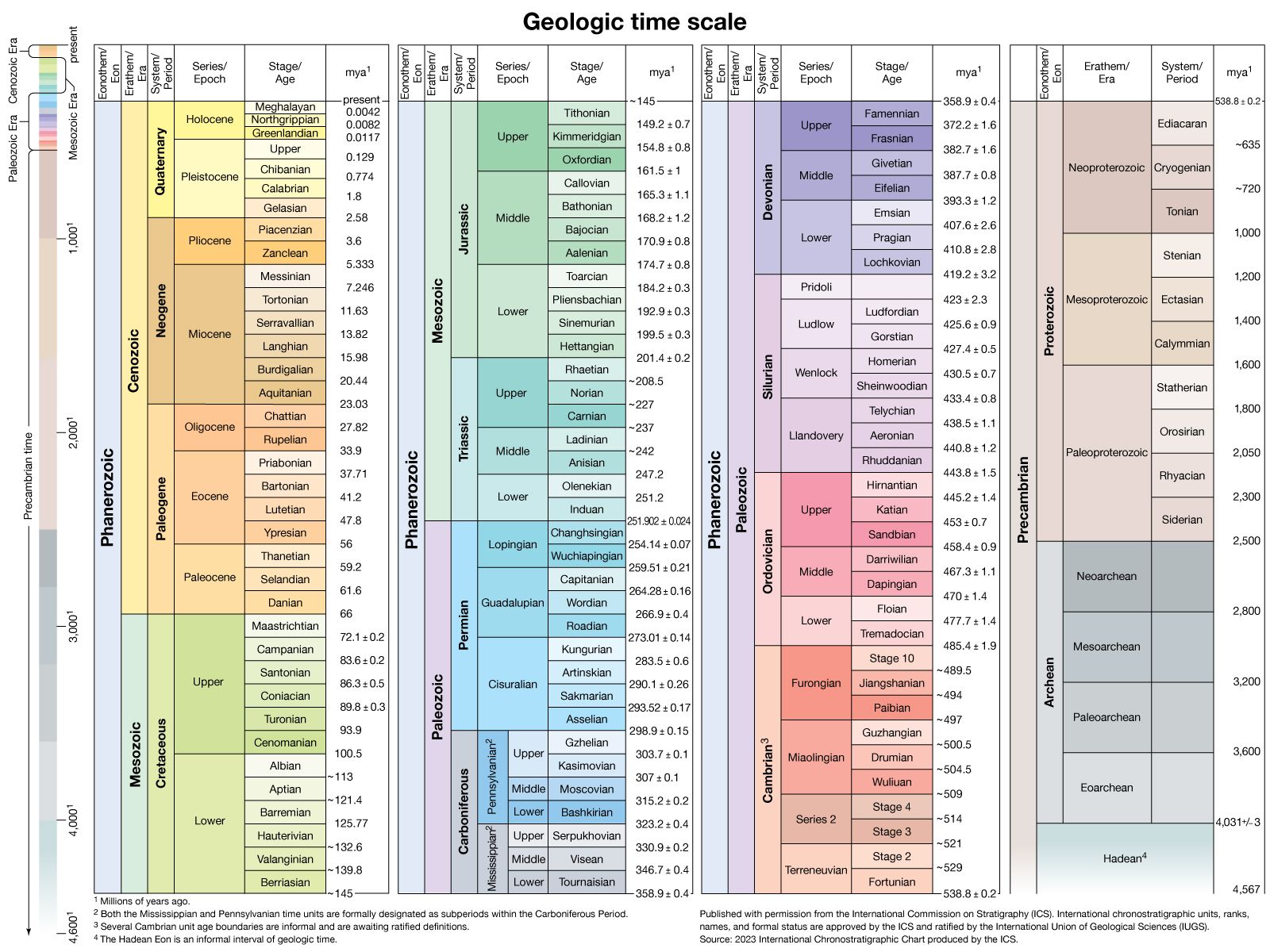
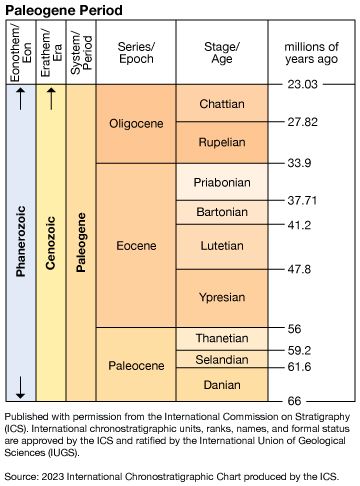
The Paleocene Epoch (approximately 66 million to 56 million years ago) was characterized by a general warming trend. During this time, North America…
How did the climate change during the Paleocene Epoch?
The Paleocene Epoch (approximately 66 million to 56 million years ago) was characterized by a general warming trend. During this time, North America experienced conditions with little to no frost, featuring seasonal alternations between wet and dry periods.1
This warming trend culminated in the Paleocene-Eocene Thermal Maximum (PETM), a significant climatic event occurring roughly 56 million years ago. During the transition into the PETM, global temperatures rose rapidly by more than 5 °C (9 °F) within a few thousand years. This interval, which lasted about 100,000 years, saw extreme warmth, with sea surface temperatures in the high-latitude Arctic reaching levels comparable to modern subtropical seas. While the exact causes remain unclear, some researchers associate this spike with the sudden release of methane hydrates from ocean sediments, potentially triggered by massive volcanic activity.23
What evidence do we have of early primate evolution during the Paleocene?
Evidence for primate evolution during the Paleocene Epoch (approximately 66 million to 56 million years ago) is limited and subject to scientific debate. While early researchers identified several genera as the first known primates, modern analysis has complicated this classification.56
The Fossil Record
The primary fossils historically associated with this period include:
- Plesiadapis: Known from complete skulls and partial skeletons found in North America and Europe. These specimens exhibit rodentlike incisors and specialized dental features.5
- Ignacius and Palaechthon: These genera were also once categorized as early primates based on available skeletal remains.5
Challenges in Classification
Recent discoveries of limb and finger bones have led some paleontologists to suggest that these genera may not be true primates at all. Instead, they may belong to the order Dermoptera, which includes the modern colugo (or “flying lemur”) of Southeast Asia. If these fossils are indeed dermopterans, the definitive primate fossil record for the Paleocene is reduced to only a few teeth of questionable status discovered in China and France.5
Because of these uncertainties, most experts agree that the first fully recognizable primate forms did not emerge until the subsequent Eocene Epoch.6
How did the oceans and marine life change during the Paleocene Epoch?
During the Paleocene Epoch (66 million to 56 million years ago), the world’s oceans underwent a significant recovery following the mass extinction event that ended the Cretaceous Period.2
Marine Life Recovery and Diversification
The terminal Cretaceous extinction had eradicated many dominant marine groups, including large swimming reptiles like mosasaurs and plesiosaurs, as well as nektonic ammonites and most microscopic plankton. Life in the early Paleocene oceans took hundreds of thousands to millions of years to recover from this event.102
By the Late Paleocene, however, many marine invertebrate groups had diversified considerably. This included a notable radiation of planktonic foraminiferans and a significant increase in the diversity of mollusks, such as bivalves and gastropods.210
Ocean Conditions
The Paleocene was characterized by a general global warming trend, with warm, equable climates extending toward the polar regions. Deep ocean waters were relatively warm during this time, and the period culminated in the Paleocene-Eocene Thermal Maximum (PETM). This brief, intense warming episode—likely triggered by the release of methane hydrates from the ocean floor—led to elevated temperatures in high-latitude waters and a temporary decline in oceanic productivity.11
What were the dominant plant and animal species during the Paleocene?
The Paleocene Epoch (66 to 56 million years ago) was a period of biological recovery and rapid diversification following the mass extinction that ended the Cretaceous Period.2
Dominant Animal Species
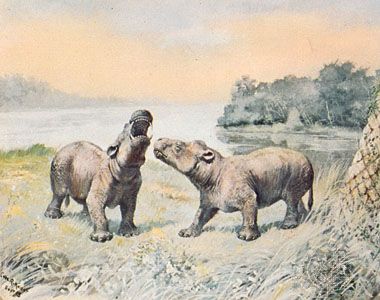
The most significant feature of Paleocene vertebrate life was the absence of dinosaurs and other large reptiles that had previously dominated the Earth. In their place, mammals underwent a rapid proliferation, evolving into many archaic or highly specialized forms.2
- Archaic Mammals: The multituberculates, a group of herbivorous mammals with rodentlike teeth, were prominent.2
- Ungulates: Condylarths—early hoofed animals—were essential members of the animal kingdom, often displaying a mix of herbivorous and insectivorous-carnivorous traits.2
- Marsupials: Opossum-like marsupials continued from the Cretaceous.2
- Primates: By the middle Paleocene, primates became more abundant, exhibiting dental anatomy intermediate between insectivores and lemurs.2
- Late Paleocene Developments: The period saw the emergence of primitive mammalian carnivores known as creodonts, as well as ancestral rodents and the earliest known hare (Eurymylus).2
Plant Life
While the fossil record for Paleocene plants is less detailed than that for animals, the era was characterized by a general warming trend with little to no frost, supporting widespread flowering plants that had begun their rapid diversification at the end of the Mesozoic.23
Sources
- Paleocene-Eocene Thermal Maximum — Encyclopædia Britannica
- Paleocene Epoch — Encyclopædia Britannica
- Climate change - Cenozoic climates — Encyclopædia Britannica
- Cenozoic Era - Cenozoic life — Encyclopædia Britannica
- primate - Paleocene — Encyclopædia Britannica
- Tertiary Period - Primates — Encyclopædia Britannica
- human evolution - Hominin habitats — Encyclopædia Britannica
- Ardipithecus - Anatomical features — Encyclopædia Britannica
- primate - Eocene — Encyclopædia Britannica
- Pleistocene Epoch - Coastal environments and sea-level changes — Encyclopædia Britannica
- Tertiary Period - Paleoclimate — Encyclopædia Britannica
- seawater - The transition stage — Encyclopædia Britannica
- Cretaceous Period - Marine life — Encyclopædia Britannica
- Ordovician Period - Diversification of life — Encyclopædia Britannica
- Pleistocene Epoch - Pleistocene fauna and flora — Encyclopædia Britannica
- Tertiary Period - Tertiary life — Encyclopædia Britannica
- Mesozoic Era - Mesozoic life — Encyclopædia Britannica
- Eocene Epoch — Encyclopædia Britannica
Published on · 4 min read