Phenacodus
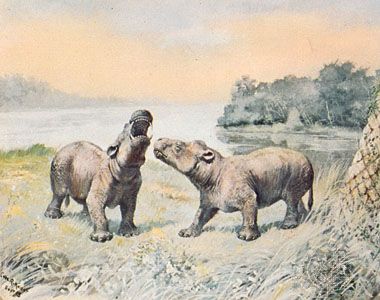
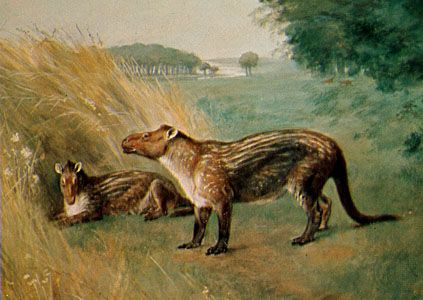
Phenacodus is an extinct genus of mammals that lived during the late Paleocene and early Eocene epochs in North America and Europe.
What is Phenacodus?
Phenacodus is an extinct genus of mammals that lived during the late Paleocene and early Eocene epochs in North America and Europe.12
As a representative of early ungulates, or hoofed mammals, Phenacodus possessed a digitigrade stance similar to that of a dog and featured five toes, exhibiting various adaptations for running. Its physical structure and dentition indicate that it was likely omnivorous; while it possessed large, well-developed canine teeth, its cheek teeth were partially adapted for consuming plants. Taxonomically, it is classified as a type of condylarth within the family Phenacodontidae.12
What are condylarths?
Condylarthra is an informal term used to describe a diverse group of extinct mammals that served as the ancestral forms for later, more advanced ungulates, or hoofed placental mammals. While the name was once used for a formal taxonomic order, it now refers generally to ungulates that lived from the Late Cretaceous through the early Paleogene periods.3
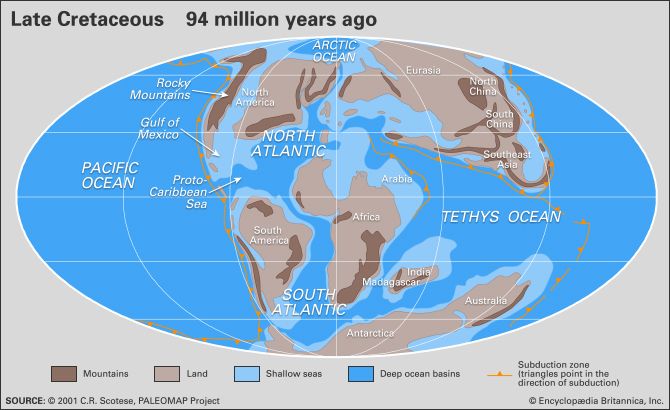
These animals originated in Asia during the Cretaceous, with the earliest known forms being the rodent-sized zhelestids from Uzbekistan. They reached their peak diversity during the Paleocene Epoch and eventually went extinct approximately 30 million years ago during the Oligocene Epoch.3
Condylarths were highly varied in size and morphology. They are considered the ancestors of perissodactyls and potentially cetaceans. Some, like the Eocene genus Phenacodus, grew to the size of a modern tapir, while others, such as Arctocyon, possessed carnivore-like teeth with long canines.3
How did early ungulates evolve into modern hoofed animals?
Early ungulates evolved into modern hoofed animals through a long process of diversification and anatomical specialization, primarily originating from a group of extinct, generalized mammals known as condylarths. These ancestral forms, which flourished during the Paleocene Epoch, were unspecialized and often carnivore-like in appearance, yet they possessed the foundational traits that would eventually define the two major modern orders of hoofed mammals: perissodactyls (odd-toed) and artiodactyls (even-toed).456
The transition involved significant skeletal adaptations, particularly in the limbs and teeth:
- Limb Specialization: Over millions of years, ungulates evolved from a primitive, five-toed stance to specialized forms optimized for running. Perissodactyls developed a mesaxonic condition, where the axis of the limb passes through the third toe, which became increasingly dominant. Conversely, artiodactyls developed a paraxonic condition, with the weight borne between the third and fourth toes.36
- Dietary Adaptation: As environments shifted from subtropical forests to more open, seasonal grasslands, these mammals evolved specialized teeth. Early bunodont molars were replaced by more complex structures capable of processing fibrous vegetation, allowing groups like bovids to thrive in diverse ecological niches.47
- Successive Waves: The history of these groups is marked by successive waves of adaptation. For instance, perissodactyls were dominant in the early Eocene, but artiodactyls became more prominent by the Oligocene, eventually radiating into the diverse forms—such as camels, deer, and bovids—seen today.6
What was the environment like during the Paleocene and Eocene epochs?
The Paleocene and Eocene epochs were characterized by a long-term “greenhouse” climate, representing some of the warmest conditions of the Cenozoic Era.8910
Climate and Temperature
The early Cenozoic experienced significant global warmth, with tropical and subtropical flora and fauna extending to high latitudes until at least 40 million years ago. A defining event was the Paleocene-Eocene Thermal Maximum (PETM), a 100,000-year interval roughly 55 million years ago that saw global temperatures spike by more than 5 °C (9 °F). During this time, Arctic sea surface temperatures reached approximately 23 °C (73 °F). Following the PETM, temperatures briefly declined before rising again during the Eocene Optimum, eventually leading to a steady cooling trend toward the Eocene-Oligocene boundary approximately 34 million years ago.98
Ecological Impact
These climatic conditions fostered massive shifts in life:
- Radiation of Mammals: Following the K–T extinction, mammals underwent rapid adaptive radiation, including the emergence of the earliest ungulates.11
- Flora: Angiosperms expanded significantly, with evergreen varieties dominating the tropics and subtropics.11
- Extinctions: The rapid onset of the PETM caused widespread extinctions in both marine and terrestrial ecosystems.89
Sources
- Phenacodus — Encyclopædia Britannica
- Phenacodus — Merriam-Webster
- Condylarthra — Encyclopædia Britannica
- perissodactyl - Evolution and paleontology — Encyclopædia Britannica
- perissodactyl - Limbs — Encyclopædia Britannica
- bovid - Evolution and diversification — Encyclopædia Britannica
- artiodactyl - Evolution and paleontology — Encyclopædia Britannica
- Paleocene-Eocene Thermal Maximum — Encyclopædia Britannica
- Climate change - Cenozoic climates — Encyclopædia Britannica
- Cenozoic Era - Cenozoic life — Encyclopædia Britannica
- Climate change - Phanerozoic climates — Encyclopædia Britannica
Published on · 3 min read