Ben Nevis
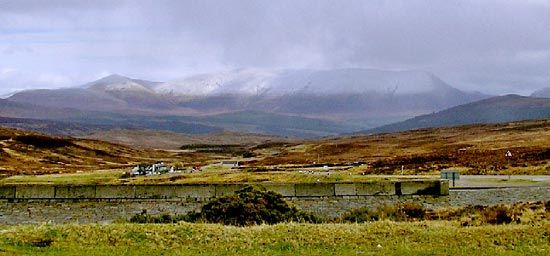
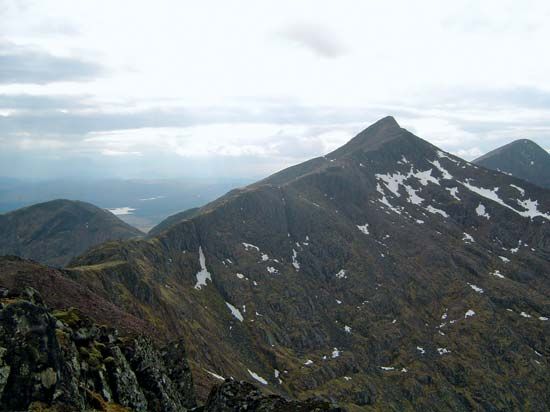
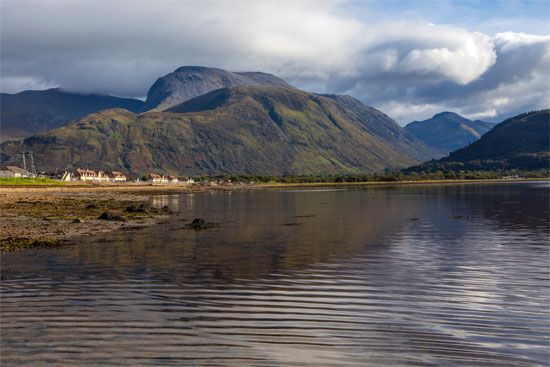
Ben Nevis is the highest mountain in the British Isles, located in the Highland council area of Scotland. It serves as the highest peak within the Grampian…
What is Ben Nevis?
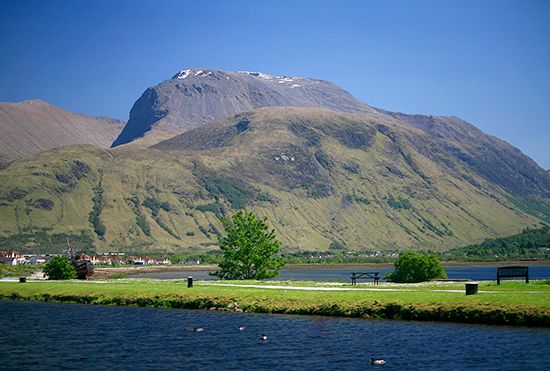
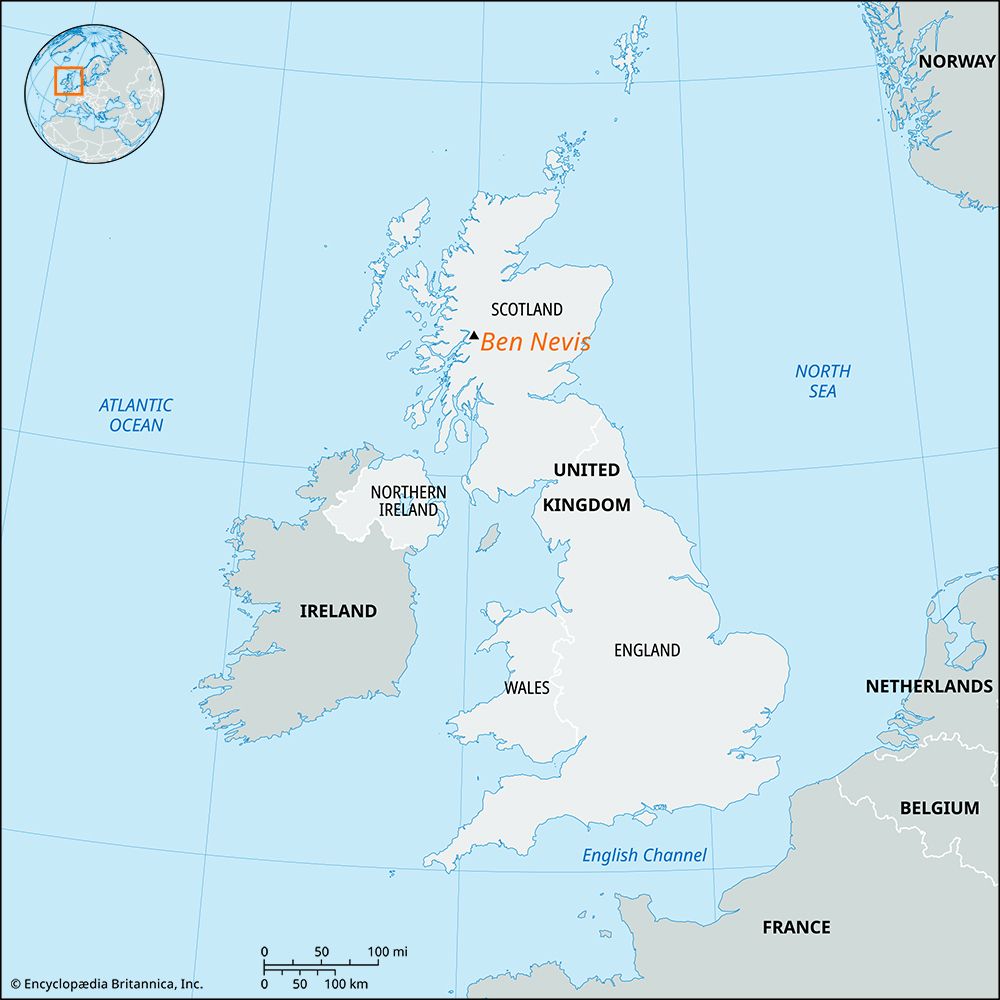
Ben Nevis is the highest mountain in the British Isles, located in the Highland council area of Scotland. It serves as the highest peak within the Grampian Mountains.1
While historical measurements have varied, the Ordnance Survey officially recognizes its elevation as 1,345 meters (4,413 feet). The mountain is characterized by a summit plateau spanning approximately 100 acres, featuring a sheer northeast face. Geologically, it is composed of a superstructure of volcanic rocks resting upon ancient schists and granites typical of the Highlands. Due to its altitude, snow can be found on parts of the mountain throughout the year, and it nearly reaches permafrost conditions.1
What are the Grampian Mountains?
The Grampian Mountains are a major mountain range located in the Highlands of Scotland. The name is derived from Mons Graupius, the site of a battle where the Roman general Agricola defeated the indigenous Picts around 84 CE. While the term can refer to the entire central Highland mass between Glen Mor and the southern edge of the Highlands, it is more strictly used to describe the latter relief feature.3
Compared to the rugged mountains of the northwest, the Grampians are generally more rounded and grassy, featuring wider plateau areas, though they still contain cliffs and pinnacles that challenge mountaineers. The range includes Britain’s highest peaks, such as Ben Nevis and the Cairngorm Mountains, the latter of which contains Ben Macdui, the second-highest mountain in the British Isles.435
How do volcanic rocks form mountains?
Volcanic rocks contribute to the formation of mountains through two primary processes: the eruption of material onto the surface and the intrusion of magma beneath the crust.6
Surface Volcanism
When magma reaches the surface, it erupts as lava or fragmented pyroclastic material. The resulting landform depends on the composition and viscosity of the material:
- Shield Volcanoes: Low-viscosity lava flows create broad, gently sloping mountains.67
- Stratovolcanoes: More viscous lava mixed with explosive debris forms steep, symmetrical cones, such as Mount Fuji. cones, such as Mount Fuji.67
- Plateaus: Large-volume fissure eruptions can build thick, extensive lava plateaus.78
Subsurface Intrusion
Many mountains are built on elevated terrain caused by the intrusion of magma into the crust. These intrusive igneous rocks cool slowly deep underground, forming massive structures like batholiths. These resistant crystalline rocks often form the cores of major mountain ranges. They are only exposed at the surface after long periods of denudation or through tectonic uplift.689
What is the climate like in the Scottish Highlands?
The Scottish Highlands experience a temperate oceanic climate that is notably milder than its latitude would suggest, largely due to the moderating influence of the surrounding seas and the North Atlantic Drift.121213
Key characteristics of the climate include:
- Temperature: Winters are relatively warm for the region, with January temperatures typically averaging above freezing, except in the interior mountains. Summers are cool, with temperatures rarely rising above 68 °F (20 °C).12
- Precipitation: The region is one of the wettest in the United Kingdom. Rainfall is significantly higher in the west, where moisture-laden winds from the Atlantic Ocean prevail; some mountainous areas receive up to 200 inches (5,100 mm) of precipitation annually. In contrast, the eastern coast is much drier, with some areas receiving as little as 30 inches (750 mm).412
- Seasonal Variation: The west tends to be milder and less prone to frost in winter but damper and cloudier in summer compared to the east. Significant snowfall is common in the Highlands at elevations above 1,500 feet (460 metres) during the winter months.4
Sources
- Ben Nevis — Encyclopædia Britannica
- Ben Nevis — Merriam-Webster
- Grampian Mountains — Encyclopædia Britannica
- Scotland - Relief of Scotland — Encyclopædia Britannica
- Cairngorm Mountains — Encyclopædia Britannica
- mountain - Volcanism — Encyclopædia Britannica
- volcano - Determinants of size and shape — Encyclopædia Britannica
- igneous rock — Encyclopædia Britannica
- How are mountains formed? — Encyclopædia Britannica
- mountain - Geomorphic characteristics — Encyclopædia Britannica
- Europe - Cenozoic igneous provinces — Encyclopædia Britannica
- Scotland - Climate of Scotland — Encyclopædia Britannica
- Highland — Encyclopædia Britannica
- Climate - Thermohaline circulation — Encyclopædia Britannica
Published on · 3 min read