Bernina Alps
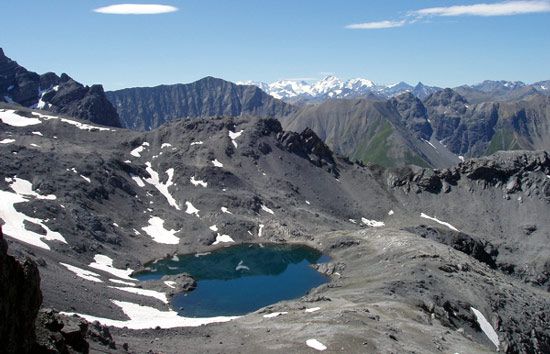
The Bernina Alps are a mountain range located in eastern Switzerland along the Italian border, forming a subrange of the Rhaetian Alps. They are situated…
What is Bernina Alps?
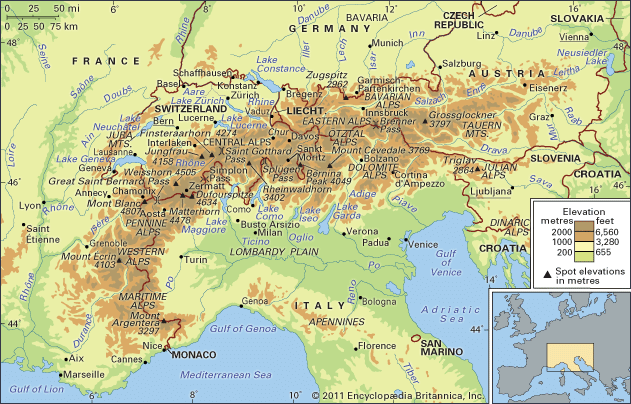
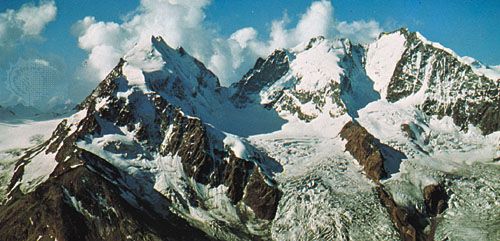
The Bernina Alps are a mountain range located in eastern Switzerland along the Italian border, forming a subrange of the Rhaetian Alps. They are situated southeast of the Engadin valley.12
The range reaches its highest point at Bernina Peak, which stands at 13,284 feet (4,049 meters) and was first ascended in 1850. The area is well-known for the Bernina Pass, a route located southeast of Saint Moritz that is traversed by both a highway and a railway; the latter was designated a UNESCO World Heritage site in 2008. Portions of the range extend into the Swiss National Park, and the region is a popular destination for mountain climbing and winter sports.12
It is important to distinguish this range from the Bernese Alps, which are a separate segment of the Central Alps located in southwestern Switzerland.3
What makes the Bernina Express railway unique?
The Bernina Express railway is a remarkable feat of engineering that traverses the Bernina Alps in eastern Switzerland. Its uniqueness is highlighted by its status as a UNESCO World Heritage site, a designation it received in 2008 for its exceptional technical and cultural significance.1
The railway is renowned for its scenic route, which crosses the high-altitude Bernina Pass at 7,638 feet (2,328 meters). By connecting regions through challenging mountainous terrain, the line serves as a vital link between the Engadin valley and the Italian border, offering passengers spectacular views of the alpine landscape.1
How do the Bernina Alps differ from the Bernese Alps?
The Bernina Alps and the Bernese Alps are distinct mountain ranges located in different regions of Switzerland, characterized by unique geography and classification.
Geographic and Classification Differences
- Location: The Bernina Alps are situated in eastern Switzerland along the Italian border, forming a subrange of the Rhaetian Alps within the Eastern Alps segment. In contrast, the Bernese Alps are a segment of the Central Alps located in southwestern Switzerland, spanning the cantons of Bern and Valais.1243
- Elevation and Peaks: The Bernina Alps reach their highest point at Bernina Peak (13,284 feet). The Bernese Alps generally feature higher elevations, with several peaks exceeding 12,000 feet, including the Finsteraarhorn (14,022 feet), Jungfrau, and Aletschhorn.143
- Glacial Features: The Bernese Alps are home to the Aletsch Glacier, one of the longest in the entire Alps.4
While both ranges are popular destinations for mountain climbing and winter sports, they serve different geographic areas and are separated by significant distance across the Swiss landscape.14
What wildlife can be found in the Swiss National Park?
The Swiss National Park, located in the Graubünden canton, serves as a strictly protected nature reserve where hunting and fishing are prohibited. This preservation allows a diverse array of alpine wildlife to thrive within its 65-square-mile area.53
The park is home to several notable species, including:
- Mammals: Ibex, chamois, red deer, foxes, martens, and marmots.5
- Birds: Eagles and various other game birds.5
Because the park functions primarily as a scientific nature reserve, it provides a sanctuary for these animals to exist with minimal human interference, making it a significant site for observing alpine fauna in their natural habitat.53
Sources
- Bernina Alps — Encyclopædia Britannica
- Bernese Alps — Encyclopædia Britannica
- Rhaetian Alps — Encyclopædia Britannica
- Alps - Physiography — Encyclopædia Britannica
- Swiss National Park — Encyclopædia Britannica
Published on · 2 min read