Ben Wyvis
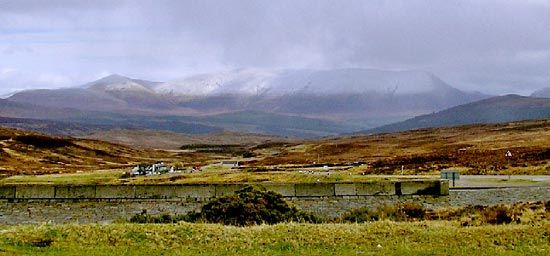
Ben Wyvis is a mountain located in the northern Highlands of Scotland, within the Highland council area.
What is Ben Wyvis?
Ben Wyvis is a mountain located in the northern Highlands of Scotland, within the Highland council area.1
Rising to an elevation of 3,429 feet (1,045 metres), its summit is situated approximately 9 miles northwest of Dingwall, a town on the Cromarty Firth—an inlet of the Moray Firth. The mountain’s landscape features the 17th-century Castle Leod on its slopes, while the 18th-century resort spa of Strathpeffer is nestled at its base.1
What are the Scottish Highlands?
The Scottish Highlands are a major physiographic and cultural region of Scotland, defined by a rugged, mountainous landscape northwest of a line stretching from Dumbarton to Stonehaven.23
Geography and Topography
The region is bisected by the Glen Mor fault line, which contains a series of lochs, including Loch Ness. The area is characterized by:2
- North of Glen Mor: An ancient, eroded plateau featuring glacier-carved glens and peaks, including the barren, hummocky terrain of the Lewisian Complex.2
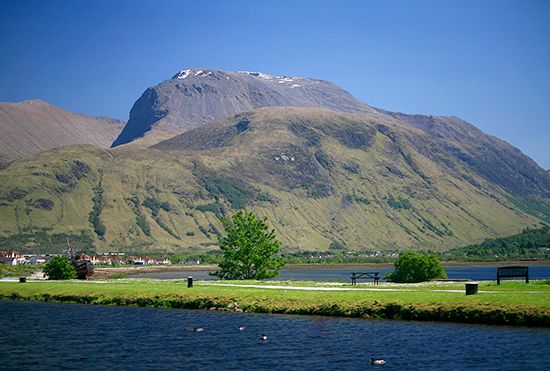
- Southeast of Glen Mor: The Grampian Mountains, which include the Cairngorm Mountains and Britain’s highest peak, Ben Nevis.24
Cultural and Historical Context
The Highlands are a stronghold of Gaelic language and customs. Historically, the region experienced significant social upheaval, notably the Highland Clearances, where tenants were evicted to make way for sheep farming. Today, the economy relies on tourism, crofting, fishing, and industries like whisky distilling. Cultural identity is often celebrated through Highland games, which feature traditional sports and music.3567
How are mountains formed?
Mountains are primarily created through orogeny, a mountain-building process driven by plate tectonics that causes the Earth’s crust to uplift or subside. These tectonic processes build the major structures of the planet, while erosion subsequently sculpts their individual shapes.89
Primary Mountain-Building Mechanisms
- Convergent Margins: Mountains often form where lithospheric plates collide. This includes continent-continent collisions, which thicken the crust, and subduction zones, where one plate sinks beneath another, triggering magmatism and crustal uplift.810
- Block Faulting: When crustal blocks are pulled apart or pushed over one another, they can create ranges. This process involves high-angle faulting and can result in features like rift valleys or tilted mountain blocks.91011
- Volcanism: Many mountains are built by the accumulation of volcanic rock on the surface. These can range from individual stratovolcanoes to vast lava plateaus.912
- Folding: Horizontal forces can cause crustal shortening and thickening, resulting in the folding of rock layers into parallel ridges and valleys.911
What is a Munro in Scottish geography?
In Scottish geography, a Munro is defined as a mountain in Scotland with an elevation of at least 3,000 feet (914.4 metres). The term is named after Sir Hugh Munro, who produced the first list of such peaks in 1891.
While the provided search results mention summits in the Monadhliath Mountains that exceed 3,000 feet, they do not explicitly define the term “Munro” in a geographical context. The dictionary entry provided refers only to the Scottish writer Hector Hugh Munro.
Sources
- Ben Wyvis — Encyclopædia Britannica
- Scotland - Relief of Scotland — Encyclopædia Britannica
- Highland — Encyclopædia Britannica
- Scotland - The Highlands of Scotland — Encyclopædia Britannica
- Scottish Highlands — Encyclopædia Britannica
- Grampian Mountains — Encyclopædia Britannica
- Scotland - Daily life and social customs — Encyclopædia Britannica
- orogeny — Encyclopædia Britannica
- plate tectonics - Mountains by subduction — Encyclopædia Britannica
- tectonic landform — Encyclopædia Britannica
- continental landform - Orogenic geomorphic systems — Encyclopædia Britannica
- mountain - Geomorphic characteristics — Encyclopædia Britannica
- volcano - Determinants of size and shape — Encyclopædia Britannica
- Monadhliath Mountains — Encyclopædia Britannica
- Munro — Merriam-Webster
Published on · 2 min read