Bermuda Triangle
There are no universally agreed-upon boundaries for the Bermuda Triangle, and it is not recognized as an official region by the U.S. Board on Geographic…
What are the exact boundaries and location of the Bermuda Triangle?
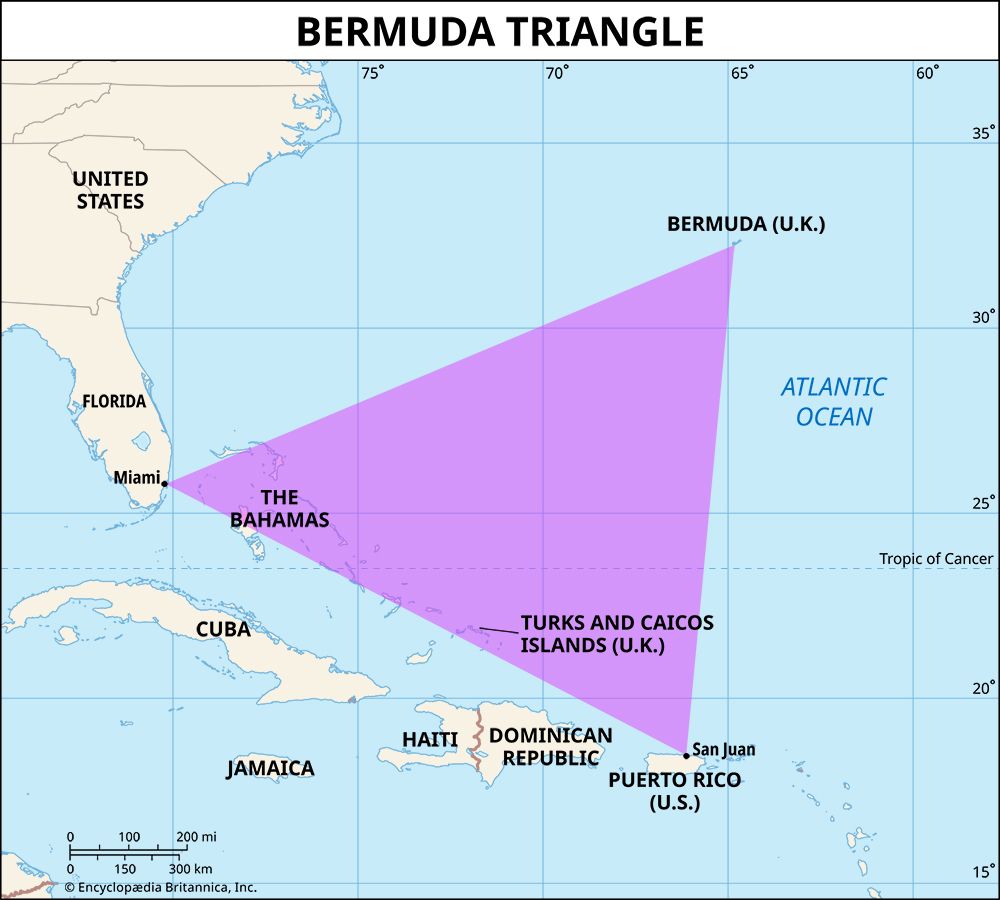
There are no universally agreed-upon boundaries for the Bermuda Triangle, and it is not recognized as an official region by the U.S. Board on Geographic Names. Consequently, the area does not appear on any world maps.1
Generally, the region is described as a section of the North Atlantic Ocean with a vague triangular shape. It is roughly bounded by:
- The southeastern coast of the U.S. (specifically the Atlantic coast of Florida)
- Bermuda
- The islands of the Greater Antilles, including Cuba, Hispaniola, Jamaica, and Puerto Rico.12
Estimates of the total area vary significantly, ranging from approximately 500,000 to 1,510,000 square miles (1,300,000 to 3,900,000 square kilometers). Despite its reputation, data indicates that disappearances do not occur with greater frequency there than in other comparable, heavily traveled regions of the ocean.12
What are some of the most famous disappearances reported in the Bermuda Triangle?
Several high-profile disappearances have contributed to the enduring legend of the Bermuda Triangle. While these incidents remain unexplained due to a lack of recovered wreckage, they are often cited in discussions regarding the region’s mysterious reputation:
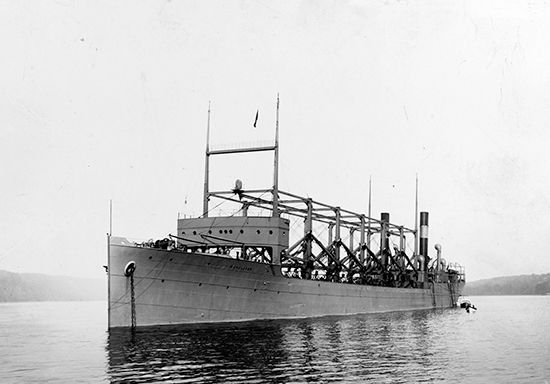
- USS Cyclops (1918): In March 1918, this U.S. Navy collier vanished while en route from Brazil to Baltimore, Maryland. The ship disappeared without a trace, and no distress signals were received or wreckage ever found.1
- Flight 19 (1945): Perhaps the most famous incident, this involved a squadron of five U.S. Navy Avenger torpedo bombers that took off from Fort Lauderdale, Florida, for a routine training mission. The pilots reported compass malfunctions and became disoriented. During the subsequent search and rescue mission, a PBM Mariner flying boat carrying 13 passengers also disappeared. No debris from any of the six aircraft was ever recovered.12
- Star Tiger (1948): This British South American Airways plane disappeared while flying from the Azores to Bermuda. Despite reports of mechanical issues prior to takeoff, the plane continued its journey. No trace of the 31 people on board was ever found.2
- Star Ariel (1949): Less than a year after the Star Tiger incident, another British South American Airways plane vanished while traveling from Bermuda to Jamaica. Despite clear weather conditions, the plane ceased communication at 18,000 feet, and no debris was ever located.2
What scientific explanations have been proposed for the unusual occurrences in the Bermuda Triangle?
While many theories regarding the Bermuda Triangle rely on supernatural speculation, scientists generally attribute the region’s reported disappearances to geophysical and environmental factors. It is important to note that data from the National Oceanic and Atmospheric Administration indicates that disappearances do not occur with greater frequency in this area than in any other heavily traveled region of the ocean.12
Proposed scientific explanations include:
- Navigational Error: One hypothesis suggests that pilots and mariners may fail to account for the agonic line—a line where true north and magnetic north align. In this region, failing to compensate for magnetic variation can lead to significant navigational errors.12
- Rogue Waves: The area is prone to rogue waves, which are massive, unpredictable waves that can reach heights of up to 100 feet (30.5 meters). These waves are theoretically powerful enough to destroy ships or aircraft without leaving behind wreckage.2
- Severe Weather: The region is subject to frequent tropical storms and hurricanes, which can create hazardous conditions for travel.1
- Ocean Currents: The Gulf Stream, a powerful and intense ocean current, passes through the area. It is known to cause sharp, rapid changes in local weather, which can complicate maritime and aerial navigation.12
What is the history behind the name ‘Bermuda Triangle’?
The term “Bermuda Triangle” is a popular name for a section of the North Atlantic Ocean that is not officially recognized by the U.S. Board on Geographic Names or depicted on any world maps.
While reports of unexplained disappearances in the region date back to the mid-19th century, the specific phrase “Bermuda Triangle” did not enter common usage until 1964. It first appeared in print in a pulp magazine article written by Vincent Gaddis, who used the term to describe a triangular region he claimed had destroyed hundreds of ships and planes without a trace. The legend was later significantly popularized by Charles Berlitz in his 1974 best-selling book, The Bermuda Triangle, which even speculated on links to the lost island of Atlantis.
Despite the name’s evocative nature, the region is one of the most heavily traveled shipping lanes in the world, and there is no evidence that incidents occur there with greater frequency than in any other comparable area of the ocean.21
Sources
- What Is Known (and Not Known) About the Bermuda Triangle — Encyclopædia Britannica
- Bermuda Triangle — Encyclopædia Britannica
- 7 Puzzling Plane Disappearances — Encyclopædia Britannica
- Climate - The Gulf Stream — Encyclopædia Britannica
- subtropical gyre — Encyclopædia Britannica
Published on · 4 min read