Beaufort Sea
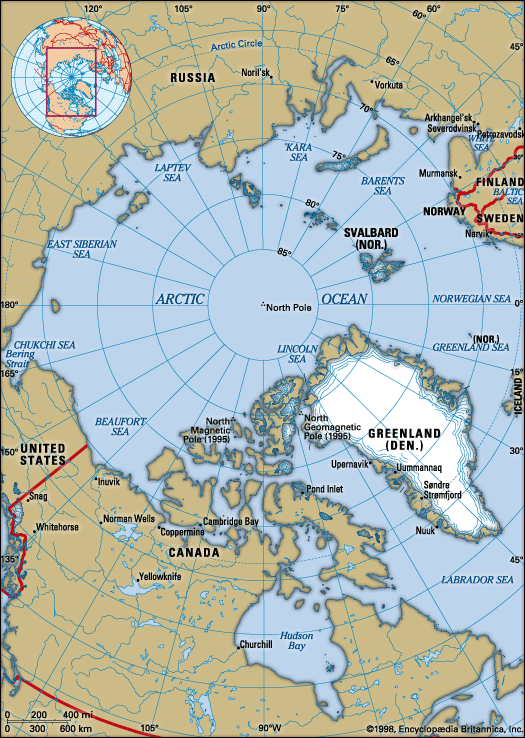
The Beaufort Sea is an outlying sea of the Arctic Ocean located north of Canada and Alaska.
Where is the Beaufort Sea located, and what are its geographical boundaries?
The Beaufort Sea is an outlying sea of the Arctic Ocean located north of Canada and Alaska.1
Its geographical boundaries are defined as follows:
- West: It extends westward from Banks Island to the Chukchi Sea1.2
- South/Southwest: It is situated north of the Alaskan and Canadian coastlines, extending northeastward from Point Barrow, Alaska.1
- East/Northeast: It reaches toward Lands End on Prince Patrick Island.1
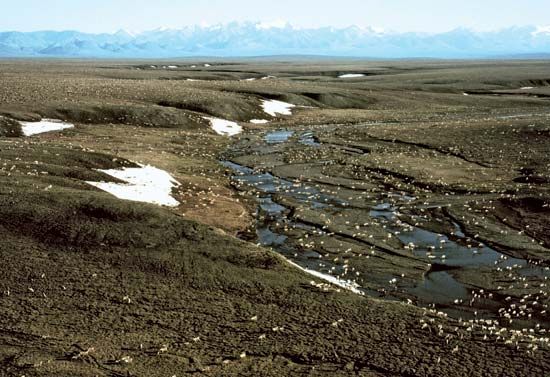
The sea covers approximately 184,000 square miles (476,000 square km) and is characterized by a narrow continental shelf and low-lying, tundra-covered coasts.1
How does the Beaufort Sea influence weather patterns in the Arctic region?
The Beaufort Sea plays a significant role in shaping the climate of the Arctic coastal lowland, particularly the North Slope of Alaska. Its ameliorating effects help maintain regional temperatures, which typically range from 35 to 55 °F (2 to 13 °C) in the summer and -5 to -20 °F (-21 to -29 °C) in the winter.3
The sea’s influence on weather patterns is driven by several key factors:
- Atmospheric Circulation: The region is subject to prevailing polar easterlies, which, combined with frequent storms, result in high winds and blowing snow across the coastal landscape.3
- Sea Ice Dynamics: The Beaufort Sea is covered by ice for approximately nine months of the year. This ice cover acts as an effective insulator, restricting heat loss from the ocean to the atmosphere. However, during winter, turbulent heat and mass transfer occur through leads (cracks in the ice) and polynyas (areas of open water), which can affect atmospheric processes for hundreds of kilometers.34
- Ice-Albedo Feedback: The presence of snow and ice significantly influences the energy balance of the region. Snow has a high albedo, reflecting solar radiation and keeping surface temperatures cool. In summer, as ice melts and meltwater ponds form, the absorption of solar radiation increases, which accelerates further melting and influences local climate variability.4
- Large-Scale Systems: The Beaufort Gyre, a clockwise current in the Beaufort Sea, is linked to a high-pressure center over the western Arctic. Shifts in this pressure center, known as the Arctic Oscillation, influence ice drift and regional weather patterns on a decadal scale.1
How deep is the Beaufort Sea, and how does its depth compare to other parts of the Arctic Ocean?
The Beaufort Sea has an average depth of 3,239 feet (1,004 meters), with a maximum recorded depth of 15,360 feet. Its topography is characterized by a narrow continental shelf that is typically less than 210 feet deep, which then descends steeply into the sea’s upper reaches to depths of 5,000 to 6,500 feet.1
When compared to the broader Arctic Ocean, the Beaufort Sea is distinct from the deep central basins. The Arctic Ocean’s major subbasins, such as the Canada Basin—which lies adjacent to the Beaufort Shelf—feature much greater average depths, with the Canada Basin averaging approximately 12,500 feet. Other deep subbasins in the Arctic, such as the Fram Basin and the Makarov Basin, reach depths of 14,070 feet and 13,200 feet, respectively. While the Beaufort Sea contains deep areas, a significant portion of its extent is defined by its relatively shallow continental shelf compared to the deep, expansive basins that characterize the central Arctic Ocean floor.71
What types of marine life can be found in the Beaufort Sea?
The Beaufort Sea supports a diverse range of marine life, though the total biomass is relatively limited due to the harsh, ice-covered environment. The ecosystem is anchored by a unique community of algae, primarily diatoms, that grow within the sea ice and support a complex food web ranging from microscopic organisms to large mammals.81
Marine Fauna
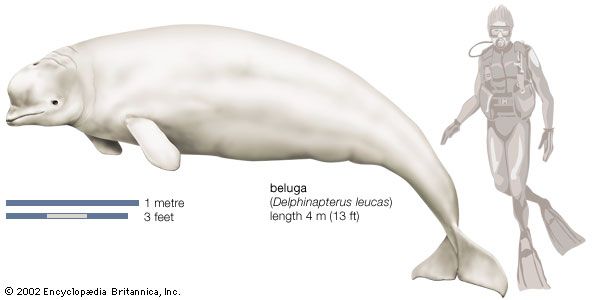
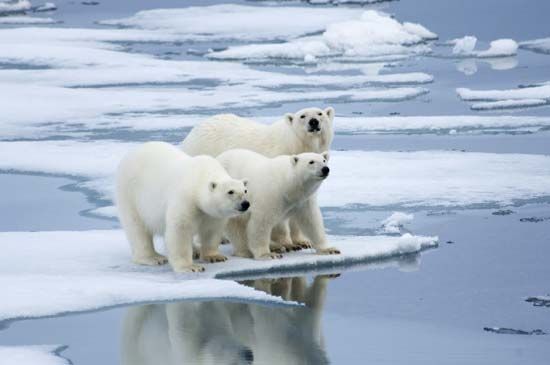
- Mammals: The region is home to several Arctic species. The bowhead whale is found in the Beaufort Sea, alongside the beluga whale. Phocids, such as the ringed and bearded seals, are also present. Additionally, the polar bear occupies a special ecological niche, relying on the sea ice for hunting and movement.1
- Fish: Fish populations are not abundant in the Arctic zone, with approximately 25 species present. The polar cod and arctic cod are the most common, serving as a vital food source for larger predators.1
- Birds: During the summer, the region hosts numerous migratory seabirds, including various species of gulls, terns, jaegers, and the auk family.1
Plankton and Benthic Life
The sea hosts over 70 species of phytoplankton and nearly 80 species of zooplankton. The bottom-dwelling (benthic) fauna is surprisingly rich, consisting of nearly 700 species, including polychaetes, bryozoans, crustaceans, and mollusks.8
Sources
- Beaufort Sea — Encyclopædia Britannica
- Chukchi Sea — Encyclopædia Britannica
- sea ice - Interactions with the oceans , atmosphere , and climate — Encyclopædia Britannica
- Alaska - Climate of Alaska — Encyclopædia Britannica
- Arctic Ocean - Oceanography — Encyclopædia Britannica
- sea ice - Pack ice drift and thickness — Encyclopædia Britannica
- Arctic Ocean - Topography of the ocean floor — Encyclopædia Britannica
- Arctic - Marine fauna — Encyclopædia Britannica
- sea ice - The emerging impacts of recent changes to sea ice — Encyclopædia Britannica
Published on · 3 min read