Swiss National Park
The Swiss National Park is a protected nature reserve located in the Graubünden canton of southeastern Switzerland, near the Italian border. Established in…
What is Swiss National Park?
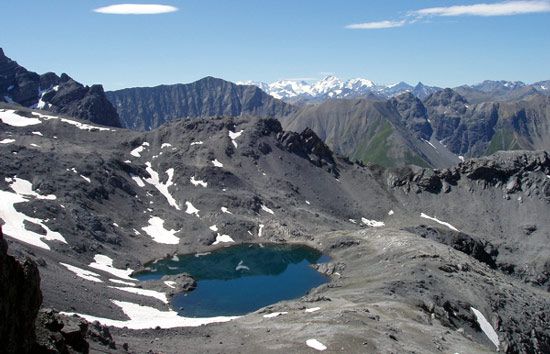
The Swiss National Park is a protected nature reserve located in the Graubünden canton of southeastern Switzerland, near the Italian border. Established in 1914 and expanded in 1959, it covers 65 square miles (169 square km) of the Central Alps and the edge of the dolomitic Eastern Alps.1
The park is dedicated to scientific conservation, meaning human activities such as hunting, fishing, lumbering, grazing, and flower picking are strictly prohibited. This preservation allows for a diverse ecosystem featuring rare Alpine vegetation and a variety of wildlife, including ibex, chamois, red deer, marmots, and eagles. Visitors can access the area via well-maintained roads, which serve as starting points for numerous foot trails throughout the reserve.1
What are the differences between an ibex and a chamois?
While both the ibex and the chamois are agile, mountain-dwelling members of the family Bovidae, they belong to different classifications and exhibit distinct physical and behavioral traits.
Key Differences
Feature
Ibex
Chamois
Classification
A true wild
goat
(
genus Capra
).
A goatlike animal (
genus Rupicapra
).
Size
Larger; males weigh ~100 kg (220 lbs).
Smaller; weigh 25–50 kg (55–110 lbs).
Horns
Large, semicircular, and transversely ridged.
Vertical, hooking sharply backward at the ends.
Appearance
Males have a beard; fur is brownish to gray.
Distinct black and white face markings; no beard.
Social Behavior
Lives in single-sex herds; old males are often solitary.
Lives in small herds; males join only during the rut.
Conflict Style
Adapted for head-on clashing.
Chases opponents to gore the throat or abdomen.
While the ibex is a sturdy, true goat, the chamois is more fragile and relies on speed and agility on steep cliffs rather than head-on combat. Both species are well-adapted to the craggy landscapes of the Alps and are protected within various national parks.321
Why is the Swiss National Park considered a nature reserve?
The Swiss National Park is classified as a nature reserve primarily because it is managed with strict scientific aims focused on the preservation of its ecosystem. Unlike areas managed for recreation or resource extraction, the park enforces a policy of non-interference with the natural environment.1
To maintain this status, the following human activities are strictly prohibited within its borders:
- Lumbering
- Grazing
- Flower picking
- Hunting
- Fishing1
By restricting these activities, the park functions as a protected sanctuary where plants and animals can exist with minimal human disturbance, consistent with the definition of a nature reserve as an area where wildlife and vegetation are shielded from development and exploitation. This approach allows for the protection of rare Alpine flora and a diverse range of wildlife, including ibex, chamois, and red deer, while providing a controlled environment for scientific observation.15
What other mountain ranges are found in Switzerland?
Switzerland’s topography is primarily defined by two major mountain ranges that flank its central plateau, known as the Mittelland:
- The Alps: Located to the south and east, the Alps are a massive range composed of complex sedimentary, metamorphic, and igneous rocks. They contain Switzerland’s highest peaks, including the Dufourspitze on the Monte Rosa massif and the iconic Matterhorn. This region serves as a vital European watershed and is home to significant transit routes, such as the Gotthard Base Tunnel.6
- The Jura Mountains: Situated in the northwest, the Jura Mountains form an arc along the border with France. These mountains are characterized by Jurassic limestone and marl, featuring karst landscapes with sinkholes and caves. While lower than the Alps—with Mount Tendre being one of the highest points—the Jura have historically been an important center for agriculture, dairying, and the Swiss watchmaking industry.67
Between these two ranges lies the Mittelland, which serves as the country’s agricultural heartland and most densely populated region.6
Sources
- Swiss National Park — Encyclopædia Britannica
- chamois — Encyclopædia Britannica
- ibex — Encyclopædia Britannica
- Alps - Plant and animal life — Encyclopædia Britannica
- nature reserve — Merriam-Webster
- Switzerland - Relief and drainage — Encyclopædia Britannica
- Jura Mountains — Encyclopædia Britannica
Published on · 3 min read