Bichir
A bichir (genus Polypterus) is any of about 10 species of primitive, air-breathing fishes native to freshwater systems in western and central Africa.
What is a bichir?
A bichir (genus Polypterus) is any of about 10 species of primitive, air-breathing fishes native to freshwater systems in western and central Africa.1
These elongated fish are characterized by thick, enameled ganoid scales, fleshy pectoral fin lobes, and a dorsal fin consisting of a series of sharp spines. Unlike many other fish, they possess functional lungs that developed from the ventral side of the endoderm, allowing them to breathe air at the water’s surface. This ancient adaptation may date back to the Silurian Period1.1
Bichirs are nocturnal foragers that feed on worms, insects, and small amphibians. Some species, such as the Senegal bichir, can even use their pectoral fins to move across land for short distances. While their exact classification remains a subject of scientific debate, they are most commonly placed in the clade Cladistia.1
Where do bichirs live?
Bichirs are native to freshwater river and lake systems located in western and central Africa1.
Within these environments, they typically inhabit the edges of streams and floodplains. During the rainy season, they are known to spawn in these swampy, floodplain areas.1
What does a bichir look like?
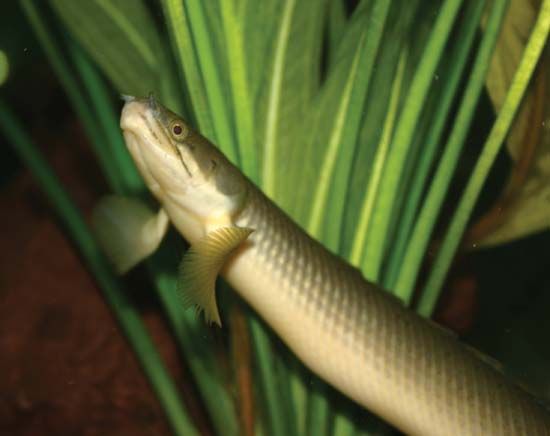
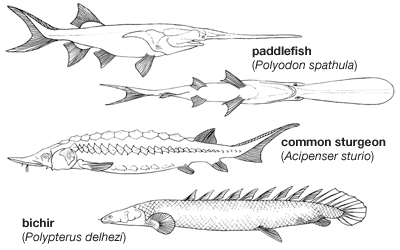
Bichirs are elongated fishes with a distinct, primitive appearance. Their bodies are covered in thick, hard, rhombic, and enameled scales known as ganoid scales. They feature fleshy lobes at the base of their pectoral fins and possess rounded tails.1
Key physical characteristics include:
- Dorsal Fin: A series of sharp spines, each accompanied by a flaglike cluster of fin rays.1
- Coloration: The upper body is typically brown, grayish, or greenish, while the lower side is often white or yellowish.1
- Size: Most species reach lengths between 30 and 60 cm (11.8 to 23.6 inches). However, larger species like the Congo bichir can grow up to 97 cm (38.2 inches) and weigh as much as 4.4 kg (9.7 pounds).1
- Head: They have two spiracles on the top of the head used to take in air for their functional lungs.1
Young bichirs look quite different from adults, possessing external branching gills that give them a newtlike appearance.1
How do bichirs breathe?
Bichirs are unique air-breathing fishes that utilize a dual respiratory system to survive in their freshwater environments. They possess functional lungs to breathe atmospheric air, supplemented by rudimentary gills that extract oxygen from the water.1
To breathe air, a bichir takes it in from the water’s surface through two spiracles located on the top of its head, which then channel the air into its paired lungs. Unlike the swim bladder found in most bony fishes, which is derived from the dorsal side of the endoderm, the lungs of the bichir developed from a pouch on the ventral (lower) side. This ancient adaptation is believed to have emerged as early as the Silurian Period.1
Sources
- bichir — Encyclopædia Britannica
- bichir — Merriam-Webster
- heteropteran - Respiratory system — Encyclopædia Britannica
Published on · 2 min read