Bigeye
The term "bigeye" refers to several distinct types of marine fish, as the name is used for different species across various families:
What is bigeye?
The term “bigeye” refers to several distinct types of marine fish, as the name is used for different species across various families:
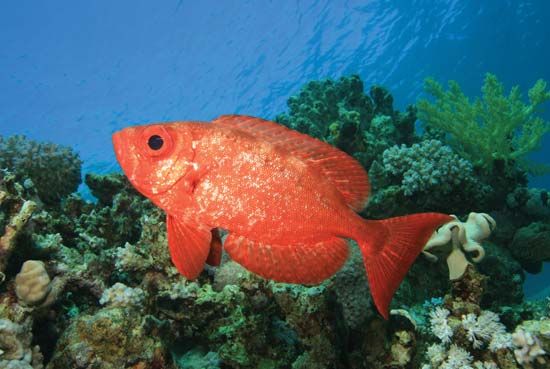
- Priacanthidae: This family comprises about 18 species of marine fish commonly known as bigeyes. These are generally nocturnal, carnivorous fish found in tropical and subtropical waters. Most are bright red and possess large, round eyes.1
- Bigeye Tuna (Thunnus obesus): This is a large, robust species of tuna characterized by its relatively large eyes, long pectoral fins, and a bluish stripe along its side. It is found in warm ocean waters worldwide and is of significant commercial value.23
- Big-eyed Scad (Trachurops crumenophthalmus): Also known as the bigeye scad, akule, or goggler, this is a small carangid fish with prominent eyes. It is widely distributed in tropical seas and serves as an important food source in many regions.4
Why do many deep-sea fish have such large eyes?
Many deep-sea fish have evolved enlarged eyes as a specialized adaptation to the extreme darkness of their environment. In the deep ocean, where sunlight is minimal or absent, these larger eyes help the fish capture the limited light available, allowing them to detect prey, potential mates, or predators.56
The specific structural adaptations of these eyes often include:
- Light Sensitivity: Many deep-sea species possess eyes designed to maximize light collection, which is essential for survival in the deep-sea habitat.5
- Tubular Shapes: Some fish have tubular-shaped eyes that restrict their field of view to the upward direction, where faint light from the surface may still penetrate.7
- Bioluminescence Detection: Because many deep-sea organisms produce their own light through bioluminescence, some fish have evolved specialized eye structures to detect these flashes, which are used for species recognition, mating signals, or luring prey.576
In contrast, bottom-dwelling (benthic) fish often have smaller eyes or may lack them entirely, as they inhabit areas where no light from the surface penetrates.57
What does it mean for a fish to be nocturnal?
For a fish, being nocturnal means that it is primarily active and hunts for food during the night. During the daylight hours, these fish remain quiescent, typically retiring to protected areas such as holes, crevices, or thick vegetation to rest.1011
This activity cycle is the opposite of diurnal species, which are active during the day and rest at night. Because fish lack eyelids, their “rest” is a state of reduced activity and responsiveness rather than the deep sleep seen in mammals; however, nocturnal fish maintain this cycle as a specialized behavioral adaptation. By hunting at night, these species can exploit different ecological niches and avoid predators that are active during the day.121011
How do bigeye tuna differ from other tuna species?
The bigeye tuna (Thunnus obesus) is a member of the genus Thunnus, which includes seven species of tuna known for their streamlined bodies and unique ability to maintain body temperatures higher than the surrounding water.2
While all tunas share common characteristics—such as a rounded, tapering body, a forked tail, and a specialized vascular system for temperature regulation—the bigeye tuna is distinguished by specific physical traits:
- Eye Size: As its name suggests, the bigeye is a robust fish characterized by its relatively large eyes.2
- Physical Markings: It possesses long pectoral fins and often displays a bluish stripe along its side.4
- General Morphology: It is categorized as a robust species within the genus, contrasting with other species that may have different fin colorations or markings, such as the yellow fins and golden stripe of the yellowfin tuna or the blue stripe of the albacore.2
Sources
- big-eyed scad — Merriam-Webster
- bigeye tuna — Merriam-Webster
- bigeye — Encyclopædia Britannica
- tuna — Encyclopædia Britannica
- deep-sea fish — Encyclopædia Britannica
- Photoreception - Diversity of eyes — Encyclopædia Britannica
- Marine bioluminescence — Encyclopædia Britannica
- Bioluminescence - The role of bioluminescence in behavior — Encyclopædia Britannica
- Photoreception - Evolution of eyes — Encyclopædia Britannica
- How do fish sleep? — Encyclopædia Britannica
- fish - Behaviour — Encyclopædia Britannica
- tetraodontiform - Activity cycle — Encyclopædia Britannica
- lungfish - Physiology and biochemistry — Encyclopædia Britannica
Published on · 3 min read