Bilby
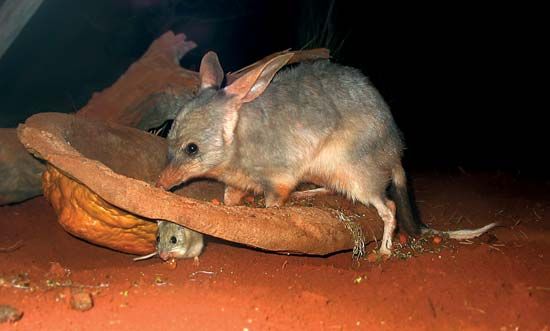
The bilby (Macrotis lagotis) possesses several distinct physical characteristics that distinguish it from other marsupials:
What are the unique physical characteristics of bilbies?
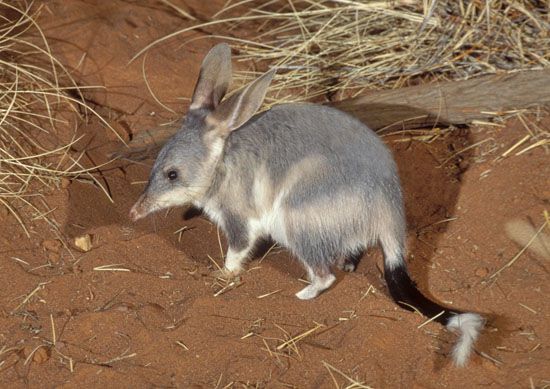
The bilby (Macrotis lagotis) possesses several distinct physical characteristics that distinguish it from other marsupials:
- Appearance: Bilbies have long, hairless ears that resemble those of rabbits, a long snout, and soft blue-gray fur with a white underbelly. Their tails are notable for a prominent band of black fur ending in a white tuft, which surrounds a naked, spurlike tip.1
- Size and Dimorphism: The species is sexually dimorphic, with males being nearly twice as large as females, reaching lengths of up to 55 cm (about 22 inches) and weights of approximately 2.5 kg (5.5 pounds).1
- Limbs and Movement: While their hind limbs are structured similarly to those of kangaroos, bilbies do not hop; instead, they lope like hares. Their forelimbs have five digits, with the middle three possessing claws.1
- Pouch Orientation: Female bilbies have a marsupium (pouch) that opens backward, an adaptation that prevents dirt from entering the cavity while the animal is burrowing.1
Where are bilbies found in Australia and what is their natural habitat?
Bilbies are native to Australia and historically occupied habitats across more than 70 percent of the continent. Today, their range has significantly contracted, and they are restricted to remote, arid interior regions.12
Current Distribution
Wild populations of bilbies are currently found in the following areas:
- Northwestern Australia: They inhabit the Great Sandy, Tanami, and Gibson desertsami, and Gibson deserts.1
- Southwestern Queensland: A small, isolated pocket of the population remains in this region.1
- Reintroduction Sites: Conservation efforts have established sustainable populations in parts of New South Wales, South Australia, Western Australia, and Queensland.1
Natural Habitat
Bilbies are adapted to life in semi-arid and arid environments. They prefer areas with loamy or sandy soil, which facilitates their specialized burrowing behavior. As solitary, nocturnal animals, they construct multiple deep burrows—reaching up to 2 meters (6.6 feet) in depth—within their home range. These burrows serve as essential refuges, protecting the animals from extreme daytime heat and potential predators.21
How does the Easter Bilby tradition compare to the Easter Bunny in Australia?
In Australia, the “Easter Bilby” was introduced as a culturally and ecologically conscious alternative to the traditional “Easter Bunny.” While the Easter Bunny is a long-standing international symbol, the Easter Bilby was promoted by the Foundation for Rabbit-Free Australia Inc. starting in 1991 to address the significant environmental damage caused by the European rabbit in Australia.1
The primary motivation for this shift is conservation-focused:
- Ecological Impact: European rabbits are an invasive species that compete with native wildlife, including the bilby, for food and resources. They are considered a major agricultural pest.1
- Public Awareness: By replacing the rabbit with a native marsupial as an Easter icon, the campaign aims to educate the Australian public about the threats facing the vulnerable bilby and the broader ecological consequences of introduced species.1
While the Easter Bunny remains a globally recognized figure, the Easter Bilby serves as a unique Australian symbol that highlights the importance of protecting native biodiversity over invasive ones.1
What is a bilby and how does it differ from other marsupials?
The bilby (Macrotis lagotis) is a small, nocturnal, burrowing marsupial native to Australia, characterized by its long snout, blue-gray fur, and large, rabbit-like ears.1
Distinctions from Other Marsupials
While the bilby shares the defining marsupial trait of giving birth to underdeveloped young that complete their growth in a pouch, it possesses several unique adaptations:
- Burrowing Behavior: Unlike many other marsupials, the bilby constructs deep, complex burrows—up to 2 meters (6.6 feet) long—to escape extreme heat and predators.12
- Pouch Orientation: To prevent dirt from entering the pouch while digging, the female bilby’s pouch opens backward, toward the rear of its body.1
- Locomotion: Although its hind limbs resemble those of a kangaroo, the bilby does not hop; instead, it moves with a loping gait similar to that of a hare.1
- Reproductive Efficiency: The bilby has one of the shortest gestation periods among mammals, lasting only 12–14 days.1
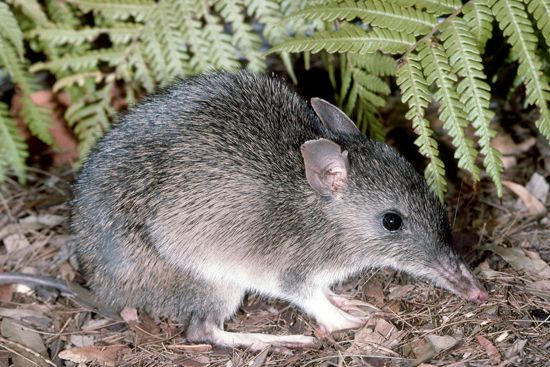
- Relationship to Bandicoots: Bilbies are closely related to bandicoots, but they are distinguished by their larger size, longer ears, and specialized burrowing habits.12
Sources
- bilby — Encyclopædia Britannica
- bandicoot — Encyclopædia Britannica
- marsupial — Encyclopædia Britannica
Published on · 3 min read