Tasmanian Devil
The Tasmanian devil (Sarcophilus harrisii) is a stocky, carnivorous marsupial that is the largest member of the family Dasyuridae.
How do Tasmanian devils compare to other marsupials in terms of size and appearance?
The Tasmanian devil (Sarcophilus harrisii) is a stocky, carnivorous marsupial that is the largest member of the family Dasyuridae2.1
Size and Physical Build
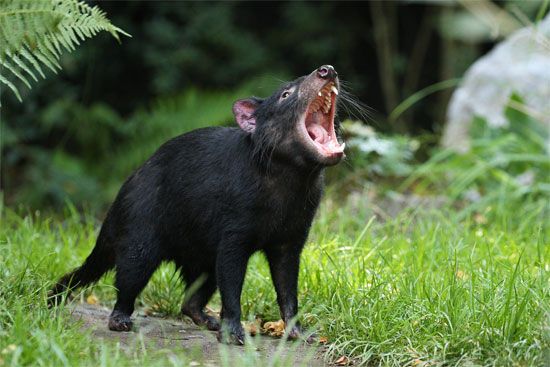
In terms of size, the Tasmanian devil is comparable to a badger. It typically reaches a length of 50 to 80 cm (20 to 31 inches), excluding its bushy tail, and can weigh up to 12 kg (26 pounds). While many marsupials range from the size of a squirrel to a medium-sized dog, the Tasmanian devil is notably more robust, characterized by heavy forequarters, a large squarish head, and powerful jaws.231
Appearance
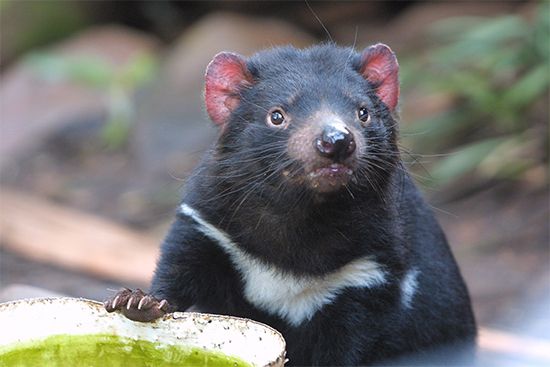
The Tasmanian devil has a chiefly black coat, often featuring a white mark on the chest and sometimes on the rump or sides. Its appearance is often described as vaguely bearlike, though its gaping jaws and strong teeth—which function similarly to those of a hyena—give it a distinct, “devilish” expression.231
What are some of the main predators and threats to Tasmanian devils besides the facial tumor disease?
While the devil facial tumour disease is a primary threat to the species, Tasmanian devils have faced significant historical and environmental pressures.
Historical Predators and Competition
The Tasmanian devil became extinct on the Australian mainland thousands of years ago. Scientists believe this decline was likely driven by the introduction of the dingo, which likely acted as a major predator or competitor for resources, leading to the species’ restriction to the island of Tasmania.2
Modern Environmental Threats
Beyond disease, the species faces ongoing conservation challenges:
- Habitat and Human Interaction: As scavengers, devils are frequently killed as roadkill, which remains a persistent threat to their population numbers.2
- Endangered Status: Due to the combination of disease and other environmental pressures, the Tasmanian devil was officially listed as an endangered species by the Tasmanian government in 2008.2
Conservationists are currently working to mitigate these threats through captive breeding programs and the establishment of isolated, healthy populations on nearby islands.2
Where is the natural habitat of Tasmanian devils, and why are they found only in certain areas?
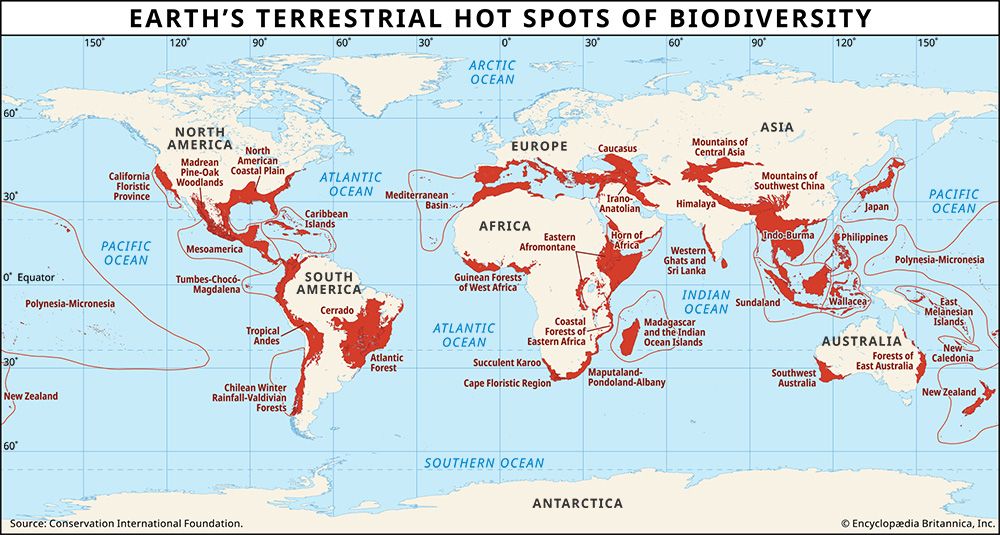
The natural habitat of the Tasmanian devil is restricted exclusively to the Australian island-state of Tasmania. Within this region, they are found in diverse environments, including the Tasmanian Wilderness, which features cool temperate rainforests and alpine vegetation.24
The species was once widespread across the Australian mainland but became extinct there thousands of years ago. Scientists believe this disappearance was likely caused by the introduction of the dingo, which acted as a significant predator or competitor for resources, forcing the remaining population to persist only on the island of Tasmania.2
In recent years, conservationists have begun efforts to reintroduce the species to the mainland, including the transfer of healthy individuals to a wildlife reserve in New South Wales to help secure the species’ future.2
What cultural significance do Tasmanian devils have in Australian folklore and popular culture?
The provided search results do not contain information regarding the cultural significance of Tasmanian devils in Australian folklore or popular culture. The available data focuses on the animal’s biological characteristics, its status as an endangered species, and the history of its population decline.21
Sources
- Tasmanian devil — Merriam-Webster
- Tasmanian devil — Encyclopædia Britannica
- marsupial — Encyclopædia Britannica
- Tasmanian Wilderness — Encyclopædia Britannica
Published on · 3 min read