Billbug
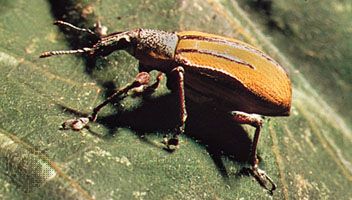
A billbug is any stout-bodied beetle belonging to the subfamily Rhynchophorinae within the weevil family, Curculionidae. These insects are characterized by a…
What is billbug?
A billbug is any stout-bodied beetle belonging to the subfamily Rhynchophorinae within the weevil family, Curculionidae. These insects are characterized by a short snout and can reach a body length of up to 5 cm (2 inches).1
The group includes several notable genera with varying impacts:
- Rhynchophorus: Found primarily in the tropics, these beetles bore through the new growth of palm trees. Their larvae are sometimes consumed by native peoples in tropical America.1
- Sphenophorus: Commonly known as corn billbugs, the larvae of this genus are known to feed on the roots of cereal crops and various grasses.12
- Other genera: The group also includes Diaprepes, Rhodobaenus (cocklebur weevils), and Sitophilus (granary and rice weevils).1
Some species, such as R. ferrugines, are considered agricultural pests because they attack coconut and wine palms, threatening the production of copra.1
How do billbugs damage crops and lawns?
Billbugs, particularly those in the genus Sphenophorus, damage crops such as corn by feeding on the plants. While the provided information identifies the maize billbug (Sphenophorus maidis) as a species sometimes destructive to corn, the specific mechanisms of how they damage lawns are not detailed in the available records.13
In agricultural contexts, billbugs are known to bore into plant tissues, which can compromise the health and development of the crop. Other members of the subfamily Rhynchophorinae, such as those in the genus Rhynchophorus, cause significant damage by boring through the new growth of palm trees, which can threaten the survival of the tree and the production of crops like copra.13
Because the provided search results do not contain specific details regarding the damage billbugs cause to lawns, I cannot provide information on that aspect of your query.
What are the main differences between weevils and other beetles?
While all weevils are beetles belonging to the order Coleoptera, they are distinguished from other beetle families by several unique physical and behavioral traits.
Key Distinctions
- The Snout: The most defining characteristic of most weevils is the presence of a snout-like projection on the head, which houses the mouthparts at its tip. This structure is used for feeding, penetration, and boring holes for egg-laying. While some other beetles have slightly elongated heads, the weevil’s snout is a specialized, functional tool.56
- Antennae: True weevils (family Curculionidae) typically possess distinctly elbowed antennae that can often be folded into special grooves along the snout. In contrast, other beetle families, such as fungus weevils (Anthribidae), have straight, non-elbowed antennae.57
- Feeding Habits: The majority of weevils are exclusively plant-feeders (phytophagous), with larvae often specialized to feed on specific plant parts like seeds, stems, or roots. While many other beetles are also plant-feeders, the order Coleoptera as a whole is incredibly diverse, including species that are predatory, scavengers, or parasitic.58
- Diversity: The family Curculionidae is one of the largest in the animal kingdom, containing about 40,000 species. Despite this, they remain distinct from other groups like scarab beetles or long-horned beetles, which exhibit vastly different body shapes, such as the horns of rhinoceros beetles or the elongated antennae of cerambycids.56
How do insects like billbugs complete their life cycle?
Billbugs, which belong to the family Curculionidae, undergo a process known as complete metamorphosis, consisting of four distinct developmental stages: egg, larva, pupa, and adult.121
The Life Cycle Process
- Egg: Reproduction in beetles is typically bisexual. Females generally lay eggs, which serve as the starting point for the life cycle.1
- Larva: Once hatched, the larva feeds and grows. Because its skin (cuticle) does not stretch, the larva must undergo molting—a process where it sheds its old skin to form a new, larger one. This is repeated several times until the larva reaches maturity. Weevil larvae are typically soft, white, and fatter in the abdominal region than at the head.131
- Pupa: After a nonfeeding prepupal stage, the insect enters the pupal stage. The pupa is a transitional form that resembles the adult but is soft, pale, and has underdeveloped wings and appendages.1
- Adult: The adult emerges when the pupal skin is shed. The new skeleton hardens and gains its final coloration, and the wings expand to full size. Once the adult stage is reached, no further growth of the hardened skeleton occurs.1
The duration of these stages varies significantly based on environmental factors such as climate, habitat, and food availability.1
Sources
- billbug — Encyclopædia Britannica
- billbug — Merriam-Webster
- heteropteran - Feeding — Encyclopædia Britannica
- maize billbug — Merriam-Webster
- weevil — Encyclopædia Britannica
- List of insects - beetles and weevils (order Coleoptera) — Encyclopædia Britannica
- fungus weevil — Encyclopædia Britannica
- Coleoptera - Feeding habits and habitats — Encyclopædia Britannica
- primitive weevil — Encyclopædia Britannica
- Coleoptera - Size range and diversity of structure — Encyclopædia Britannica
- Curculio — Encyclopædia Britannica
- wheel bug: Top Questions — Encyclopædia Britannica
- Coleoptera - Larvae — Encyclopædia Britannica
- Coleoptera - General features — Encyclopædia Britannica
Published on · 3 min read