Coleoptera
The order Coleoptera is the largest group of insects, comprising beetles and weevils that occupy nearly every climate. Because of their diversity, you may…
What are some common examples of coleopteran insects that we might encounter in daily life?
The order Coleoptera is the largest group of insects, comprising beetles and weevils that occupy nearly every climate. Because of their diversity, you may encounter several types in your daily life:1
- Ladybugs: Often found in gardens, these familiar, hemispheric beetles are beneficial predators that feed on aphids and other pests.2
- Fireflies: Members of the family Lampyridae, these insects are notable for their ability to produce light, a trait they use to attract attention.13
- Darkling beetles: These nocturnal insects are common in many environments. Their larvae, known as mealworms, are frequently encountered as food for pets, while other species, such as flour beetles, are common pests in stored dried foods.4
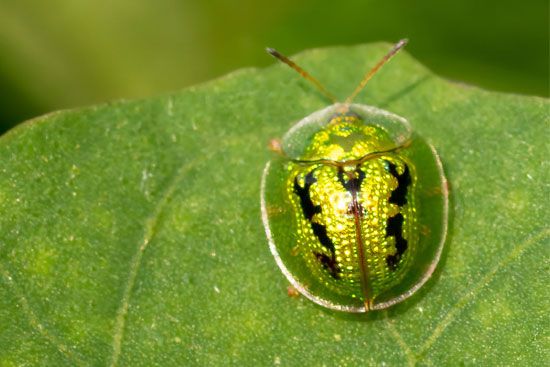
- Cucumber beetles: These greenish-yellow, spotted or striped leaf beetles are frequently seen in gardens, where they feed on various plants.5
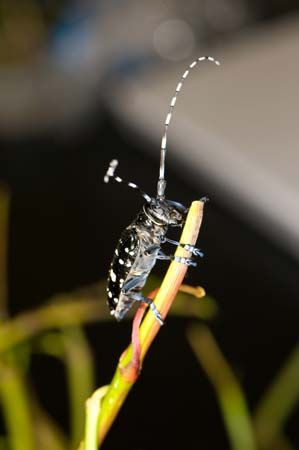
- Long-horned beetles: Named for their exceptionally long antennae, these beetles are often associated with trees and woody plants, where their larvae bore into wood.6
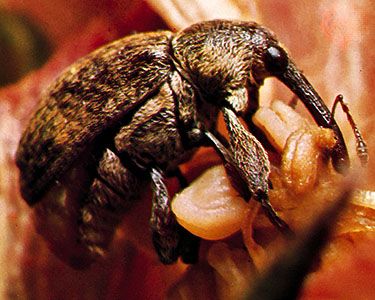
How have coleopteran insects adapted to different environments and diets?
Coleopteran insects, or beetles, have successfully adapted to nearly every habitat on Earth through specialized physical structures and diverse feeding strategies.5
Structural Adaptations
A defining adaptation of the order is the development of elytra—hardened front wings that protect the delicate flying wings beneath. This structure likely evolved to allow beetles to thrive in confined spaces, such as under tree bark, where their wings would otherwise be vulnerable to damage. Additionally, many species have evolved defensive mechanisms, such as the bombardier beetle, which can discharge a hot, foul-smelling gas to repel predators. Others utilize camouflage, mimicking moss or twigs, or feign death to avoid detection. Some species, like the flat bark beetle, have even adapted to extreme cold by producing specialized chemicals that act as cryoprotectants.891011
Dietary Adaptations
Beetles exhibit immense dietary flexibility, feeding on almost any plant or animal material. Their mouthparts are typically adapted for chewing, allowing them to exploit varied food sources:512
- Plant Feeders: Many species are phytophagous, consuming foliage, roots, blossoms, or boring into wood and fruit.5
- Predators: Many beetles, such as carabids and diving beetles, are active hunters that feed on other insects, snails, or small aquatic animals.5
- Scavengers: Others, including water scavenger beetles and dung beetles, play vital roles in ecosystems by consuming decaying organic matter, fungi, or excrement.5
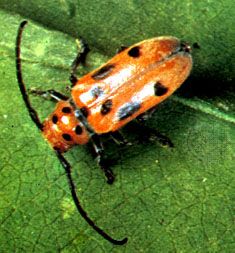
How do beetles’ wings and wing covers (elytra) function, and why are they important?
In beetles (Coleoptera), the wings are highly specialized to balance the needs of flight and protection. The insect’s mesothorax bears the forewings, which have evolved into thickened, horny structures known as elytra (singular: elytron).1415
Function and Importance
The primary function of the elytra is to serve as protective sheaths for the delicate, membranous hindwings located on the metathorax. When the beetle is at rest, the elytra fold over the abdomen, shielding the flight wings and the soft body parts beneath from environmental hazards.14151617
This structural adaptation is considered a key evolutionary development, likely emerging to allow beetles to inhabit confined or rugged spaces, such as under tree bark, where fragile wings would otherwise be easily damaged. While the elytra provide essential protection, the hindwings remain the primary organs for locomotion, capable of sustaining powerful flight in many species. In some beetles, however, these wings have become reduced or lost entirely, and in certain cases, the elytra themselves may be fused or absent.181415
What are some of the largest and smallest known coleopteran species?
Coleopteran insects, or beetles, exhibit an extraordinary range in size, spanning from microscopic organisms to some of the largest insects on the planet.1920
Largest Species
Beetles are among the most conspicuous insects due to their substantial size. Some of the largest include:20
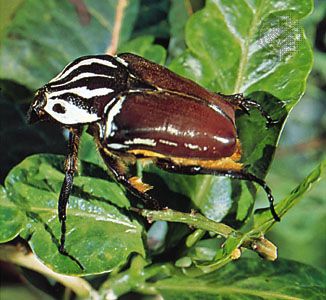
- Goliath Beetles (Goliathus species): These are among the heftiest insects alive. The goliath beetle (Goliathus goliathus) can reach lengths of up to 200 mm (almost 8 inches) and widths of 75 mm (2.95 inches). Their larvae are particularly massive, sometimes weighing nearly a quarter of a pound.1921
- Rhinoceros Beetles: Certain species, such as Xyloryctes satyrus, can also reach lengths exceeding 200 mm. Additionally, the larvae of the rhinoceros beetle Megasoma actaeon have been recorded at weights exceeding 200 grams (0.44 pound).1922
Smallest Species
At the other end of the spectrum, some beetles are among the smallest known arthropods.22
Sources
- Coleoptera — Encyclopædia Britannica
- ladybug — Encyclopædia Britannica
- List of insects - beetles and weevils (order Coleoptera) — Encyclopædia Britannica
- darkling beetle — Encyclopædia Britannica
- Coleoptera - Feeding habits and habitats — Encyclopædia Britannica
- cucumber beetle — Encyclopædia Britannica
- long-horned beetle — Encyclopædia Britannica
- 8 Animals That Live in Extreme Environments — Encyclopædia Britannica
- insect - Head — Encyclopædia Britannica
- Coleoptera - Evolution and paleontology — Encyclopædia Britannica
- Coleoptera - Distinguishing taxonomic features — Encyclopædia Britannica
- heteropteran - Mouthparts — Encyclopædia Britannica
- Coleoptera - Protection — Encyclopædia Britannica
- Coleoptera - Adult features — Encyclopædia Britannica
- insect - Thorax — Encyclopædia Britannica
- net-winged beetle — Encyclopædia Britannica
- heteropteran - Wings — Encyclopædia Britannica
- elytron — Merriam-Webster
- arthropod - Size range — Encyclopædia Britannica
- feather-winged beetle — Encyclopædia Britannica
- Big Bugs and Colossal Crabs: 7 Invertebrates of Unusual Size — Encyclopædia Britannica
- Coleoptera - Size range and diversity of structure — Encyclopædia Britannica
Published on · 4 min read