Biochemical Oxygen Demand
Biochemical oxygen demand (BOD) is the amount of dissolved oxygen required by microorganisms to metabolize organic matter present in water.
What is biochemical oxygen demand?
Biochemical oxygen demand (BOD) is the amount of dissolved oxygen required by microorganisms to metabolize organic matter present in water.12
Because microorganisms consume oxygen as they break down organic material, high levels of organic pollutants—such as those found in sewage—lead to a higher BOD. This process is significant because a high BOD reduces the oxygen available for aquatic life, such as fish, which can be detrimental to water resources, which can be detrimental to water resources. Consequently, BOD serves as a critical indicator of pollution levels in a body of water.1
To protect ecosystems, wastewater treatment facilities are designed to reduce the organic content of effluent before it is discharged, thereby lowering its BOD and preventing the depletion of oxygen in receiving streams, lakes, and rivers.1
How does wastewater treatment reduce BOD levels?
Wastewater treatment facilities reduce biochemical oxygen demand (BOD) primarily through biological processes that remove soluble organic matter. The reduction occurs across different stages of treatment:34
- Primary Treatment: This initial step removes approximately 35 percent of BOD by settling out suspended solids, though it does not address dissolved impurities.4
- Secondary Treatment: This stage is essential for significant BOD reduction, typically removing more than 85 percent of organic matter. It utilizes microorganisms to consume organic impurities as food, converting them into carbon dioxide, water, and energy. Common methods include:43
- Activated Sludge Process: Wastewater is mixed with an active suspension of microorganisms in an aeration tank. Compressed air or mechanical mixers provide oxygen, allowing the microbes to metabolize dissolved organics efficiently.1
- Other Biological Methods: Techniques such as trickling filters, oxidation ponds, and rotating biological contactors also provide environments for microbes to break down organic pollutants.3
- Tertiary Treatment: When higher levels of purification are required, advanced processes can remove more than 99 percent of impurities, further lowering BOD.4
By removing these organic materials before discharge, treatment plants protect the dissolved oxygen balance in receiving water bodies.35
What happens to fish when dissolved oxygen levels drop?
When dissolved oxygen levels in water drop significantly—a condition known as hypoxia—it poses a severe threat to fish and other aquatic life.
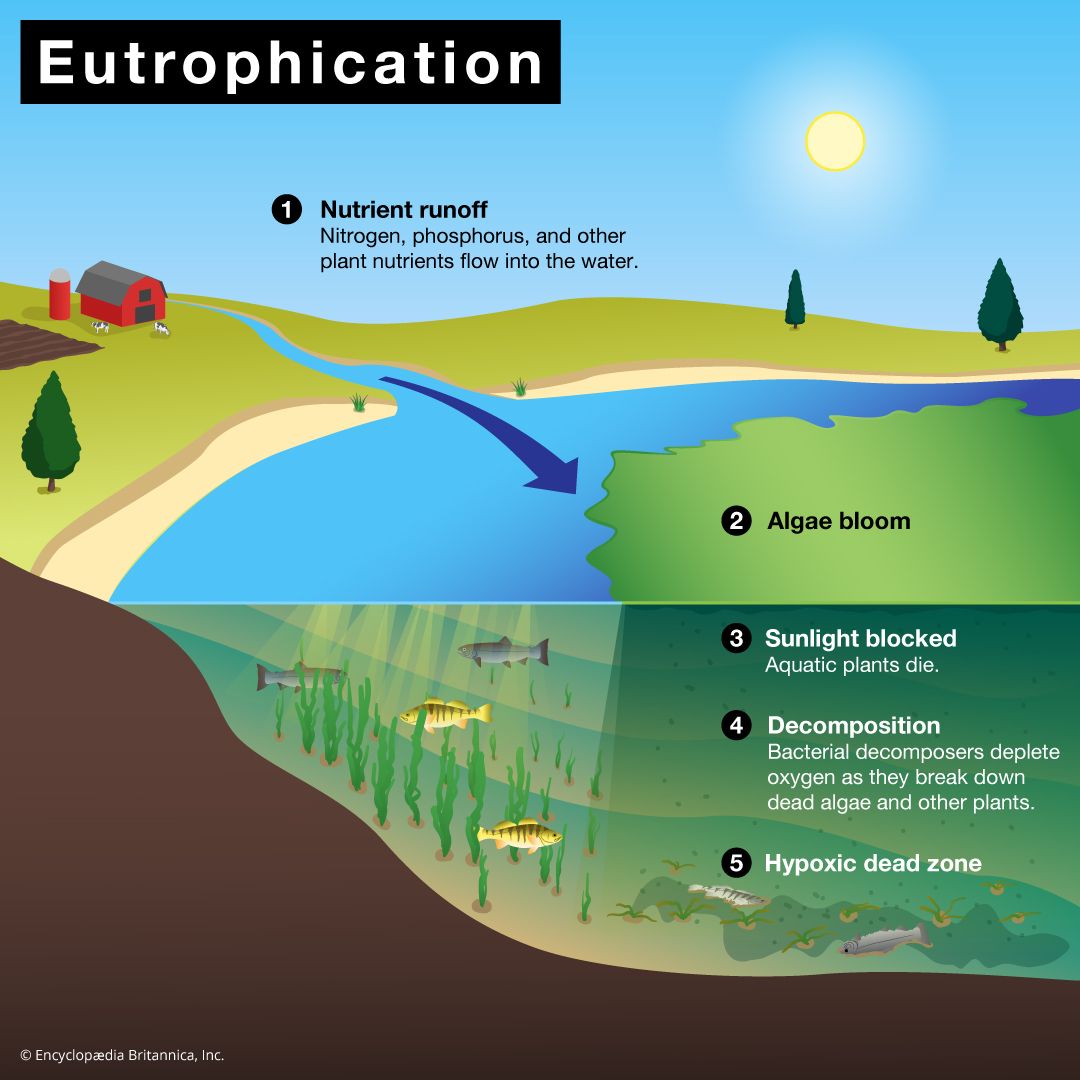
Because fish rely on their gills to extract oxygen directly from the water, they are highly sensitive to changes in oxygen concentration. When levels fall below critical thresholds, such as one milligram per liter, fish may suffer from physiological stress or death. In extreme cases, such as those caused by cultural eutrophication, this leads to massive fish kills, which can disrupt the entire food chain and devastate local fisheries and economies.7
Furthermore, the water blooms that often accompany these low-oxygen conditions can exacerbate the problem by blocking light and, in some instances, releasing toxins that poison wildlife.7
What are the main sources of organic pollution in water?
Organic pollution in water primarily stems from human activities that introduce putrescible substances into aquatic environments. The main sources include:
- Domestic Sewage: This is a primary source of organic matter. Municipal sewage from cities and towns contains human waste and other biodegradable organics that, when discharged into surface waters, require significant oxygen for decomposition.910
- Industrial Waste: Various industrial processes, such as those in chemical-processing facilities, steel mills, and food production, generate organic-rich wastewater. Industrial sewage can have biochemical oxygen demand (BOD) levels significantly higher than those found in domestic sewage.1110
- Agricultural Runoff: While often associated with nutrients, agricultural runoff contributes to organic pollution by transporting plant matter and fertilizers into waterways. These nutrients trigger algal blooms; when these massive quantities of algae die, their subsequent decomposition by microorganisms consumes vast amounts of dissolved oxygen.910
- Storm Sewage: In areas with combined sewerage systems, storm runoff can mix with domestic sewage, creating high-BOD surges that overwhelm treatment systems and discharge organic pollutants directly into receiving waters.11
Sources
- biochemical oxygen demand — Encyclopædia Britannica
- biochemical oxygen demand — Merriam-Webster
- wastewater treatment - Secondary treatment — Encyclopædia Britannica
- wastewater treatment - Activated sludge — Encyclopædia Britannica
- wastewater treatment - Wastewater treatment and disposal — Encyclopædia Britannica
- wastewater treatment - Digestion — Encyclopædia Britannica
- 14 Questions About Aquatic Animals Answered - How do fish breathe underwater? — Encyclopædia Britannica
- eutrophication — Encyclopædia Britannica
- water pollution - Domestic sewage — Encyclopædia Britannica
- wastewater treatment - Organic material — Encyclopædia Britannica
- river - Environmental problems attendant on river use — Encyclopædia Britannica
Published on · 3 min read