Food Chain
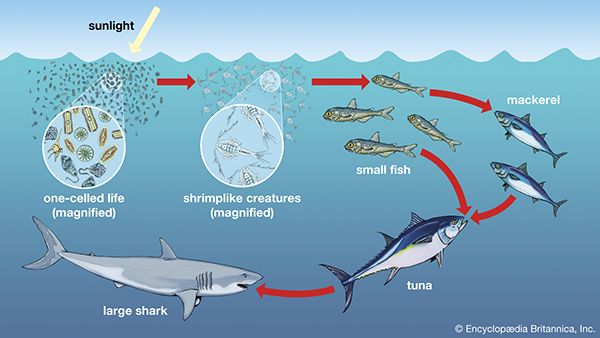
In an ecosystem, energy and nutrients move through a food chain via distinct processes. Energy flows in a one-way direction, while nutrients are continuously…
How do energy and nutrients flow through a food chain?
In an ecosystem, energy and nutrients move through a food chain via distinct processes. Energy flows in a one-way direction, while nutrients are continuously recycled.1
Energy Flow
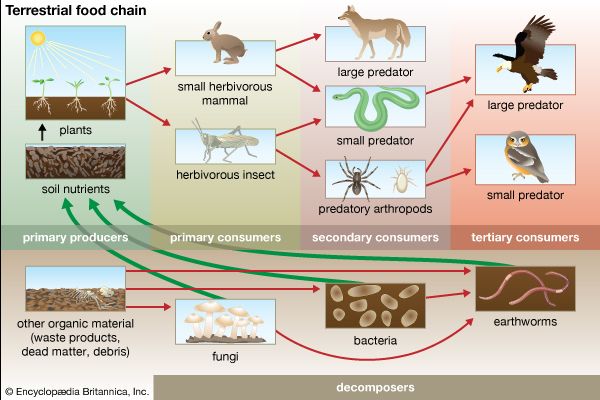
The Sun serves as the primary energy source for most ecosystems. Autotrophs (producers), such as plants, capture solar energy through photosynthesis and convert it into chemical energy. As this energy moves up the trophic levels—from producers to primary, secondary, and tertiary consumers—a significant portion is lost as heat due to metabolic processes. Because of this loss, only about 10 percent of energy is typically transferred between levels, limiting the length of food chains.213456
Nutrient Cycling
Unlike energy, nutrients are chemical elements that are recycled. Decomposers and detritivores break down dead organic matter, returning essential elements like nitrogen, carbon, and phosphorus to the environment. These nutrients are then taken up by producers to support growth, continuing the cycle through biogeochemical cycles the cycle through biogeochemical cycles.124
How do keystone species influence food chains and ecosystem stability?
Keystone species are organisms that exert a disproportionately large influence on their environment relative to their abundance, playing a critical role in maintaining biodiversity and ecosystem structure.78
Mechanisms of Influence
Keystone species stabilize ecosystems through two primary methods:
- Population Control: Many are apex predators that regulate the numbers of dominant species. For example, the starfish Pisaster ochraceus prevents mussels from monopolizing rocky intertidal shores, allowing other species to thrive.78
- Resource Provisioning: Some species, such as figs, act as essential food sources during periods of scarcity, supporting a wide array of birds and mammals that might otherwise disappear.78
Trophic Cascades
The removal or addition of these species often triggers a trophic cascade, where changes at one level of a food chain cause reciprocal population shifts throughout the entire web. For instance, the loss of sea otters leads to an overabundance of sea urchins, which can decimate kelp forests. Because these interactions dictate nutrient cycling and primary production, the conservation of keystone species is vital for maintaining the health and stability of natural ecosystems.9
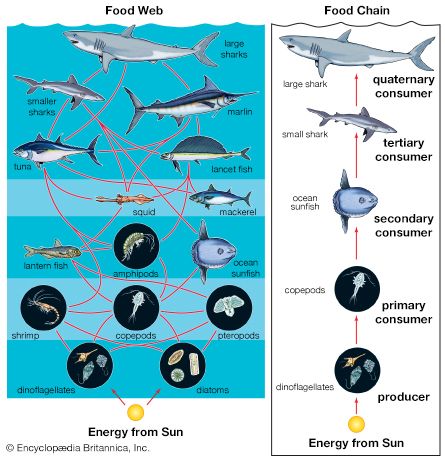
What is a food chain and how does it relate to the broader concept of a food web?
A food chain is the linear sequence of transfers of matter and energy from one organism to another within an ecosystem. These chains are organized into trophic levels, starting with producers (such as plants) that convert solar energy into food, followed by various levels of consumers and decomposers. Because energy is lost as heat at each step, food chains typically consist of only four or five levels.11011
In contrast, a food web is a complex network of interconnecting and overlapping food chains. While a food chain illustrates a single path of consumption, a food web provides a more accurate representation of an ecosystem by showing how most organisms consume or are consumed by multiple species. Many organisms participate in several food chains simultaneously, and food webs account for these diverse feeding relationships, such as omnivores that feed across multiple trophic levels.1110
How do invasive species disrupt existing food chains in an ecosystem?
Invasive species disrupt existing food chains by introducing nonnative organisms that possess competitive advantages over indigenous species, often because the new environment lacks natural predators to keep their populations in check. This disruption typically manifests in several ways:12
- Predation: Invasive predators can be highly efficient at capturing prey, leading to rapid population declines or the localized extinction of native species. For example, the brown tree snake caused the extinction of several bird and reptile species on Pacific islands.12913
- Resource Competition: Invasive species may outcompete native organisms for essential resources like food, sunlight, and living space. Kudzu, for instance, deprives native plants of sunlight, while Asian carp consume vast amounts of algae and zooplankton, leaving little for native fish.12913
- Disease Transmission: Invasive species often serve as vectors for parasites and pathogens to which native populations have no natural resistance.1213
These actions can trigger trophic cascades, where the loss of a native species causes reciprocal, often damaging, shifts in the populations of other organisms throughout the food web.1413
Sources
- food chain — Encyclopædia Britannica
- food web — Encyclopædia Britannica
- community ecology - Autotrophs and heterotrophs — Encyclopædia Britannica
- ecosystem — Encyclopædia Britannica
- food: Top Questions — Encyclopædia Britannica
- Biosphere - Energy transfers and pyramids — Encyclopædia Britannica
- keystone species — Encyclopædia Britannica
- community ecology - Keystone species — Encyclopædia Britannica
- trophic cascade — Encyclopædia Britannica
- food chain — Merriam-Webster
- trophic level — Encyclopædia Britannica
- invasive species — Encyclopædia Britannica
- invasive species - A global problem — Encyclopædia Britannica
- invasive species - Solutions — Encyclopædia Britannica
- conservation - Associated difficulties and costs — Encyclopædia Britannica
- habitat loss — Encyclopædia Britannica
Published on · 3 min read