Eutrophication
Eutrophication, particularly the human-accelerated process known as cultural eutrophication, creates significant economic and social challenges by degrading…
What are some of the economic and social impacts of eutrophication?
Eutrophication, particularly the human-accelerated process known as cultural eutrophication, creates significant economic and social challenges by degrading aquatic ecosystems.123
Economic Impacts
- Fisheries and Industry: Massive fish kills caused by hypoxia (oxygen depletion) directly damage local fisheries and the broader food chain, leading to substantial economic losses.1
- Maintenance Costs: Excessive growth of aquatic plants and algae clogs irrigation and drainage infrastructure, which increases maintenance costs and reduces the operational capacity of these systems.4
- Water Quality: The degradation of water bodies necessitates increased investment in wastewater treatment and pollution control to restore usability for human consumption and industry.13
Social Impacts
- Public Health: Contaminated water can pose direct threats to human health. For instance, high levels of nitrates and nitrites in groundwater can be toxic to both humans and livestock.34
- Recreation: The murky, algae-filled state of eutrophic waters diminishes the value of recreational bodies of water, limiting their use for tourism and leisure.1
What is eutrophication and how does it occur in aquatic ecosystems?
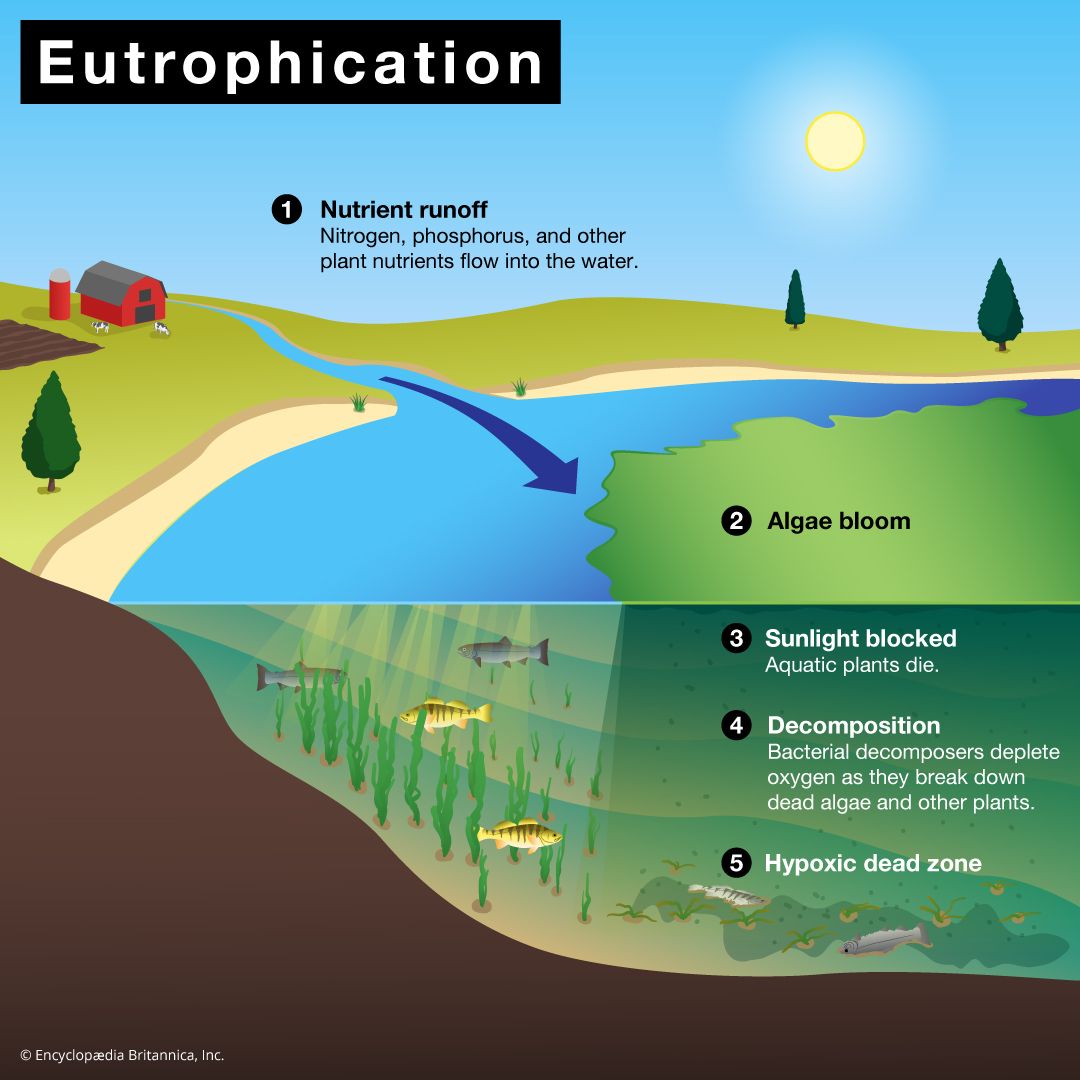
Eutrophication is the gradual increase in the concentration of phosphorus, nitrogen, and other plant nutrients within an aquatic ecosystem, such as a lake or coastal marine system. While this process occurs naturally over long periods as organic material accumulates, human activities—a process known as cultural eutrophication—can drastically accelerate it.21
How It Occurs
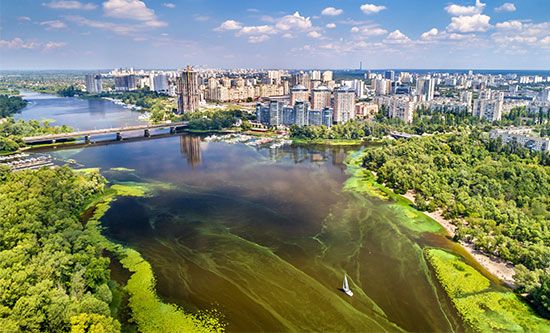
The process is driven by the influx of nutrients from sources such as agricultural fertilizer runoff, municipal sewage treatment, detergents, and animal waste2. These nutrients stimulate the excessive growth of algae and phytoplankton, resulting in water blooms.26
These blooms create several ecological consequences:
- Light and Oxygen Depletion: Dense surface blooms prevent light from penetrating the water, hindering the growth of underwater plants and reducing oxygen absorption.2
- Hypoxia: As the massive amounts of algae die and decompose, the process consumes the available dissolved oxygen, leading to hypoxia—a state of extremely low oxygen.26
- Dead Zones: In these oxygen-depleted environments, fish, mollusks, and other bottom-dwelling organisms often suffocate, creating “dead zones” where little life can survive.76
How does eutrophication affect the oxygen levels in water bodies?
Eutrophication significantly reduces oxygen levels in water bodies through a chain of biological and chemical reactions triggered by nutrient enrichment. When excessive nutrients—primarily nitrogen and phosphorus from sources like fertilizer runoff and sewage treatment—enter an aquatic ecosystem, they stimulate rapid, massive growth of algae and phytoplankton, known as water blooms.281
These blooms impact oxygen levels in two primary ways:
- Reduced Absorption: Dense surface blooms prevent sunlight from penetrating the water, which inhibits the growth of submerged plants and limits the natural oxygen absorption necessary for aquatic life.8
- Decomposition and Hypoxia: As the massive quantities of algae die, they sink and are broken down by aerobic microorganisms. This decomposition process consumes vast amounts of dissolved oxygen, a measurement known as biochemical oxygen demand (BOD).869
When the demand for oxygen exceeds the available supply, the water becomes hypoxic, creating “dead zones” where oxygen levels are too low to support fish, mollusks, and other aquatic organisms, often leading to massive die-offs.281
What are some examples of ecosystems that have been severely affected by eutrophication?
Cultural eutrophication, driven by human activities such as agricultural runoff and sewage discharge, has severely impacted numerous aquatic ecosystems worldwide. These environments often experience “dead zones”—areas of extreme oxygen depletion (hypoxia) where aquatic life struggles to survive.111
Notable examples of ecosystems affected by this process include:
- Lake Erie: During the 1960s and 1970s, this lake experienced such extreme eutrophication due to nutrient loading that it became widely known as the “dead lake,” serving as a prominent example of the consequences of human-induced pollution.11
- Chesapeake and Delaware Bays: These eastern U.S. estuaries have faced significant degradation. By the 1970s, residential and industrial development led to heavy pollution, causing a sharp decline in fish and shellfish populations.13
- Gulf of Mexico: The outflow of the Mississippi River carries massive amounts of nitrogen and phosphates from agricultural runoff into the gulf. This has led to an increase in the frequency and size of hypoxic “dead zones,” which can span thousands of square miles.12
- The Black Sea: This region has suffered from massive fish kills and widespread disruption to the food chain due to hypoxic waters resulting from cultural eutrophication.1
- European Estuaries: Systems such as the Scheldt in Belgium and the Netherlands, as well as the North Sea, have experienced significant biotic shifts, including a decrease in diatom productivity and an increase in cyanobacteria due to nutrient imbalances.17
Sources
- eutrophication — Encyclopædia Britannica
- eutrophication Has Greek Roots — Merriam-Webster
- hydrosphere - Eutrophication — Encyclopædia Britannica
- water pollution - Domestic sewage — Encyclopædia Britannica
- Agricultural technology - Plant nutrients — Encyclopædia Britannica
- conservation - Pollution — Encyclopædia Britannica
- hydrologic sciences - The history of lakes — Encyclopædia Britannica
- Algae - Distribution and abundance — Encyclopædia Britannica
- biochemical oxygen demand — Encyclopædia Britannica
- biochemical oxygen demand — Merriam-Webster
- plant - Changes in biosystems: pollution — Encyclopædia Britannica
- Chesapeake Bay — Encyclopædia Britannica
- Gulf of Mexico / Gulf of America - Study and the impact of human activity — Encyclopædia Britannica
Published on · 4 min read
