Grassland
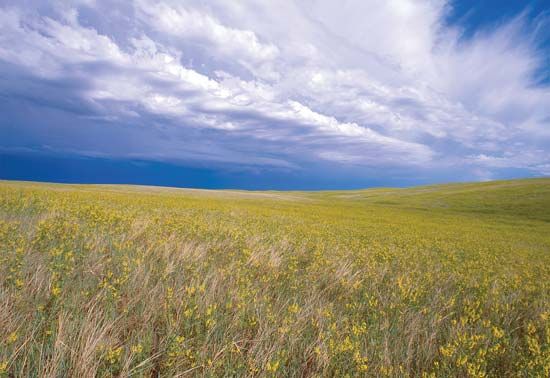
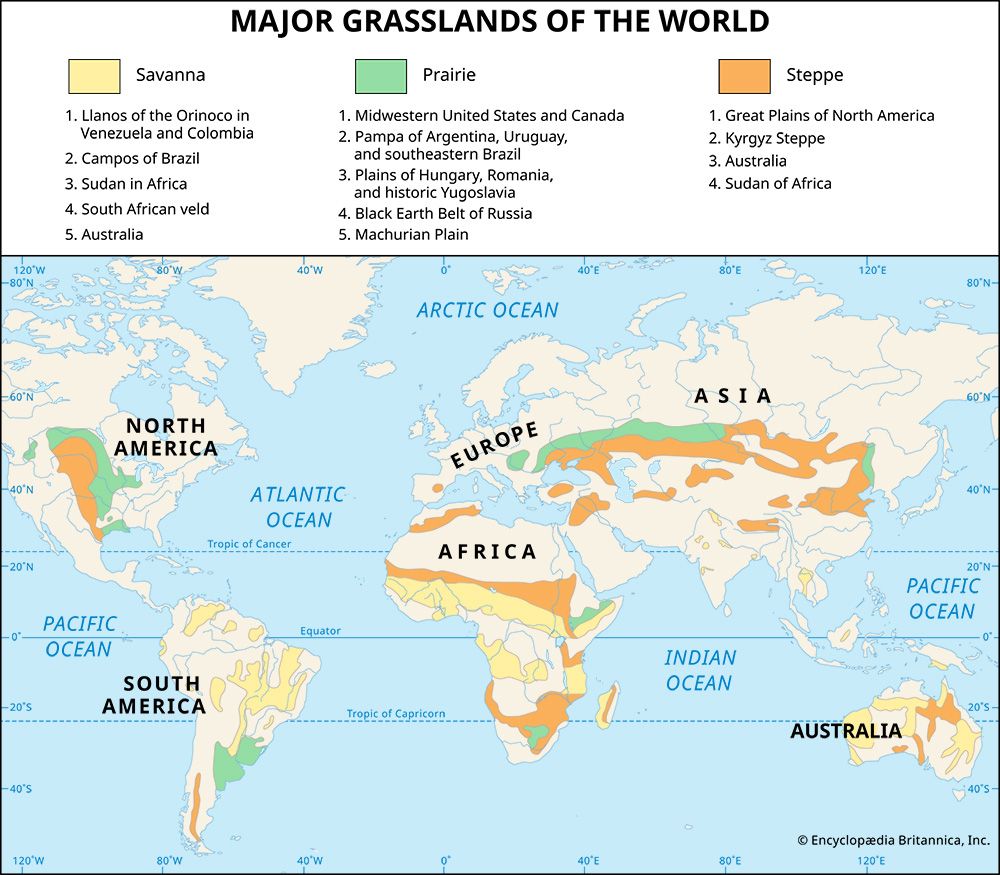
Natural grasslands are primarily categorized into two broad types based on their climatic conditions: tropical grasslands and temperate grasslands.
What are the main types of grasslands found around the world?
Natural grasslands are primarily categorized into two broad types based on their climatic conditions: tropical grasslands and temperate grasslands.1
Tropical Grasslands
These regions generally lie between tropical forests and deserts, experiencing high temperatures (15 to 35 °C) and distinct wet and dry seasons. They are often associated with savannas, which are distinguished by the presence of scattered trees. Major examples include the Sahel in Africa, parts of East Africa, and regions in Australia.21
Temperate Grasslands
These areas are typically colder and drier than tropical grasslands, with significant seasonal temperature variations. They include:2
- Steppes: Vast, tree-less plains with low rainfall, such as the Eurasian Steppe.3
- Prairies: Found primarily in North America, these are often subdivided into tallgrass, mixed-grass, and shortgrass subtypes based on moisture levels.4
- Tussock Grasslands: Characterized by bunch grasses that form a lumpy, matted appearance, common in cool, moist regions like New Zealand and subantarctic islands.1
What is the importance of grasslands in carbon sequestration?
Grasslands play a critical role in the global carbon cycle, serving as one of the world’s largest terrestrial carbon reservoirs. They account for approximately one-third of all carbon stored on land.8
The importance of grasslands in carbon sequestration—the process of capturing and storing atmospheric carbon dioxide—is largely found beneath the surface. While many studies have historically focused on aboveground biomass, the subterranean component of grasslands is significantly more substantial, sometimes reaching up to 10 times the mass of the aboveground portion. This underground storage is vital because it keeps carbon sequestered in the soil, preventing it from being released into the atmosphere as carbon dioxide.89
However, this carbon pool is vulnerable. Human activities, such as converting grasslands to cropland or engaging in sustained heavy grazing, can disrupt the natural balance of these ecosystems. Such disturbances often lead to the degradation of vegetation and soil erosion, which can trigger the release of stored carbon back into the atmosphere.89
How do grazing animals influence grassland ecosystems?
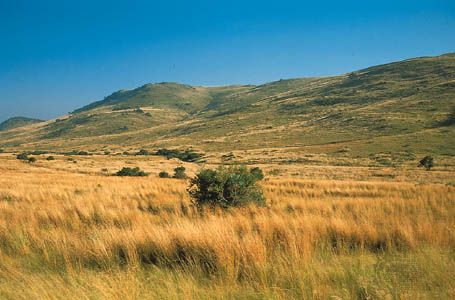
Grazing animals exert a profound influence on grassland ecosystems, acting as both natural regulators and potential agents of degradation depending on the intensity and management of their presence.611
Ecological Roles and Impacts
- Vegetation Composition: Herbivores alter plant communities by selectively consuming certain species while leaving others untouched. This selective pressure can provide a competitive advantage to inedible or less palatable plants, such as cacti or woody shrubs, which may eventually dominate the landscape if grazing is too intense.11
- Soil Health: Grazing activities can significantly impact soil structure. Livestock movement can compact the soil, which hinders root development and reduces water infiltration. Furthermore, trampling can destroy the plant roots that bind soil together, leading to increased runoff and topsoil erosion during rain events.11
- Nutrient and Energy Cycling: Grazing animals facilitate the turnover of plant matter. While they consume vegetation, their presence also influences the rate at which organic matter is processed within the ecosystem. In some regions, such as the Eurasian steppe, the burrowing and feeding activities of rodents are essential for maintaining the composition and health of the vegetation.67
Management and Sustainability
The distinction between sustainable grazing and overgrazing is critical. While moderate grazing can be a natural component of these ecosystems, sustained heavy grazing often leads to:
- Degradation: The reduction of forage production and the loss of native plant diversity.11
- Desertification: In vulnerable regions like the Sahel, overgrazing has contributed to the expansion of desert conditions.11
- Management Strategies: Effective range management focuses on regulating the number, duration, and season of grazing. Practices such as rotational grazing—moving livestock frequently to prevent permanent damage—are essential for maintaining the long-term productivity of rangelands.11
What are some common plant species found in grassland ecosystems?
Grassland ecosystems are characterized by a diverse array of plant species, primarily dominated by perennial grasses that have adapted to survive seasonal droughts and periodic disturbances like fire and grazing.57
Common Grass Species
The composition of these ecosystems varies significantly by region and moisture availability:
- North American Prairies: These are often categorized by height. Tallgrass prairies feature species like big bluestem, little bluestem, prairie cordgrass, and Indian grass5. Drier regions support midgrass and shortgrass species, including needlegrass, grama grass, wheatgrass, and buffalo grass.12135
- Global Grasslands:
- Eurasian Steppe: Frequently dominated by various species of Stipa (needlegrass), Festuca (fescue), and Agropyron (wheatgrass).12
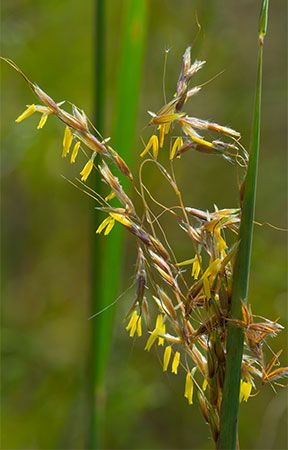
- African Savannas: Common grasses include bluestem (Andropogon), thatching grass (Hyparrhenia), kangaroo grass (Themeda), and elephant grass.1
- Australian Grasslands: Often feature spinifex (Triodia and Plectrachne), Mitchell grass (Astrebla), and spear grass.121
- South American Pampas: Diverse species of Stipa, Paspalum, and Andropogon are prevalent.12
Other Vegetation
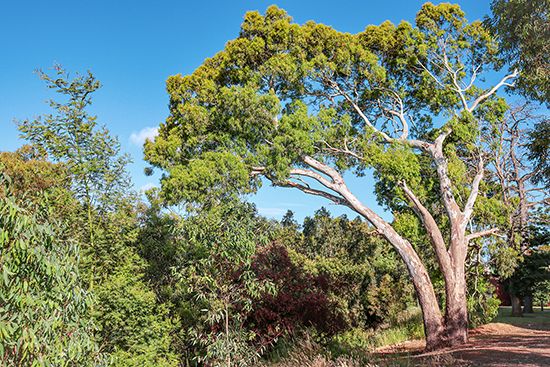
While grasses dominate, these ecosystems also host a variety of herbaceous plants, forbs, and, in the case of savannas, scattered trees such as acacia, baobab, and eucalyptus.121
Sources
- Grassland - Environment — Encyclopædia Britannica
- Grassland - Origin — Encyclopædia Britannica
- Steppe — Encyclopædia Britannica
- Savanna - Origin — Encyclopædia Britannica
- Prairie — Encyclopædia Britannica
- Grassland - Biological productivity — Encyclopædia Britannica
- Grassland - Biota — Encyclopædia Britannica
- soil - Soils and global warming — Encyclopædia Britannica
- carbon sequestration — Merriam-Webster
- soil - Carbon and nitrogen cycles — Encyclopædia Britannica
- Rangeland — Encyclopædia Britannica
- Savanna - Population and community development and structure — Encyclopædia Britannica
- Savanna - Flora — Encyclopædia Britannica
- Grassland - Population and community development and structure — Encyclopædia Britannica
- North America - Temperate grasslands — Encyclopædia Britannica
Published on · 4 min read