Biting Midge
A biting midge (family Ceratopogonidae) is a tiny, bloodsucking insect belonging to the order Diptera. Often measuring only about 1 mm (0.04 inch) in length…
What is biting midge?
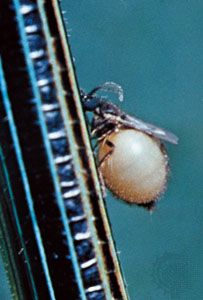
A biting midge (family Ceratopogonidae) is a tiny, bloodsucking insect belonging to the order Diptera. Often measuring only about 1 mm (0.04 inch) in length, these insects are frequently called “no-see-ums” because their irritating bites are felt even though the insects themselves are difficult to spot.12
Only the females possess the bladelike, piercing mouthparts necessary to feed on blood, which they require for egg production. While they are notorious pests near seashores, lakes, and rivers, they are distinct from the nonbiting midge (family Chironomidae), which lacks the structures for blood feeding.314
Although some biting midges can act as vectors for filarial worms, many common species that attack humans—such as those in the genera Culicoides and Leptoconops—are not known to transmit diseases to people. Their larvae typically develop in moist soil, under tree bark, or in fresh and brackish water.12
Why do only female biting midges feed on blood?
It is a common misconception that all biting midges feed on blood; in reality, only the females possess the specialized, piercing mouthparts required to do so. Similar to mosquitoes, female biting midges require a blood meal to obtain the proteins and iron necessary for the maturation of their eggs.54
While the female seeks out blood to support her reproductive cycle, both males and non-fertilized females typically sustain themselves on flower nectar, serving as pollinators in their environments. The blood-feeding behavior is strictly a functional adaptation for egg production, which is why the males, who do not participate in reproduction in this manner, lack the anatomy to bite.54
What are some other common insects that are often mistaken for biting midges?
Because biting midges are extremely small and often appear in swarms, they are frequently confused with other tiny flies. The term “gnat” is often used as a catch-all name for these insects, leading to significant overlap in common terminology.1
Common insects often mistaken for biting midges include:
- Nonbiting Midges (family Chironomidae): These insects superficially resemble mosquitoes and biting midges but are harmless. They lack the specialized, piercing mouthparts required for blood feeding and are often found swarming near ponds or streams.21
- Mosquitoes: While often larger than biting midges, mosquitoes are frequently confused with them due to their similar swarming behavior and blood-feeding habits.21
- Black Flies: In North America, these are sometimes colloquially referred to as gnats and are often grouped with biting midges due to their tendency to annoy humans and animals.1
- Fungus Gnats and Fruit Flies: These small flies are also frequently lumped into the general category of “gnats” because of their size and tendency to hover around humans or plants.1
How do scientists distinguish between different species of biting midges?
Scientists distinguish between different species of biting midges (family Ceratopogonidae) primarily through detailed morphological analysis. Because these insects are extremely small—often measuring only about 1 mm (0.04 inch) in length—specialized microscopic examination is required to identify specific traits.4
Taxonomists focus on several key anatomical features to differentiate between genera such as Culicoides and Leptoconops:
- Wing Venation: The pattern of veins on the wings is a critical diagnostic feature used to categorize these flies.1
- Mouthparts: While all biting midges possess piercing mouthparts, subtle variations in the structure of these appendages help distinguish between species.4
- Antennae and Sensory Organs: The structure of the antennae and other sensory structures often varies between species and sexes.1
- Larval Habitat: Because different species occupy distinct ecological niches—ranging from fresh or brackish water to moist soil or under tree bark—the environment in which the larvae are found can provide significant clues for identification.4
Sources
- biting midge — Encyclopædia Britannica
- biting midge — Merriam-Webster
- Diptera - Importance — Encyclopædia Britannica
- midge — Encyclopædia Britannica
- Why do mosquitoes drink blood? — Encyclopædia Britannica
- gnat — Encyclopædia Britannica
Published on · 3 min read