Bittern
Bitterns exhibit significant variation in sexual dimorphism depending on their genus. In the genus Botaurus, which includes large species like the American…
How do male and female bitterns differ in appearance or behavior?
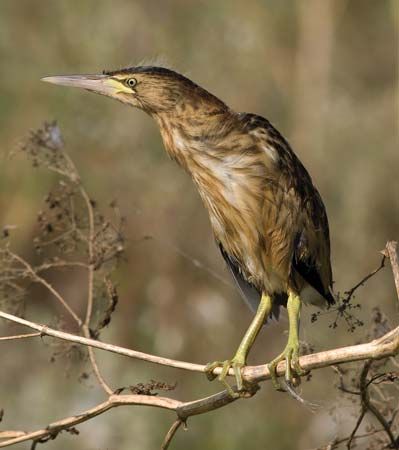
Bitterns exhibit significant variation in sexual dimorphism depending on their genus. In the genus Botaurus, which includes large species like the American bittern, the sexes look alike. Their behavior differs during the breeding season, as males produce booming calls to attract mates, while females are responsible for nesting duties, including constructing a crude nest and incubating the eggs.1
Conversely, in the genus Ixobrychus, which consists of smaller species, the sexes are unlike in appearance. Unlike their larger relatives, both the male and female share nesting responsibilities.1
It is important to note that the sun bittern, a distinct species, is not a true bittern. In this species, both sexes participate in incubation, and the male utilizes his strikingly patterned wings for courtship and threat displays.2
Where are bitterns typically found and what is their preferred habitat?
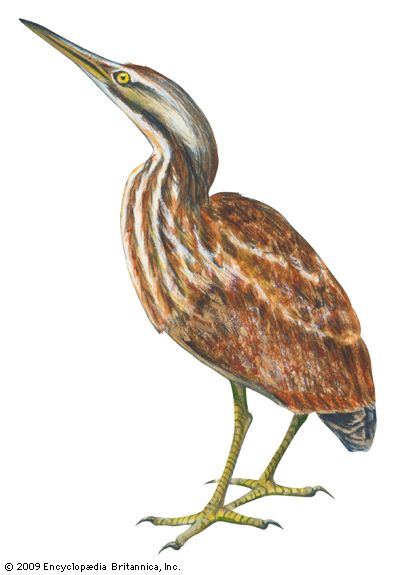
Bitterns are solitary marsh birds found almost worldwide, belonging to the subfamily Botaurinae. Their preferred habitat consists of swamps and marshes, where they rely on dense vegetation for survival.1
These birds have evolved a camouflage pattern of variegated brown and buff streaks that allows them to blend into their surroundings. When threatened, they escape detection by standing upright with their bills pointed toward the sky, effectively mimicking the reeds and grasses of their environment. They hunt small swamp animals, such as fish, frogs, and crayfish, by spearing them with their sharp-pointed bills.1
While the 12 species of true bitterns are widespread, the unrelated sun bittern is found specifically in tropical America, where it prefers to live on the ground along forest streams.2
What are the breeding habits and nesting behaviors of bitterns?
Breeding and nesting habits among bitterns vary significantly between the two primary genera, Botaurus and Ixobrychus. Unlike many other ciconiiforms, bitterns are not gregarious and do not nest in colonies.
Genus Botaurus
These larger bitterns are typically found in temperate regions. During the spring, males perform courtship by emitting booming calls to attract mates. In this genus, the female is solely responsible for nesting duties. She constructs a crude platform of vegetation near the water level and typically lays a clutch of four to six olive-brown eggs, which she incubates alone while also tending to the young.13
Genus Ixobrychus
These smaller bitterns exhibit different social dynamics, as the sexes share nesting responsibilities, including incubation and chick rearing. They build neat nests placed well above the water level, sometimes even in trees. Their clutches are larger, consisting of up to 10 white, bluish, or greenish eggs.1
What are the different species of bitterns and how do they differ?
There are 12 species of bitterns, which are solitary marsh birds belonging to the subfamily Botaurinae. They are categorized into two distinct genera based on size and behavior:
Genus Botaurus
These are large birds primarily found in temperate regions. The sexes look alike, and males are known for their booming courtship calls.
- Eurasian bittern (B. stellaris): The largest species, reaching up to 75 cm.
- American bittern (B. lentiginosus): Slightly smaller than the Eurasian variety.
- Australian bittern (B. poiciloptilus).
- South American (pinnated) bittern (B. pinnatus).
Genus Ixobrychus
These are smaller birds (30–40 cm) where the sexes differ in appearance and share nesting duties.
- Least bittern (I. exilis): Found in America.
- Little bittern (I. minutus): Found in Eurasia, Africa, and Australia.
- Chinese little (yellow) bittern (I. sinensis).
- Variegated (stripe-backed) bittern (I. involucris): Found in South America.
- African dwarf bittern (I. sturmii).
- Schrenk’s little bittern (I. eurhythmus): Found in southeastern Asia.
- Cinnamon little (chestnut) bittern (I. cinnamomeus): Found in southeastern Asia.
- Black mangrove bittern (I. flavicollis): The largest of this genus, sometimes classified as Dupetor.
Note that the sun bittern is an unrelated species from tropical America.
Sources
- Bittern — Encyclopædia Britannica
- Sun bittern — Encyclopædia Britannica
- Ciconiiform - Reproduction and nesting — Encyclopædia Britannica
- Heron — Encyclopædia Britannica
Published on · 3 min read