Blackbird
The term "blackbird" does not refer to a single, taxonomically distinct group with a specific number of species. Instead, it is a common name applied to two…
How many species of blackbirds exist, and where are they commonly found?
The term “blackbird” does not refer to a single, taxonomically distinct group with a specific number of species. Instead, it is a common name applied to two unrelated types of birds:12
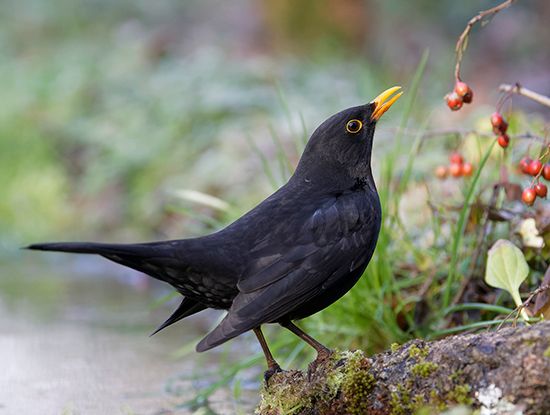
- Old World Blackbird (Turdus merula): This is a member of the thrush family. It is commonly found in woods and gardens throughout temperate Eurasia and northern Africa, and it has been established in Australia and New Zealand.12
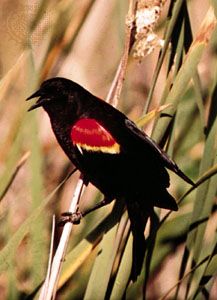
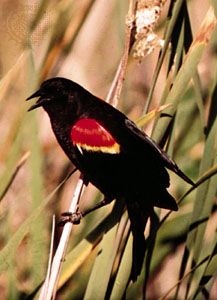
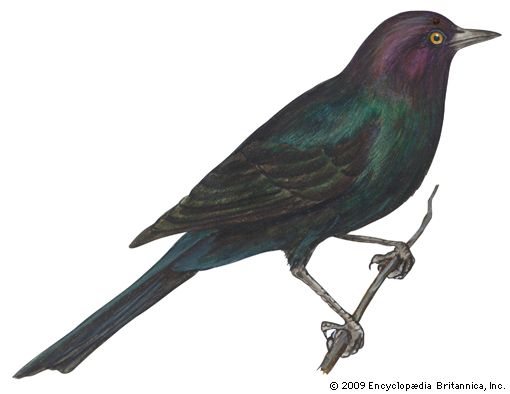
- New World Blackbirds: These belong to the Icteridae family, a diverse group of about 100 species found throughout the Americas. Well-known examples include the red-winged blackbird, the rusty blackbird, and Brewer’s blackbird, which are distributed across regions ranging from Canada to South America.13
Because “blackbird” is a colloquial name rather than a scientific classification, there is no fixed count of how many species exist under this label.12
How do blackbirds communicate and what are their common vocalizations?
Blackbirds, like other birds, rely heavily on auditory signals for communication and social interaction. While “blackbird” refers to diverse species—including the Old World thrush (Turdus merula) and various New World icterids—their communication strategies generally follow patterns common to many songbirds.145
Common Vocalizations
- Song: Typically used by males, especially during the breeding season, to establish and maintain territories and to attract mates. These songs are often complex and can be used by individuals to recognize mates and neighbors.14
- Alarm Notes: These serve to alert others to the presence of danger. Many species use distinct notes to differentiate between threats, such as a predator seen overhead versus one on the ground.1
- Location Notes: Soft calls used by pairs or flocks to maintain contact and stay together.1
- Begging Calls: Vocalizations produced by nestlings to stimulate parents to provide food.1
- Aggressive and Courtship Calls: Specific sounds associated with mating rituals or territorial disputes.1
Communication is facilitated by both genetic predisposition and environmental learning, with many birds developing their songs by practicing and referring to a “song template” stored in the brain.6
What are the breeding and nesting habits of blackbirds?
The breeding and nesting habits of blackbirds are diverse, reflecting the varied behaviors found within the Icteridae family and other groups commonly called blackbirds.78
Breeding and Territoriality
Most blackbirds are solitary nesters, with monogamous pairs defending a territory that supports their breeding activities, including courtship, mating, and food gathering. However, some species, such as the North American red-winged blackbird, maintain territories for nesting but forage for food outside of these defended areas. In contrast, certain members of the Icteridae family are brood parasites, such as some cowbirds, which lay their eggs in the nests of other species, leaving the foster parents to raise their young.79
Nesting Habits
Blackbirds exhibit a wide range of nesting strategies:10
- Construction: Many species in the Icteridae family are known for building soft, hanging nests that can reach lengths of 0.6 meters (2 feet) or more.8
- Site Selection: Nests are typically constructed using various plant materials, such as grasses, twigs, and fibers, and are often placed in vegetation, trees, or shrubs.8
- Competition: Some species may appropriate the nests of others, sometimes evicting the original owners and destroying their eggs or young in the process.8
What is the difference between New World and Old World blackbirds?
The term “blackbird” refers to two distinct groups of birds that are not closely related, belonging to different biological families.1
Old World Blackbirds
The Old World blackbird (Turdus merula) is a member of the thrush family. These birds are native to temperate Eurasia and have been introduced to regions such as Australia and New Zealand. They typically grow to about 25 cm (10 inches) in length. Males are characterized by black plumage, while females are brown; both sexes feature distinctive orange bills and eye-rims. Their behavior is often compared to that of the American robin.1
New World Blackbirds
New World blackbirds belong to the family Icteridae. This diverse group includes species such as the red-winged blackbird, which is found from Canada to the West Indies and Central America. Other notable members include the rusty blackbird, Brewer’s blackbird, and the red-breasted blackbird of South America. These birds vary in appearance, with many displaying unique color patches or entirely black plumage.1
Sources
- Blackbird — Encyclopædia Britannica
- Icteridae — Encyclopædia Britannica
- blackbird — Merriam-Webster
- Animal social behavior - The proximate mechanisms of social behavior — Encyclopædia Britannica
- Bird - Sound — Encyclopædia Britannica
- sound reception - Uses of hearing in birds — Encyclopædia Britannica
- Bird - Nesting — Encyclopædia Britannica
- Passeriform - Territoriality and courtship — Encyclopædia Britannica
- Passeriform - Nesting — Encyclopædia Britannica
- Reproductive behaviour - Birds — Encyclopædia Britannica
Published on · 4 min read