Blue Butterfly
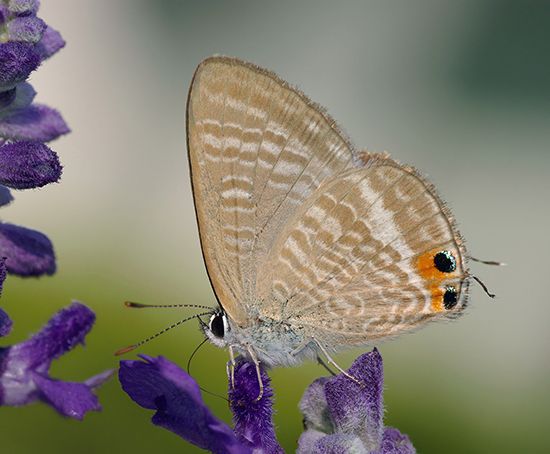
The term "blue butterfly" typically refers to members of the Polyommatinae subfamily within the Lycaenidae family. These insects are generally small and…
What are the distinguishing features of blue butterflies?
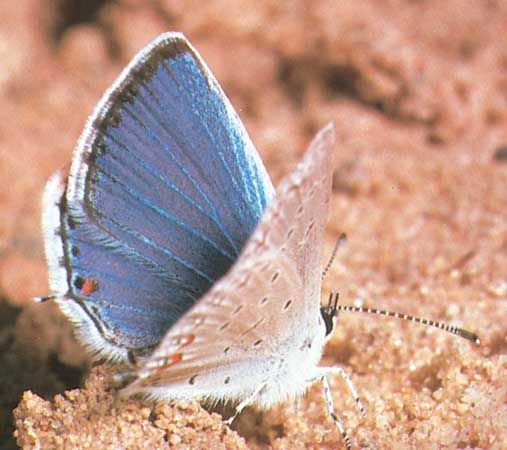
The term “blue butterfly” typically refers to members of the Polyommatinae subfamily within the Lycaenidae family. These insects are generally small and delicate, with wingspans ranging from 18 to 38 mm, and are characterized by rapid flight and iridescent blue wings.1
In contrast, the Morpho genus consists of much larger tropical butterflies, with wingspans reaching up to 20 cm. Their brilliant blue coloration is a structural color produced by microscopic ridges on their wing scales that scatter and reflect light. This phenomenon, often involving the Tyndall effect, occurs when shorter blue wavelengths are reflected by small particles while longer wavelengths are absorbed by underlying dark pigments like melanin.23
Key distinguishing features include:
- Size: Polyommatinae are small (18–38 mm), while Morphos are very large (up to 20 cm).12
- Wing Structure: Morphos utilize complex “ground” and “glass” scales to diffract and spread light, enhancing brightness for long-distance communication.2
- Behavior: Many Polyommatinae larvae have symbiotic relationships with ants, sometimes secreting honeydew to attract them.1
Which species of blue butterflies are most common and where can they be found?
“Blue butterflies” typically refer to the subfamily Polyommatinae, a widely distributed group within the Lycaenidae family. These insects are found globally, though specific species have distinct ranges. For example, the pigmy blue (Brephidium exilis) is a notable species, while the Karner blue (Lycaeides melissa samuelis) is famously restricted to specific savanna and barren habitats in North America, where it relies on wild lupine for survival.1
While the term “blue butterfly” is often used for these small, delicate species, the term is also frequently applied to the Morpho genus. These are very large, iridescent butterflies found throughout tropical regions of the Americas, including Mexico, Central America, and South American countries such as Colombia, Ecuador, and Peru. They inhabit forests ranging from sea level up to 1,400 meters.2
How do blue butterflies get their vibrant blue coloration?
The vibrant blue coloration seen in many butterflies is primarily a result of structural coloration rather than pigments. In the Morpho genus, this effect is created by microscopic ridges on the wing scales that scatter and reflect light. These scales, categorized as ground scales and glass scales, work together to produce the butterfly’s characteristic iridescence. Ground scales absorb longer wavelengths of light, reflecting blue to purple hues, while a layer of transparent glass scales acts as a diffraction grating, spreading the reflected light to enhance brightness and facilitate long-distance communication.2
Similarly, members of the Polyommatinae subfamily, commonly known as blue butterflies, possess iridescent wing surfaces that rely on these structural properties to produce their brilliant appearance. While some insects utilize pigments like pterins—which provide white, yellow, orange, or red colors—the intense blue observed in these butterflies is a physical phenomenon caused by the interaction of light with the nanostructures of their wing scales.125
What is the life cycle of a blue butterfly, from egg to adult?
Blue butterflies, which belong to the subfamily Polyommatinae, undergo a process of holometabolous (complete) metamorphosis, consisting of four distinct stages: egg, larva, pupa, and adult.9
- Egg: The life cycle begins when a female butterfly lays her eggs on a specific host plant, which serves as the primary food source for the emerging hatchlings.10
- Larva (Caterpillar): Upon hatching, the larva enters a growth phase. Blue butterfly larvae are typically short, broad, and sluglike. In many species, these caterpillars have a symbiotic relationship with ants; the larvae secrete honeydew, which the ants consume, and in return, the ants may protect the larvae. Some specialized species, such as the large blue (Phengaris arion), spend their entire larval and pupal stages within an ant nest.1
- Pupa (Chrysalis): The larva eventually transforms into a pupa, or chrysalis. Unlike moths, most true butterflies do not form cocoons; instead, they pupate naked. The chrysalis is often supported by a silk girdle or hangs from a silk pad. During this stage, the insect undergoes a major internal reorganization to develop adult structures.119
- Adult: The final stage is the emergence of the adult butterfly. After exiting the chrysalis, the adult must dry its wings before it is capable of flight. Adults are characterized by their delicate appearance and often brilliant, iridescent blue wings.21
Sources
- blue butterfly — Encyclopædia Britannica
- morpho — Encyclopædia Britannica
- coloration - Purines and pterins — Encyclopædia Britannica
- coloration - Structural and biochemical bases for colour — Encyclopædia Britannica
- coloration - Reflection — Encyclopædia Britannica
- coloration - Scattering — Encyclopædia Britannica
- Lycaenidae — Merriam-Webster
- blue morpho — Merriam-Webster
- Monarch butterfly - Life cycle — Encyclopædia Britannica
- Lepidoptera - Pupa , or chrysalis — Encyclopædia Britannica
- Metamorphosis — Encyclopædia Britannica
Published on · 3 min read