Blue Mountains
The term "Blue Mountains" refers to two prominent, distinct geographical regions:
What is Blue Mountains?
The term “Blue Mountains” refers to two prominent, distinct geographical regions:
Blue Mountains, Australia
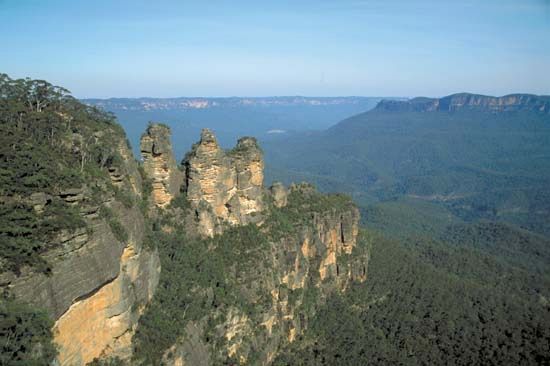
Located in eastern New South Wales, this section of the Great Dividing Range is a dissected sandstone plateau. The range is named for the bluish haze created by light diffusing through oil droplets dispersed by indigenous eucalyptus trees. It is a popular tourist destination, home to the Blue Mountains National Park and the City of Blue Mountains, which includes the administrative centre of Katoomba.12
Blue Mountains, Jamaica
This mountain range in eastern Jamaica reaches its highest point at Blue Mountain Peak (7,402 feet). The region is known for its high biodiversity and the cultivation of world-renowned coffee. In 2015, the area was designated a World Heritage site for its natural significance and its historical role as a refuge for Taino people and Maroons escaping enslavement.3
How do eucalyptus trees create the blue haze in the Australian mountains?
The characteristic blue haze observed in the Australian Blue Mountains is an optical phenomenon caused by the diffusion of light.
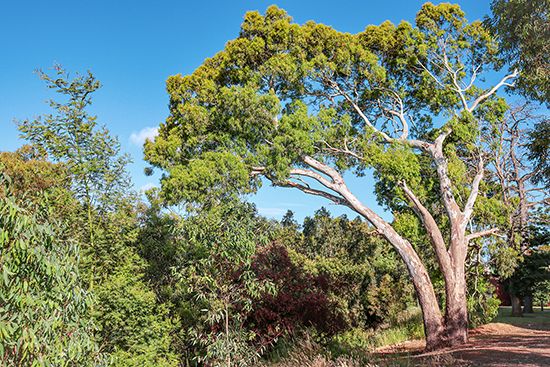
Indigenous eucalyptus trees release a volatile aromatic oil from their leaves into the surrounding atmosphere. When light rays interact with these microscopic droplets of dispersed oil, the light is diffused, creating a bluish veil over the landscape. This effect is a form of haze, which occurs when small particles suspended in the atmosphere reduce horizontal visibility and impart an opalescent appearance to the air.14
What makes Blue Mountain coffee from Jamaica so famous?
Blue Mountain coffee is renowned for its status as one of the most expensive and sought-after coffees in the world. Its fame is largely attributed to the unique environment of the Blue Mountains in eastern Jamaica.
The region provides a distinct microclimate that is ideal for coffee cultivation. The mountain slopes receive significant rainfall, and the high altitude—reaching up to 7,402 feet at Blue Mountain Peak—combined with cooler temperatures, creates a slow-maturing process for the coffee cherries. This extended maturation period is often credited with developing the coffee’s complex flavor profile. Today, the coffee is primarily cultivated by small-scale farmers in the valleys, and a significant portion of the harvest is exported to Japan.2
What role did the Blue Mountains play for the Maroons in Jamaica?
The Blue Mountains served as a vital sanctuary for Maroons—formerly enslaved Africans who fled captivity—providing the remote, rugged terrain necessary to establish independent communities and resist colonial forces.
In the 18th century, these mountains became the site of significant resistance during the Maroon Wars. Queen Nanni, a prominent military and cultural leader, established Nanni Town at a high vantage point within the range. This settlement was strategically positioned to evade British capture, protected by armed sentinels who utilized the abeng—a side-blown horn—to communicate across the difficult landscape.
The historical significance of this region was formally recognized in 2015 when the Blue and John Crow Mountains were designated a UNESCO World Heritage site. This designation honors both the area’s biodiversity and its role as a refuge for Taino people and Maroons, whose legacy of freedom and resistance remains a foundational element of Jamaican history and culture.26
Sources
- Blue Mountains — Encyclopædia Britannica
- Blue Mountains — Encyclopædia Britannica
- Katoomba — Encyclopædia Britannica
- eucalyptus — Encyclopædia Britannica
- Haze — Encyclopædia Britannica
- maroon community — Encyclopædia Britannica
- maroon community - The Jamaican rebellions — Encyclopædia Britannica
Published on · 2 min read