Borah Peak
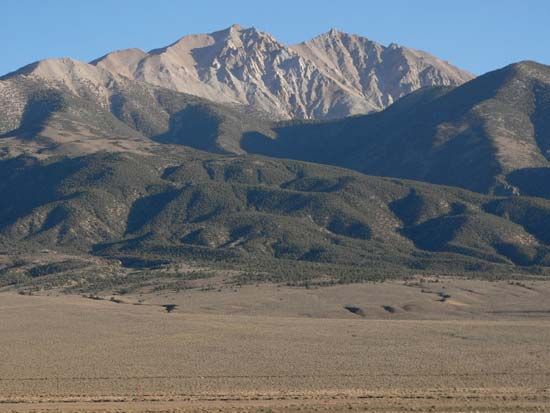
Borah Peak is a mountain located in the Lost River Range of Custer County, Idaho, United States. Standing at an elevation of 12,662 feet (3,859 meters), it…
What is Borah Peak?
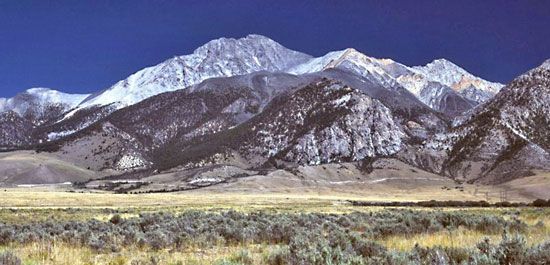
Borah Peak is a mountain located in the Lost River Range of Custer County, Idaho, United States. Standing at an elevation of 12,662 feet (3,859 meters), it is the highest point in the state.12
The peak is situated within the Challis National Forest, approximately 50 miles northeast of Hailey. It was named in honor of William E. Borah, a prominent U.S. senator from Idaho. The mountain is located in a tectonically active region and served as the epicenter of a 7.2-magnitude earthquake on the Richter scale in 1983.1
What is the Lost River Range?
The Lost River Range is a mountain range located in central Idaho, United States, situated within the Northern Rocky Mountains physiographic province.13
The range is notable for containing Borah Peak, which, at an elevation of 12,662 feet (3,859 meters), serves as the highest point in the state of Idaho. Geologically, the area is characterized as a tectonically active district; the region was the epicenter of a significant 7.2-magnitude earthquake on the Richter scale in 1983. The range is part of the broader mountainous landscape of central Idaho, where peaks frequently reach elevations between 10,000 and 12,000 feet.13
How do earthquakes affect mountain formation?
Earthquakes are not the primary cause of mountain formation; rather, they are a byproduct of the tectonic processes that build mountains. Mountain building, or orogeny, is driven by the movement of lithospheric plates, which interact through convergence, divergence, or sliding past one another.45
These interactions create the structural changes that form mountains:
- Folding and Thrusting: When plates collide, crustal layers are compressed, folded, and thrust over one another. This process creates fold belts and pushes deep-seated crystalline rocks to the surface, forming high mountain ranges like the Himalayas high mountain ranges like the Himalayas.46
- Block Faulting: In regions where the crust is pulled apart or sheared, blocks of rock are elevated or subside along faults. This creates block-fault mountains and rift valleys, such as those found in the Basin and Range Province of the United States.71
Earthquakes occur when stress accumulated along these faults is suddenly released. While they are a symptom of the ongoing tectonic activity that shapes the Earth’s surface, they do not “build” the mountains themselves; instead, they mark the active deformation of the crust as mountains continue to rise or shift.748
Who was William E. Borah?
William E. Borah (1865–1940) was a prominent Republican U.S. senator from Idaho who served for 33 years, making his tenure one of the longest in American history. He is perhaps best remembered for his staunch isolationism, most notably leading the successful opposition to the United States joining the League of Nations and the World Court following World War I.11
As chairman of the Senate Committee on Foreign Relations starting in 1924, Borah wielded significant influence. While he resisted military entanglements, he supported international efforts like the Kellogg–Briand Pact and the Good Neighbor policy. Domestically, he championed the creation of the Department of Labor and the Children’s Bureau, while supporting federal income tax and antitrust efforts.11
His legacy is also preserved geographically; Borah Peak, the highest point in Idaho, was named in his honor.1
Sources
- Borah Peak — Encyclopædia Britannica
- Borah Peak — Merriam-Webster
- Idaho - Relief and drainage — Encyclopædia Britannica
- mountain - Geomorphic characteristics — Encyclopædia Britannica
- plate tectonics - Principles of plate tectonics — Encyclopædia Britannica
- orogeny — Encyclopædia Britannica
- continental landform - Orogenic geomorphic systems — Encyclopædia Britannica
- North America - 30 to 2.5 million years ago — Encyclopædia Britannica
- Sevier orogeny — Encyclopædia Britannica
- mountain - Alpine- (or Himalayan-)type belts — Encyclopædia Britannica
- William E. Borah — Encyclopædia Britannica
Published on · 2 min read