Blue Mountains
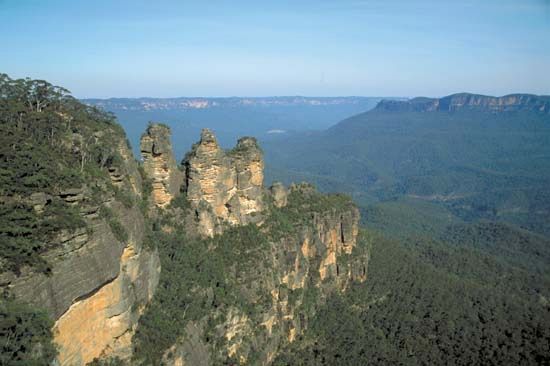
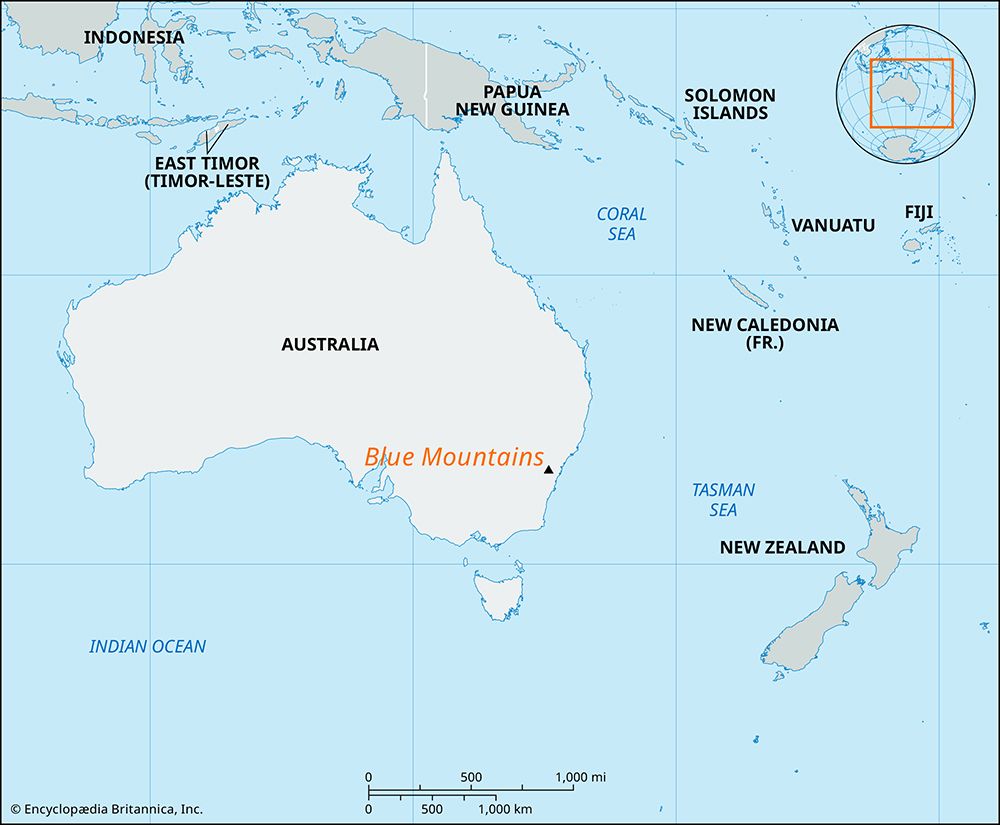
The Blue Mountains in New South Wales, Australia, are a section of the Great Dividing Range characterized by a well-dissected sandstone plateau.
What is the geological history of the Blue Mountains in New South Wales, Australia?
The Blue Mountains in New South Wales, Australia, are a section of the Great Dividing Range characterized by a well-dissected sandstone plateau.1
While the provided search results identify the region as a significant geological feature consisting of a plateau with precipitous slopes, they do not contain specific details regarding the chronological geological history or the formation processes of the Blue Mountains. The range is noted for its elevation, rising from an eastern escarpment to a western scarp, and for the presence of features such as the Jenolan Caves.12
How did the Blue Mountains get their name, and what causes their distinctive blue haze?
The Blue Mountains in New South Wales, Australia, derive their name directly from their characteristic appearance. The range is famously known for the distinct bluish hue that blankets the landscape when viewed from a distance.1
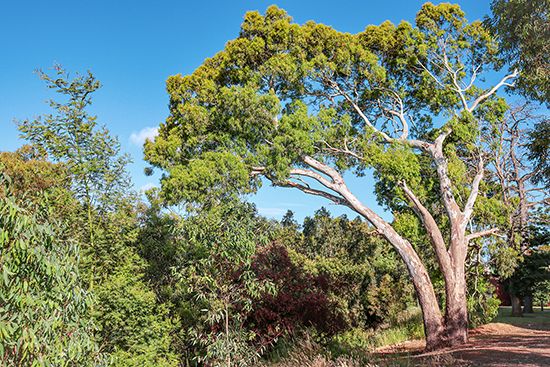
This phenomenon is caused by the diffusion of light rays through fine droplets of oil. These oil droplets are dispersed into the atmosphere by the vast number of indigenous eucalyptus trees that populate the region. As sunlight interacts with these airborne particles, the scattering effect creates the signature blue haze that gives the mountains their name.1
What are some of the most famous landmarks and natural attractions in the Blue Mountains?
The Blue Mountains region is a premier destination in New South Wales, offering a variety of natural and historical attractions. Key landmarks include:
- Blue Mountains National Park: A vast nature reserve covering 1,035 square miles, centered on the scenic Grose River valley. It serves as the primary hub for outdoor exploration in the region.41
- Jenolan Caves: Located on the western margin of the mountains, these caves are one of Australia’s most famous tourist sites. They feature a complex system of tunnels and caverns carved into limestone, renowned for their unique formations like stalactites.34
- The Zig Zag: An abandoned railway route that historically provided a path over the mountains and remains a notable point of interest for visitors.4
The region is also home to several historic townships, such as Katoomba and Leura, which are popular vacation centers situated along the Great Western Highway.4
How has tourism developed in the Blue Mountains, and what impact has it had on the local environment and economy?
Tourism in the Blue Mountains has evolved significantly since the region was first crossed by European explorers in 1813. Initially serving as a retreat for wealthy residents of Sydney, the area transitioned into a major vacation center as infrastructure improved with the construction of the Great Western Highway and rail links.15
The economic shift is perhaps best exemplified by Katoomba. Once a coal-mining hub, the town pivoted toward tourism as mining declined. Today, former industrial infrastructure—such as the railway once used to transport coal—has been repurposed into attractions like the Scenic Railway, which now carries visitors into the Jamison Valley.5
This rapid development has fueled significant urban growth, leading to the formation of the City of Blue Mountains in 1947, a confederation of over 20 townships. While the region’s popularity supports a robust local economy, the city is situated within the boundaries of the Blue Mountains National Park, necessitating a careful balance between accommodating visitors and preserving the natural environment.1
Sources
- Blue Mountains — Encyclopædia Britannica
- Blue Mountains — Merriam-Webster
- Great Dividing Range — Encyclopædia Britannica
- Jenolan Caves — Encyclopædia Britannica
- Katoomba — Encyclopædia Britannica
Published on · 3 min read