Eucalyptus
Eucalyptus trees have evolved several remarkable adaptations to survive and thrive in the fire-prone and often nutrient-poor environments of their native…
How are eucalyptus trees adapted to survive in their native habitats?
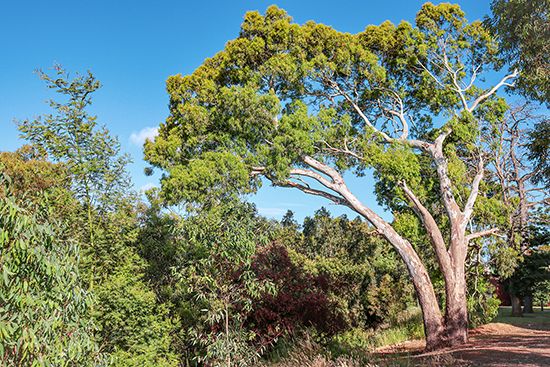
Eucalyptus trees have evolved several remarkable adaptations to survive and thrive in the fire-prone and often nutrient-poor environments of their native Australian habitats.12
Fire Survival Strategies
- Resprouting: Many species possess lignotubers—woody, rounded outgrowths at the base of the trunk containing vegetative buds and food reserves. If the tree is damaged by fire, drought, or grazing, these buds produce new shoots to renew growth. Additionally, some species have specialized buds protected under the bark of their trunks that emerge after a blaze.31
- Fire-activated Seeds: Certain species have fruits sealed with resin that only open to release seeds after the heat of a fire has melted the seal.1
- Tall Crowns: By maintaining a tall crown with few lower branches, many Eucalyptus trees keep their vital growth tissues far above the reach of most flames, allowing them to survive with only minor trunk charring.1
Environmental Adaptations
- Nutrient Efficiency: The genus shows a tendency toward sclerophylly (the formation of hard, leathery leaves), an adaptation often linked to the low soil nutrient levels characteristic of the Australian continent.2
- Leaf Structure: Their leaves often hang obliquely or vertically to manage exposure, and they contain large oil-containing cells.34
What are the most common uses of eucalyptus in industry and medicine?
Eucalyptus trees are among the most economically valuable plants in the order Myrtales, serving a wide range of industrial and medicinal purposes.3
Medicinal Uses
The leaves of many species, particularly the Tasmanian bluegum and black peppermint tree, contain a volatile aromatic oil known as eucalyptus oil. This oil is a primary medicinal ingredient found in expectorants and inhalants. Additionally, several species yield an astringent, dark reddish resin called Botany Bay kino, which is extracted from the tree trunk.3
Industrial Uses
- Timber and Construction: Eucalyptus wood is widely utilized as fuel, while its timber is a standard material for building and fencing3.
- Manufacturing: The bark of various species is harvested for use in papermaking and tanning processes.3
Many species are also cultivated globally in forestry plantations or as shade trees due to their rapid growth and utility.3
What are some of the most common species of eucalyptus and how do they differ?
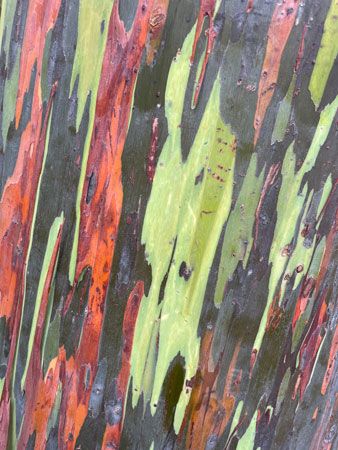
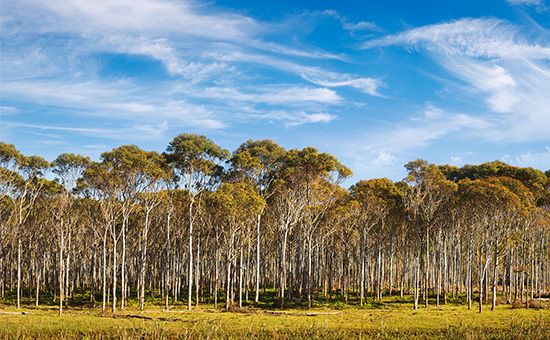
The genus Eucalyptus comprises over 660 species, which are often categorized into six subgroups based on their distinct bark types: peppermints (fibrous), stringybarks (stringlike fibrous), boxes (rough), bloodwoods (rough scaly), gums (smooth), and ironbarks (hard).3
Notable Species and Their Characteristics
Species within this genus vary significantly in size, habitat, and utility:
- Giant Gum Tree (Eucalyptus regnans): One of the largest species, it can reach heights of 90 meters (300 feet). It is native to Victoria and Tasmania and is highly valued for its massive scale.53
- Tasmanian Bluegum (E. globulus): Widely recognized for its medicinal oil, which is rich in aromatic compounds used in expectorants and inhalants.5
- Murray Red Gum (E. camaldulensis): Also known as the river gum, this species is characterized by its smooth gray bark and durable red wood. It is frequently grown globally for shade and ornamental purposes.67
- Peppermint Species (E. dives and E. radiata): These are specifically noted for producing oils containing cineole, limonene, or citral, which are highly valued for their germicidal and fever-controlling properties.3
- Jarrah (E. marginata): A prominent timber-yielding species known for its high-quality wood used in construction.5
These species differ primarily in their bark texture, chemical composition of their essential oils, and their specific applications in industry, ranging from heavy construction timber to specialized medicinal extracts.53
How have Indigenous Australians traditionally used eucalyptus trees?
Indigenous Australians have maintained a profound relationship with the landscape for tens of thousands of years, utilizing eucalyptus trees as a central component of their environmental management and daily life.
A primary traditional practice involves the use of fire to manage savanna ecosystems. Indigenous Australians have historically lit fires for several strategic purposes:
- Land Management: Fires are used to keep the country open and accessible, facilitating easier travel across the landscape.3
- Hunting: Controlled burning helps reveal and capture small edible animals, such as lizards, turtles, and rodents.3
- Resource Cultivation: Burning creates areas that encourage the growth of fresh green grass, which attracts game like wallabies, and promotes the development of plants that produce edible tubers.3
- Protection: Early-season fires, which are less intense, are sometimes employed to create firebreaks. These protect fire-sensitive areas, such as patches of rainforest, which may hold specific religious or utilitarian significance.3
Because eucalyptus trees are well-adapted to fire, they dominate the Australian savanna, thriving in the environments shaped by these long-standing traditional practices.3
Sources
- Playing with Wildfire: 5 Amazing Adaptations of Pyrophytic Plants — Encyclopædia Britannica
- Myrtales - Characteristic morphological features — Encyclopædia Britannica
- eucalyptus — Encyclopædia Britannica
- Australia - Plant life — Encyclopædia Britannica
- Myrtales - Economic and ecological importance — Encyclopædia Britannica
- river gum — Merriam-Webster
- Murray red gum — Merriam-Webster
- Savanna - Role of wildfire — Encyclopædia Britannica
Published on · 4 min read